How does a triode tube produce the NEGATIVE portion of an AC signal

Thread Starter

Jsprite7660

Joined Jan 9, 2024
40
Hey all,

I understand how a triode tube (or any tube) can amplify the positive portion of an AC signal, because the positive charge, on the grid, attracts electrons off of the cathode towards the plate. BUT, once the AC signal goes into it's negative swing, wouldn't this "negative charge" repel the electrons from moving from the cathode to the plate????

How is the negative portion of an AC signal passed, if it theoretically should turn the "valve" off? Considering that the electrons are negatively charged and wanting to repel one another.

I know this is basic stuff, but I can't get around this part of it not making sense.
 

nsaspook

Joined Aug 27, 2009
16,249
Normally on a triode (or any tube) the grid bias is always negative (Some RF power tubes are designed to have positive grid current at signal peaks to increase plate current in class C).

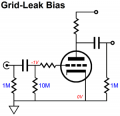
1762743665654.png
https://www.w8ji.com/fusing_and_floating_grids.htm
Grid Leak Bias
Grid leak bias is developed when a series resistance, with a suitable shunting energy storage capacitance, is placed between a control grid and the dc return path to the cathode. When the grid is driven positive current flows to the cathode. This current causes a voltage drop across a modest value resistance, and the resulting voltage drop charges a leak capacitor. The capacitor charges with a negative potential towards the grid and a positive potential towards the signal source. After many RF cycles of rectified grid current, the grid leak storage capacitor will charge to a reasonably stable voltage. Of course if grid drive is changed, the capacitor moves to a new voltage level. Bias voltage is proportional to grid current and the value of series leak resistance.

Grid leak bias is commonly used in class C amplifiers or self-excited oscillators. It is generally just a portion of total bias. It is undesirable in linear amplifiers because it encourages gain compression, although very small levels of grid leak bias can be used to equalize grid current in parallel tubes.
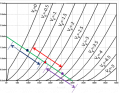
In the cases where its always negative, the AC signal modulates the negative bias to more of less negative and the plate current decreases or increases with the change in negative bias.

1762741028123.png
 
Last edited:

BobTPH

Joined Jun 5, 2013
11,463
The voltage at the plate does not have to go negative. It just has to go lower than the bias point. Then the capacitor coupling the output reverses the voltage beyond that point. The reversing current all comes from the capacitor. Leave the capacitor out and there is no reversing current.

Or, you can use positive and negative supplies and bias it to the middle. Then the current comes from the two supplies.

Edited to add: It is the same with transistors. The fact that electrons are traveling in a vacuum has no effect on it.
 
Last edited:

MrChips

Joined Oct 2, 2009
34,621
The AC signal can have any voltage, positive or negative. What is important is that the amplifier (tube, transistor or IC op amp) is biased to operate in the linear region. The incoming signal is AC coupled to the input of the amplifier. In other words, the input is biased to the required range and the output of the amplifier does not saturate at the supply rail voltages, i.e. at the lowest and highest voltage range.

It does not matter if the circuit uses a triode tube or a transistor.
 

ericgibbs

Joined Jan 29, 2010
21,390
hi js,
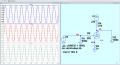
A vacuum tube/valve will conduct without a Grid voltage, the usual method is to insert a series resistor in the Cathode path, this make the Cathode positive wrt to the Grid, due to the quiescent Cathode to Anode current.

The Grid input signal can then be a +/- voltage swing, which appears as a negative signal wrt to the Cathode bias voltage.

LTSpice example shows it clearly.
E
EG 1830.png
 

schmitt trigger

Joined Jul 12, 2010
2,026
Please google “Class A” amplifier.

Explaining it in a simple sentence, it means biasing the active element, transistor or tube, in a region where it will accommodate swings above and below the quiescent voltage.

EDIT; per NSAspooks suggestion, google instead “amplifier classes”.
 

BobTPH

Joined Jun 5, 2013
11,463
Let me try to illustrate what I was trying to say in post #3.

Look at the circuit in post #2, but put a speaker in place of resistor from the output to ground.

What happens when you turn the power on and the input is at ground?

Lets say the B+ voltage is 100V and the bias point at the plate is 50V.

The output capacitor charges through the speaker (making a loud click) until the right side of the output capacitor is at 0V and thus there is 50V across the capacitor. Then a quiescent state is reached and no current is flowing in the speaker.

Now we apply a signal, which is a square wave which starts by going positive. Since the common cathode configuration, like a common emitter, is inverting, the plate goes down in voltage to say 25V.

The voltage across the capacitor cannot change instantly, so right side of the output capacitor remains 50V lower than left side, making it (25 -50) = -25V.

Since the other side of the speaker is at ground, there is -25V across the speaker and current flows through the speaker toward the capacitor. That is the negative going side of the waveform you were looking for.

Of course the capacitor is discharging during this half cycle, but if the capacitor is large enough, its voltage will not change that much during that period.

Now the input signal reverses and goes negative. The plate goes to 75V and the output goes to +25V and the current through the speaker reverses.

Thus both halves of the waveform are reflected in the speaker current. In other words, there is an alternating current in the speaker.
 

MisterBill2

Joined Jan 23, 2018
27,159
The AC signal can have any voltage, positive or negative. What is important is that the amplifier (tube, transistor or IC op amp) is biased to operate in the linear region. The incoming signal is AC coupled to the input of the amplifier. In other words, the input is biased to the required range and the output of the amplifier does not saturate at the supply rail voltages, i.e. at the lowest and highest voltage range.

It does not matter if the circuit uses a triode tube or a transistor.
Mr Chips has it exactly right, in clearer words than I was able to pull together in a short time. The Positive and the Negative, both depend on having the zero reference in the correct position.
 

MisterBill2

Joined Jan 23, 2018
27,159
Of course, both tubes and transistors have non-linear functions past the linear portions of their curves. THAT is why for some sound coloration a transistor amplifier just does not work. The hard rock sound of tube amplifiers driven far past the linear edge is difficult to duplicate any other way. POSSIBLE but it takes a much more complex circuit to duplicate the harmonic content of those old 6L6 tubes being way over-driven. Transistors driven into saturation and cutoff produce a different set of harmonics. The complexity is why some of the better pedals are rather expensive.
 
Top