The maximum output from a '358 is about 1.5V below the supply voltage.I thought that the output from the LM358 would be max volts
When used as a comparator, does it always output the max voltage? That seems to be what it is doing here.The maximum output from a '358 is about 1.5V below the supply voltage.
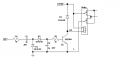
It will if the non-inverting input voltage is more positive than the inverting input voltage, unless you take steps to reduce the voltage gain of the opamp.When used as a comparator, does it always output the max voltage?
That's a man-machine interface issue. You need to balance out the danger of damaging the drive-shaft equipment by giving a sudden command against the danger of not being able to avoid a collision because you can't give a sudden command. With a single control stick the operator would know that he was performing a dangerous action by moving the stick rapidly, in the same way as he would know not to command a tight turn at speed, so I have come down on the side of not having a delay. And I would like to get the basic circuit working before adding any extras!It will if the non-inverting input voltage is more positive than the inverting input voltage, unless you take steps to reduce the voltage gain of the opamp.
Even if you get this field reversal to work by using a comparator, won't some delay circuit be needed to prevent the motor being reversed instantly when the operator slams the control stick from one extreme position to the other?
That could be due to the fact that the common mode input range of the '358 goes from zero only to ~1.2V below the +ve supply rail, i.e. ~6V with a 7.2V supply.the output signal still turns off at full reverse power...
That could be due to the fact that the common mode input range of the '358 goes from zero only to ~1.2V below the +ve supply rail, i.e. ~6V with a 7.2V supply.
I think the effects of PWM pulsing, plus motor BEMF, are going to cause erratic triggering of the comparator unless you add hysteresis.
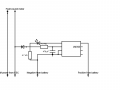
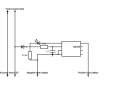
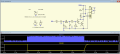
I understand that, in ESCs of the type which use an H-bridge of MOSFETS to control speed and direction, one motor terminal is clamped to a supply rail (+V or ground, depending on whether high-side or low-side pulsing is used) while the other terminal is pulsed. If so, an alternative approach to using a comparator is simply to monitor the voltage on one motor terminal and detect when it changes from static to pulsing. Below is a suggested circuit to do that. Simulation shows it should work over a 6V-12V supply range, a 1kHz to 20kHz PWM frequency range, high or low side pulsing and a 1% to 99% duty cycle range.
View attachment 164940
Here, m1 is the input from one motor terminal. The circuit shares a common ground with the ESC. When m1 is pulsed, C2 charges up and Q1 switches on. When m1 is static, C2 discharges quickly via the Q1 base-emitter junction and Q1 switches off.
The H-bridge purpose is to provide a reversing function. The alternative is a DPDT relay.I wonder if all ESCs work that way, including the ones which have a reverse function, because those are the ones I want to use it for...?
If you mean in your present circuit, then op-amp output >> resistor >> transistor base. The resistor should be sized to allow a base current about 1/10 of the coil current. NPN emitter >> ground. Relay coil between NPN collector and +v supply.how would you attach an NPN transistor to the output of the op-amp?
A well-designed ESC should cope with BEMF and switching transients, but it doesn't hurt to provide extra suppression components across the motor. Since the relay will be switching the field winding, arc-supressor capacitors across its contacts would be advisable.Will extra back emf be generated and could this cause problems?
As much as that? I had in mind a coil current ~100mA, so a base current of about 10mA. 70mA is too much for the '358 to source, so a D667 won't be suitable and a Darlington transistor or a logic-level MOSFET would be needed to switch the relay.That's 700mA.
Well, the op-amp comparator approach seems to work as well as I can test it on the bench without a relay, so I'm starting on the 'pulse-checker'. I don't have any 1uf polyester or ceramic - will electrolytic radial do?..............Below is a suggested circuit to do that. Simulation shows it should work over a 6V-12V supply range, a 1kHz to 20kHz PWM frequency range, high or low side pulsing and a 1% to 99% duty cycle range.
View attachment 164940
Here, m1 is the input from one motor terminal. The circuit shares a common ground with the ESC. When m1 is pulsed, C2 charges up and Q1 switches on. When m1 is static, C2 discharges quickly via the Q1 base-emitter junction and Q1 switches off.
Yes, but ensure correct polarity. You could use higher values than the 1uF shown, at the expense of delaying the pulsing/non-pulsing decision.I don't have any 1uf polyester or ceramic - will electrolytic radial do?
Yes, but ensure correct polarity. You could use higher values than the 1uF shown, at the expense of delaying the pulsing/non-pulsing decision.