Oscilloscope Features

Wuerstchenhund

Joined Aug 31, 2017
189
SAMPLE RATE
=================
An oscilloscope does just one thing- it looks at voltage levels so many times per second. In order for you to capture enough samples, your scope should be able to capture at least 5 data points for the fastest signal you ever intend to examine.

Let's look at a 32MHz MCU, just as an example. Brand doesn't matter- clockrate is all you're interested in.

32MHz means, that the MCU has a hearbeat pulse every 1/32000000th of a second. How fast is that? Well, that's 0.00000003125 seconds per heartbeat/pulse, or 31.25ns per pulse. Divide that by 5, at a minimum so the scope can read at least 5 samples to display that waveform with some cleanness- and that means the scope should be able to sample at atleast 6.25ns-- or 160MHz.
You don't need 5 times per sample to reconstruct a valid waveform, you need more than two. As long as the signal is BW limited, a sample rate that is slightly higher than 2x the highest frequency (Nyquist-Shannon) to sample is completely sufficient.

For the scopes discussed, the Rigol DS1054z has a sample rate of 1GSa/s in single channel mode, 500MSa/s in dual channel mode and 250MSa/s in 4 channel mode, which is more than sufficient to get a valid reproduction of a 100MHz sine wave. The Siglents are the same or better.

Don't be afraid of purchasing an old scope either- Tektronics, Agilent, Lucent, all made fine scopes in their day. Finding a TDS360 for $200.00 could give you all the scope you ever need.
While I agree that older DSOs can be a great alternative, this isn't really true for the bottom of the barrel price range. For the <$350 a brand new Rigol DS1054z goes for you will have a hard time to find a 2nd hand DSO that even comes close to it's performance and capabilities, and your $200 TDS360 doesn't look like such a great bargain any more when considering it's ridiculously small sample memory (1kpts) which means your fancy 1GSa/s sample rate (and with it its useable BW) will drop like a rock on longer time bases, it's limited feature sets (no serial decode for a start), it's awfully slow processing making even low resolution FFTs painful, or the simple fact that it's a over 25 year old instrument which is likely to fail sooner rather than later.

The TDS 360 wasn't great back when it was new, and unlike wine it doesn't get better with age.

Of those $200, half of it was just for the Tektronix name, which may be of value to you but for the OP I'd recommend to buy after performance not for some faded brand image.


This is one of those areas where people say digital is better, but the main difference is that with analog, you see the actual waveform, not 'cleaned up'.
That's nonsense, sorry. I know it's still common belief amongst fans of old analog scopes but there is no 'clean up' on digital scopes, which if used correctly show the real waveform with a precision in accordance with its specs (which are worlds above those of analog scopes). In fact, there's a certain amount of 'clean-up' with an analog scopes, as they tend to hide signal noise in the gloming phosphor trace (which is why a trace on an analog scope often looks cleaner, while on a DSO it looks noisy).
 
Last edited:

MrChips

Joined Oct 2, 2009
34,807
I beg to disagree. If you are looking for frequency information, then the sampling theorem says that you need to sample by at least twice the maximum frequency. If you are looking at a 10ns risetime then you will need at least 5 samples, 10 would be better. Hence you need a sampling rate of at least 500MS/s or 1GS/s in order to view a 20MHz signal (about 25-50 samples per period). The scope software will interpolate between samples to make it appear as a smooth trace.

Can you see better with an analog scope vs a digital scope? Yes.
I believe the member is referring to the display shown on a logic analyzer feature of a DSO. On a logic analyzer, the display shows only logic levels and not true voltages. The member demonstrated that with reference to a photo of the screen of a logic analyzer
 

BR-549

Joined Sep 22, 2013
4,931
I think a person's first scope should be a CRT. But I'm old and worn out. A digital hobbyist ought to look into that Siglent. Plenty of comparative storage and the com decoders would be handy.

It's the math capability and spectrum memory that make it awful tempting for me.
 

Wuerstchenhund

Joined Aug 31, 2017
189
I beg to disagree. If you are looking for frequency information, then the sampling theorem says that you need to sample by at least twice the maximum frequency.
That is not correct. According to Nyquist-Shannon, the sample rate must be higher than 2 times the highest frequency component in the signal.

https://en.wikipedia.org/wiki/Nyquist–Shannon_sampling_theorem

'higher than 2 times' means something like a factor of 2.4x, i.e. if the sample rate is higher than 2.4 times the highest frequency component of your signal then Nyquist-Shannon is satisfied, however since working with fractions means the number of samples per period will not be constant (and some periods may only get two samples so violate Nyquist-Shannon) so in real-life we're looking at a factor of 3.

If you are looking at a 10ns risetime then you will need at least 5 samples, 10 would be better. Hence you need a sampling rate of at least 500MS/s or 1GS/s in order to view a 20MHz signal (about 25-50 samples per period). The scope software will interpolate between samples to make it appear as a smooth trace.
I'm sorry but that is nonsense. You don't need 500MSa/s to get a valid reproduction of a 20MHz sine wave. Not even close. 50MSa/s is sufficient in theory (i.e. a perfect sine wave, which doesn't exist in reality), and for a real-life signal (which will contain some amount of jitter, plus there's the quantization error of the scope) you're perfectly safe with say 100MSa/s.

The reason the idea you need at least 5 to 10 samples per period which is still stuck in people's heads comes from the early days of digital scopes, where thanks to the slow processing in scopes interpolation was either absent or limited to linear (i.e. a direct line between sample points), which meant that you had a choice between a few widely spaced dots or a zigzac line which barely resembled the input signal. The only solution was to increase the sample rate so that you got enough points on screen that a waveform became recognizeable.

But that was back then in the '80s. Later scopes became powerful enough to employ sin(x)/x interpolation which returns a valid waveform even with 2.4 sample points per period.

Today this isn't an issue, even in very cheap scopes like the Rigol DS1054z.

Can you see better with an analog scope vs a digital scope? Yes.
I believe the member is referring to the display shown on a logic analyzer feature of a DSO. On a logic analyzer, the display shows only logic levels and not true voltages. The member demonstrated that with reference to a photo of the screen of a logic analyzer
If that's what he meant then it's a absurdly stupid comparison. The LA on a MSO is made for displaying logic levels, so of course it will only show logic levels as that's its purpose. But it does so for 8, 16, 32 or whatever your buswidth is. To see the signal level on an MSO the user just has to use the scope portion of his MSO.

It's like saying an analog multimeter is better at measuring resistance than a digital multimeter where only the beeper function (open/close tester) is used.

Besides, good luck trying to show 8 or more signals in parallel in a time-corelated manner on an analog boat anchor. So much to the idea that an analog scope would show more...
 
Last edited:

Wuerstchenhund

Joined Aug 31, 2017
189
I agree, most analog scopes are better in X/Y mode than this outdated, slow Uni-T bottom-of-the-barrel digital scope. Which isn't saying much about digital scope because this one is crap.

Most decent DSOs are actually pretty good at X/Y, and there are a few (like some models from Rohde & Schwarz) that even have Z input (i.e. brightness modulation). Which means you can even use your scope clock or other gizmos that use X/Y/Z to show stuff on a scope screen, although to be fair only the glow of a CRT gives it the proper feeling.
 
Last edited:

BR-549

Joined Sep 22, 2013
4,931
Most just use the Z to pulse, to make a dot or marker. But one can modulate it with analog too.

Black and green tv.
 

rsjsouza

Joined Apr 21, 2014
425
I just saw this thread. Great comments all around. I would like to reiterate a few points that may be lost throughout the discussion.
- When working with microcontrollers, the usual maximum speed of digital signals (i.e., square waves) you will experience is what is externally available in its peripherals - it may or may not be the same as the core clock speed.
- For these signals (square waves), usually having five times (or fifth harmonic) bandwidth of the fundamental frequency helps in showing a reasonable approximation of the actual square wave (this link contains an excellent article that shows the waveform as you add harmonics).
- Triangular waves (common in motor accelleration/deaccelleration PWM envelope curves) also require more bandwidth than the fundamental but not as radical as a square wave - usually three times the frequency and you already get a good representation of the waveform (a good animation is shown here).
- Sinewaves, which cater to your audio interests, do not have such hard requirement: as Wuerstchendhund says, they can be reproduced quite well with a bandwidth roughly double the fundamental frequency.
- Still in the microcontroller world, decoding the serial datastreams is a great plus. Although this can be done with cheap eBay USB logic analyzers, sometimes having this feature built into the oscilloscope is quite convenient.
- If your microcontrollers interface with very high speed buses or protocols (USB, Ethernet, SDRAM/DDR, etc.), no entry level oscilloscope can faithfully reproduce or analyze this. You would need something much higher priced for that.
- If you have the space and can afford one, analog scopes are excellent to do several experiments all around, but do not replace a digital unit for your intended uses. Also, if you have access to an older very high quality unit from Tektronix, they usually have very good low noise front ends.

About brands, usually the second TIer brands (Rigol, Siglent, GW Instek) have good choices around 100Mhz with four channels. In particular, the Siglent SDS1104X-E is a bit higher priced than the leader Rigol DS1054Z but it is a more modern architecture with better features. The GW Instek GDS1054 has excellent reports about it as well.

In my opinion, the only option worth considering from the more established brands is the Keysight DSOX1072A/1102A - although only two channels, it has great overall performance as well as the brand's great support.
 

Thread Starter

jackhevans

Joined Sep 2, 2018
9
I just saw this thread. Great comments all around. I would like to reiterate a few points that may be lost throughout the discussion.
I agree completely, I've already learned a lot more than where I was at before the discussion. And thank you for your input, as well.

About brands, usually the second TIer brands (Rigol, Siglent, GW Instek) have good choices around 100Mhz with four channels. In particular, the Siglent SDS1104X-E is a bit higher priced than the leader Rigol DS1054Z but it is a more modern architecture with better features. The GW Instek GDS1054 has excellent reports about it as well.
I'm leaning pretty heavily in the direction of the SS1104X0E at this point. It look like a pretty good starter tool, it's not a big chunk of my budget, and I think I'll learn a lot from using it toward what I might need for a better 'scope later. My dad used to like to say that, at some point, you just have to dive in and maybe make a mistake or two rather than wait for the perfect moment; otherwise you never learn anything. :-D
 

ian field

Joined Oct 27, 2012
6,536
I’m a hobbyist looking into buying my first oscilloscope. I’m NOT looking for a brand recommendation or price war. :) Rather, I'm hoping to get a better understanding of what features I should be looking at in my product research.
Typically, my work falls into these categories:

  • Microcontroller circuits and pre-built boards (Arduino, mostly) running clocks from 16 MHz to 32 MHz
  • Sound generator circuits (discrete and op-amp) and pre-built boards (for WAV/MP3 on SD cards), and amplifiers
  • Small DC motor controllers (12 V, 1/2 amp or so) with H bridge and PWM control (500-2000 Hz)

An example project I’m in the design phase of is a music box with a digital selector for choosing songs to play and a variable speed motor for turning a miniature carousel. I'd like to be able to test the audio signal quality before and after the amplifier, look for glitches in the motor PWM signal, and verify the I2C line between controllers, that sort of thing.

Based on my understanding of attenuation in scopes, I think a 100 MHz scope is likely to suit my needs, although a nagging voice in my head keeps saying "more is better!". I think two channels would probably be good, but I’m planning to go with four just to give myself a little room for growth. I’m definitely looking at ones with at least the option of adding some digital channels from monitoring I2C and SPI communication between different controllers.

Am I in the right ballpark with those numbers and what I want to do? What other features, tolerances, or gotchas should I pay attention to while researching different scopes? Any and all advice would be greatly appreciated.
Normally I'd suggest a cheap SH CRO to get a feel for it, but I think your applications warrant diving straight in with a digital. There are some real cheapie DSOs from SE Asia, but you can probably get more bang for your buck with a DSO module that you hook up to a laptop. might cost more, but lots more spec - and your next upgrade will probably be a SW download.
 

Wuerstchenhund

Joined Aug 31, 2017
189
- When working with microcontrollers, the usual maximum speed of digital signals (i.e., square waves) you will experience is what is externally available in its peripherals - it may or may not be the same as the core clock speed.
- For these signals (square waves), usually having five times (or fifth harmonic) bandwidth of the fundamental frequency helps in showing a reasonable approximation of the actual square wave (this link contains an excellent article that shows the waveform as you add harmonics).
- Triangular waves (common in motor accelleration/deaccelleration PWM envelope curves) also require more bandwidth than the fundamental but not as radical as a square wave - usually three times the frequency and you already get a good representation of the waveform (a good animation is shown here).
- Sinewaves, which cater to your audio interests, do not have such hard requirement: as Wuerstchendhund says, they can be reproduced quite well with a bandwidth roughly double the fundamental frequency.
I'd also like to add that it should be remembered that specs like scope BW are rated for sine waves, and that any non-sine signal is nothing more than a combination of multiple sine waves with different frequencies.

Which also means that, for non-sine signals, we have to look at its highest frequency component when assessing what sample rate we need. As you said, for square waves many people look at the 5th or even the 9th harmonic.

About brands, usually the second TIer brands (Rigol, Siglent, GW Instek) have good choices around 100Mhz with four channels. In particular, the Siglent SDS1104X-E is a bit higher priced than the leader Rigol DS1054Z but it is a more modern architecture with better features. The GW Instek GDS1054 has excellent reports about it as well.
I'm a bit wary about the GW Instek GDS-1054 to be honest, as it's around the same as the Rigol DS1054z but from factory doesn't support any serial decoding (this can be hacked in by using software for the GDS-2000E but no-one knows how long this loophole will stay open).

In my opinion, the only option worth considering from the more established brands is the Keysight DSOX1072A/1102A - although only two channels, it has great overall performance as well as the brand's great support.
True, but it's awfully expensive, and even compared with the other entry-level contenders it has really small sample memory (1Mpts, while Rigol offers 12Mpts/24Mpts and Siglent 14Mpts), no network port (standard with Rigol/Siglent), plus it comes with the crappiest probes I've ever seen.


I'm leaning pretty heavily in the direction of the SS1104X0E at this point. It look like a pretty good starter tool, it's not a big chunk of my budget, and I think I'll learn a lot from using it toward what I might need for a better 'scope later. My dad used to like to say that, at some point, you just have to dive in and maybe make a mistake or two rather than wait for the perfect moment; otherwise you never learn anything. :-D
I'm sure you won't regret it. And being a DSO, you'll learn how to use a digital scope correctly right from the start.

Normally I'd suggest a cheap SH CRO to get a feel for it
I wouldn't, at least not as a beginner/learner scope. We don't teach student drivers to drive horse and buggy, so why should a starter in electronics learn the use of test equipment which has long been obsolete, and which due to its limitations required practices that are of little use or even counter-productive on a digital scope?

For curiosity or as collector's item, sure, why not. Or if you're completely broke and get an analog scope for free (any scope is better than no scope, although if you can't afford the $350 for a scope then I wonder how you want to afford all the other tools you need). But for a starter with a decent budget it's pretty much money pissed away.
 
Last edited:

Wuerstchenhund

Joined Aug 31, 2017
189
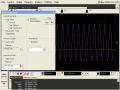
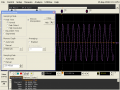
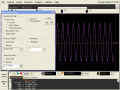
For those that are interested, I did a quick test in the lab with a 20MHz sine wave to demonstrate that you don't really need 1GSa/s for a measly 20MHz signal.

The signal comes from a Siglent SDG6052X generator, and goes via a Huber+Suhner Enviroflex 400 cable to an Agilent Infiniium DSO8064A 600MHz scope. After reaching the scope the input signal is BW limited by a 20MHz Low-Pass filter to prevent aliasing at lower sample rates. Sin(x)/x is enabled to allow the mathematically correct reconstruction of the signal.


Here's the signal at 4GSa/s:

DSO8000A_-_IMG003.png


Here's the signal at 2GSa/s:

DSO8000A_-_IMG004.png


Here's the signal at 1GSa/s:

DSO8000A_-_IMG005.png


Here's the signal at 500MSa/s:
DSO8000A_-_IMG006.png


Here's the signal at 250MSa/s:
DSO8000A_-_IMG007.png
Here's the signal at 100MSa/s:

DSO8000A_-_IMG010.png


As the test shows, 100MSa/s are completely sufficient to get a true reproduction of a 20Mhz sine wave. Actually, I could probably go down to 60MSa/s if it was supported by the scope, as at 60MSa/s we'd be at 3 samples per period, which satisfies the Nyquist-Shannon requirement that the sample rate is more than 2x the highest frequency in the signal.
 

ian field

Joined Oct 27, 2012
6,536
I'd also like to add that it should be remembered that specs like scope BW are rated for sine waves, and that any non-sine signal is nothing more than a combination of multiple sine waves with different frequencies.


I'm a bit wary about the GW Instek GDS-1054 to be honest, as it's around the same as the Rigol DS1054z but from factory doesn't support any serial decoding (this can be hacked in by using software for the GDS-2000E but no-one knows how long this loophole will stay open).


True, but it's awfully expensive, and even compared with the other entry-level contenders it has really small sample memory (1Mpts, while Rigol offers 12Mpts/24Mpts and Siglent 14Mpts), no network port (standard with Rigol/Siglent), plus it comes with the crappiest probes I've ever seen.


I'm sure you won't regret it. And being a DSO, you'll learn how to use a digital scope correctly right from the start.


I wouldn't, at least not as a beginner/learner scope. We don't teach student drivers to drive horse and buggy, so why should a starter in electronics learn the use of test equipment which has long been obsolete, and which due to its limitations required practices that are of little use or even counter-productive on a digital scope?

For curiosity or as collector's item, sure, why not. Or if you're completely broke and get an analog scope for free (any scope is better than no scope, although if you can't afford the $350 for a scope then I wonder how you want to afford all the other tools you need). But for a starter with a decent budget it's pretty much money pissed away.
Maybe I cheated - I got a bunch of CROs for free that didn't need much repairing. The Tek465 has pretty good spec - its sort of my Sunday best.

CROs are a PITA for anything digital, but I don't have the dosh for a shiny new one.

A scope was the "holy grail" when I started out - the more I learned, the less I needed one.
 

nsaspook

Joined Aug 27, 2009
16,320
For those that are interested, I did a quick test in the lab with a 20MHz sine wave to demonstrate that you don't really need 1GSa/s for a measly 20MHz signal.

....

As the test shows, 100MSa/s are completely sufficient to get a true reproduction of a 20Mhz sine wave. Actually, I could probably go down to 60MSa/s if it was supported by the scope, as at 60MSa/s we'd be at 3 samples per period, which satisfies the Nyquist-Shannon requirement that the sample rate is more than 2x the highest frequency in the signal.
Cool

https://www.tek.com/document/application-note/real-time-versus-equivalent-time-sampling
http://www.siglentamerica.com/USA_website_2014/FAQ/SDS/ScopeBandwidthSelection_092016.pdf

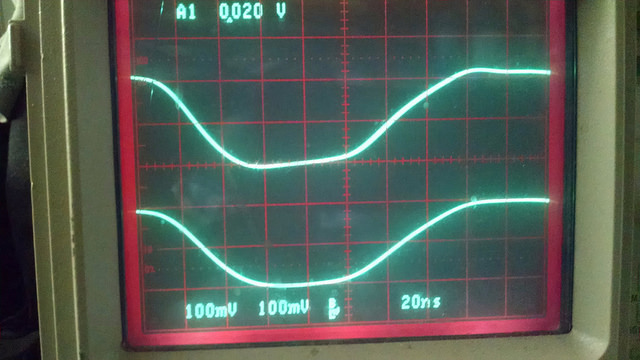
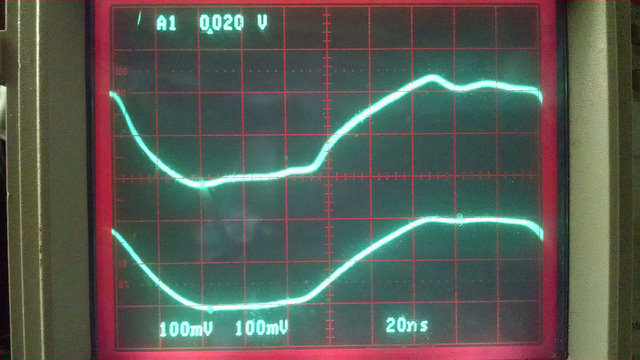
Often we are interested in rise/fall time assorted waveform for some sort of transmission effect on the signal.

The same source signal with different signal paths BW limited to 20MHz on analog scope 350 MHz (real bandwidth) 2465A

They look much the same.

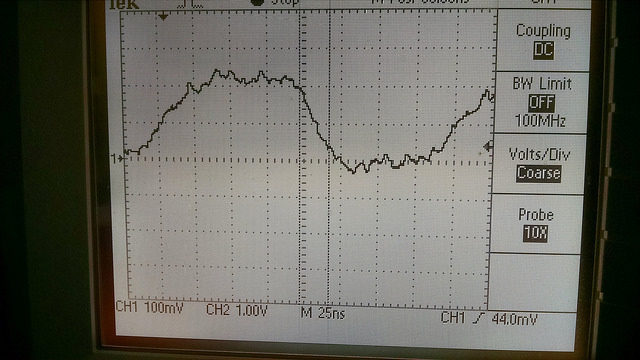
Full BW

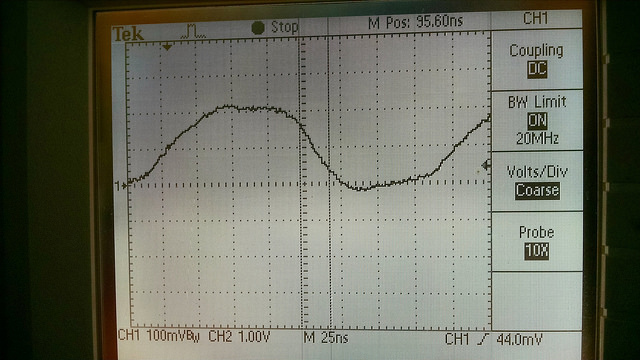
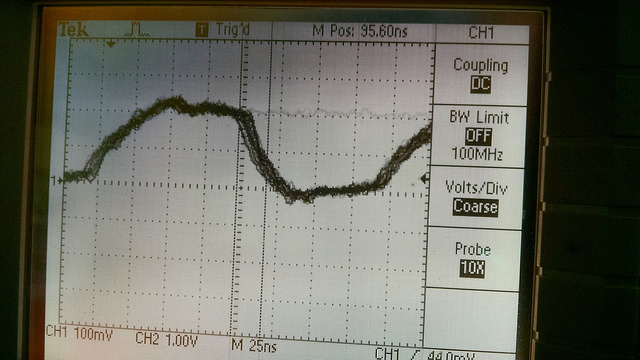
Much easier to see the difference between signals. The analog scope CRT tends to hide random noise resulting in a 'cleaner' viewing signal of repeating signal features.
The waveform intensity/Analog persistence function on a DSO does the same thing.
http://www.hit.bme.hu/~papay/edu/DSOdisp/gradient.htm

Top signal from above 20MHz BW limit on TDS 220 100MHz 1GS/s (an oldie now low-end DSO with a small sample memory)


Full B/W STOP


Full BW RUN
 
Last edited:

rsjsouza

Joined Apr 21, 2014
425
I'm a bit wary about the GW Instek GDS-1054 to be honest, as it's around the same as the Rigol DS1054z but from factory doesn't support any serial decoding (this can be hacked in by using software for the GDS-2000E but no-one knows how long this loophole will stay open).
I missed the lack of serial decoding of the GDS-1054B. Thanks.


True, but it's awfully expensive, and even compared with the other entry-level contenders it has really small sample memory (1Mpts, while Rigol offers 12Mpts/24Mpts and Siglent 14Mpts), no network port (standard with Rigol/Siglent), plus it comes with the crappiest probes I've ever seen.
All correct, but Keysight support is quite good and, despite this is a new model, they tend to support their products for a very long time.

Thanks again, everyone... I really appreciate all of the information, much of which was new to me. I especially appreciate the civility when discussing different viewpoints; hard to find on the Internet these days! I went ahead and ordered an SDS1104X-E today, which I think will get me started pretty well.
Excellent choice! Hopefully it gives you years of enjoyment - if your projects take off and you end up needing something more featured, you can always resell it.
 

Wuerstchenhund

Joined Aug 31, 2017
189
Hi Jack, since you mentioned that you use a high-quality Fluke (one of my favorites from my early days) multimeter instead of a more conventional “hobbyist” multimeter, you might want to consider purchasing a Rohde & Schwarz oscilloscope. Granted, the Rohde&Schwarz RTC1000, for example, costs more than the Rigol or Siglent scopes, but offer twice the sample rate of the Rigol scopes, and as others have advised, a high sample rate is the way to go: the higher the better, especially as clock rates are going to keep increasing.
Not every increase of sample rate is actually useful. As long as Nyquist-Shannon is satisfied (i.e. the sample rate is high enough to cover the real analog BW) then any increase beyond is pretty much pointless and only serves to eat up your sample memory much quicker.

As to the RTC1000, it's essentially a repackaged Hameg HMO1000, a platform which is now more than 4 years old and even when it was new wasn't exactly ground-breaking. Today, with only 2Mpts of memory, 128k FFT, a dire update rate (max 10k wfms/s) and a tiny 6.5" low-resolution screen it's no longer competitive with what else is on on market in 2018.

Even more so when the 50MHz 2Ch RTC1002 costs a whooping $975, and that excludes serial decoders! Packages which include the 200MHz BW upgrade (i.e. RTC1k-202) push the price to $1785.

All while a Siglent SDS1204X-E goes for $649 - with 200MHz BW, 4 channels, 14Mpts memory, 1M FFT, 100k wfms/s update rate, and including serial decoders and also some functions like Bode plotting that isn't even available on the RTC1000.

And if 2 channels are enough then the $379 SDS1202X-E offers essentially the same at $379.

Also, options provide the functionality of an oscilloscope, logic analyzer, protocol analyzer, frequency analyzer, pattern generator, function generator, digital voltmeter and component tester, allowing you to configure it to what you need.
Sure you can, if you're loaded enough to pay for the excessive prices R&S is asking for these options. Which soldily puts the RTC1000 into the price range of bigger models of the competition, all while no matter how much you invest the RTC1000 will still be constrained by its limited specs.

For example, for less than the price of an RTC1002 with 300MHz upgrade you can get a Siglent SDS2302X which is a 300MHz 2ch scope with 2GSa/s, 140Mpts of memory and an update rate of up to 140k wfms/s.

These scopes are also backed by R&S's professional product support team.
Yes, that's right, and for commercial customers like me the support is indeed really good. That doesn't however mean that there are no firmware issues, something which in my experience R&S is plagued a lot more than other big brands like Keysight. For example, the RTB2000, which is a very nice scope, has been out for a while and still many firmware and functionality issues remain unfixed.

Don't get me wrong, R&S has great instruments, and we buy a lot of R&S gear (especially high end spectrum analyszers, which are the best of the industry). But what R&S is offering in the entry-level market is pretty dire and ridiculously overpriced.

Rohde_TestWalker
Why do I have the feeling that there is a commercial relationship with R&S you should declare?
 

danadak

Joined Mar 10, 2018
4,057
Oversampling. Keep in mind Nyquist applies to band limited signals.
Often not the case in digital work, eg. pulse fidelity considerations,
signals not band limited that have many harmonics >> fundamental.

The X 5 rule -

https://www.tek.com/document/online/primer/xyzs-scopes/ch3/evaluating-oscilloscopes


Some guidance -.

https://www.asee.org/public/conferences/1/papers/2914/download

http://www.testunlimited.com/pdf/an/5989-5733EN.pdf


Some other comments on oversampling, SNR for example.

https://www.silabs.com/documents/public/application-notes/an118.pdf

http://www.ti.com/lit/an/slaa594a/slaa594a.pdf


Regards, Dana.
 
Last edited:

Wuerstchenhund

Joined Aug 31, 2017
189
Before we look at features, you really need to understand basics that are universal irregardless of scope brand. If you don't start with these basics, you could wind up regretting it, or not having a scope to do what you need.

SAMPLE RATE
=================
An oscilloscope does just one thing- it looks at voltage levels so many times per second. In order for you to capture enough samples, your scope should be able to capture at least 5 data points for the fastest signal you ever intend to examine.
Not really, the 5x rule comes from the early day of DSOs where some scopes only offered points or linear interpolation, and where a high number of sample points was necessary to get a rough resemblance of what the signal looks like.

These days, ideally your max sample rate should be fast enough to cover the true(!) (not spec'd) analog BW of your scope (i.e. 3x the upper BW limit) to prevent aliasing. So for say a 70Mhz scope which often will have a 100MHz real-life BW this would be at least 210MSa/s.

Let's look at a 32MHz MCU, just as an example. Brand doesn't matter- clockrate is all you're interested in.

32MHz means, that the MCU has a hearbeat pulse every 1/32000000th of a second. How fast is that? Well, that's 0.00000003125 seconds per heartbeat/pulse, or 31.25ns per pulse. Divide that by 5, at a minimum so the scope can read at least 5 samples to display that waveform with some cleanness- and that means the scope should be able to sample at atleast 6.25ns-- or 160MHz.
That's not correct. A 32MHz MCU clock is usually pretty much a square wave (OK, it could also be a sine or a triangle wave) with a fundamental frequency (or 1st harmonics) of 32MHz. To get a realistic reproduction, you want to capture at least to the 9nth harmonics, which for a 32MHz fundamental is 288MHz.

=> You want a scope with an analog BW of 300MHz to look at it, and based on the BW you want to sample at at least 1GSa/s (assuming a real BW of 330MHz).

If the clock is a sine wave then it's easy (in this case a 32MHz BW and 100MSa/s sample rate would be enough), but if it's a triangle wave then it's similar complex to the square wave.

I _strongly_ recommend atleast 1Gigasample/second, and 2 if you can find scope and afford it.
I'd recommend a max sample rate that is appropriate for the actual scope BW. There's no benefit to have a 70MHz scope sample at 1GSa/s over 500MSa/s.

Don't be afraid of purchasing an old scope either- Tektronics, Agilent, Lucent, all made fine scopes in their day. Finding a TDS360 for $200.00 could give you all the scope you ever need.
While I agree in general that an older DSO can give you all you need, one has to be a bit more careful. As the example of Tektronix, a company who unarguably made the best analog scopes ever made, but couldn't make a decent DSO since the end of the analog era and is now pretty much the bottom of the barrel when it comes to DSOs, shows, just looking for brands that were great 3 decades ago doesn't cut it.

A TDS360 for $200 is pretty much money flushed down the drain when a brand new Rigol DS1054z can be had for less than $400 brand new. The TDS360 may have 200MHz BW and 1GSa/s, however it also has a laughable small sample memory of 1000 points which means your sampling rate (and thereby your useable BW) drops like a rock when using slightly longer timebase settings. It's also slow, with very limited functionality, and now >25 years old (and like many of those old Teks it suffers from the capacitor plague).

I'd strongly recommend to get a DSO from a manufacturer who actually understood how to do a DSO properly. Obviously my first choice would be LeCroy, the company that invented the DSO and has been since for DSOs what Tek was for analog scopes. Most of their scopes come with comparable large memory and a huge suite of sophisticated waveform analysis and measurement tools. Even their scopes from the late '80s come with remarkable features, but for low budget buyers the 9300 Series from the early to late '90s probably offers the best bang for the buck.

My other recommendation would be HP, which has several scopes that still make great beginner's scopes. Like the 54645A/D (A is scope, D is the MSO variant), which are the first scopes using HP's MegaZoom ASIC for very high update rates. These scopes come with 1Mpts of memory which is a good starting point, are easy to operate and can often be found for less than $150. The 2nd 54600 Series generation was sold under Agilent name and comes with updated UI and better specs, and while sellers often ask for ludicrous prices there often are opportunities to get them pretty cheap.

As to scopes from bygone brands like Lucent or Gould, I'd say just don't go there. Ever. They left the scope market when DSOs were still pretty new, which means their scopes haven't particularly great specs. And good luck finding spares or service documents in case of a defect.

One thing to remember however is that in the entry-level class you can't get more bang for the buck than with the current offerings from Siglent and Rigol. Buying 2nd hand is unlikely to give you the same features or performance at a similar price. When 2nd hand comes in is when you need a more sophisticated scope than a typical entry-level scope, or larger BWs (500Mhz and up), both which can often be found at attractive prices on the 2nd hand market.

TRACES
=========
You want at least 2 traces. 3 or 4 is better, but at least 2. Having two traces allows you to monitor one signal and compare it against another-- which is invaluable.
Well, DSOs don't have "traces" in the same way as on analog scopes. You have a number of inputs and you can display each input independently on the screen. Depending on the scope, you may also have other functions like math or reference traces which can be displayed in addition (or even without) the main channels.

PROBES
=========
Now we get down to the least thought of (usually), yet most vital part of your oscilloscope- the probes. The reason being: They are the last-mile between your scope and the signal- and how they interpret, load, or alter the signal is important to understand. I kid you not when I say that it is possible for your probes to cost more than the oscilloscope itself. You want at least 10x probes - that value is an attenuation or 'scaling' factor. Make sure of your price of probes, and if you can get a better deal on an extra pair at the time you purchase your scope- get them then, so you have a back up.
That is something I'd agree 100%. Probing is important, no matter if your scope is analog or digital, but so is your probing technique.

What I'd like to add, though:

- Don't get x1/x10 switchable probes, they can literally be deadly as on many switching from x10 to x1 can happen inadertendly, and if that happens when probing larger voltages it can (best case) kill your scope or kill you! Get fixed X10 probes as they are more than sufficient for probably 99.9% of all tasks where passive divider probes are good enough.

- Probe BW: passive probes are often labelled as suitable for 500MHz or more, but unless it's a lo-Z probe passive probes are only good up to below 300MHz. Everything else above, use an active probe.

- When buying probes, cheap ones (i.e. those Hantek P6000 Series probes often found on ebay) do well, but make sure their capacity range covers the input capacitance of your scope.

Lastly, talk to someone near you who knows how to use a scope properly. It is vital that you understand how your scope grounds, and how it isolates itself. If not, you could connect your probes and their individual grounds in such a way (with an A/C signal for example), and create a short right through your scope, damaging probe, scope, or both. This can happen easier than you think. _always_ be cognizant of exactly what the path of current is through your scope so as to avoid making it a path to ground.
I also 100% agree on this!


This is one of those areas where people say digital is better, but the main difference is that with analog, you see the actual waveform, not 'cleaned up'. And it is incredibly valuable to be able to see this because this alone can help someone solve signal problems because the waveform doesn't lie.
There is no 'cleaning up' by digital scopes. Seriously, there isn't. A DSO digitizes a signal within its specified performance. As an analog scope shows a trace within it's performance.

The idea of DSOs 'cleaning up' the signal come from people who don't understand how a DSO works.

Besides, the reason you can't see the ringing on the Tek is because it's dreadful screen layout makes things so cramped that you miss details. Tek scopes are also incredibly slow especially under load, so there's always a chance to miss something. But that is more down to the specific scope and not down to digital scopes in general.

I have nothing against new digital, but... I'd hate to be entirely without analog for the reason above. I can see ringing, I can see capacitor and inductor behavior with the analog. I don't know how much of that might be lost with an 'all digital' scope.
As I said, nothing of that gets lost on a DSO if you know how to operate it properly (and to do so differs a lot from how to do that on an analog scope!).

However, aside from knowing how to operate a scope, one should also select a decent one and ideally not made by a brand that was king 30 years ago but since the advent of DSOs has come up with products that are mediocre at best.
 
Last edited:
Top