Facebook
 Google
 GitHub
 Linkedin
edit:::: I am watching some youtube videos, and it appears as though a common emitter amplifier will be the correct choice, as I am interested primarily for this project in audio signals, no more than 20khz. A common base amplifier appears to be outside of the wheelhouse of the 1014d anyway, as it is not good for higher frequency signals, and the best use for the common base appears to be higher frequency signals. But, I am still intrigued by the low current output. Also, I just like the concept of the common base amp, and also, I wonder if it will be generally a very energy efficient design in this case.
hey!
my oscilloscope is oops. well, it's a fnirsi 1014d . i saw in some forums that it is the hardware, not the firmware, that prevents a lower sensitivity. Well, I don't understand this honestly, but if I use the lowest setting (50mv per div), I can see my signal which i attenuate down and down until at around 40mv it vanishes. It appears to be a firmware cutout because at other settings, if the signal gets very low it cuts out as well, so i'm not necessarily sold that the hardware can't detect an 8mv signal, but just the same, my scope is what it is. I have another one (fnirsi dso153, which I got for 10$ plus shipping) which has a 10mv setting, and detects the 8mv signal fine.
i am building the elenco am/fm superhet radio, where there are lots of tests in the booklet that have you injecting signal which needs to be around 8mv pp, for context. I don't have a proper signal generator, the 1014d produces only 2.5vpp with no option to change it, and my various kits (xr2206 and icl8038 kits) that i have assembled bottom out at around 300mvpp, so I made a little attenuator with a 50k pot and some caps, which is able to reduce the signal to the bottom of detection by the dso153, right around 8mvpp is as far as I can actually make it out on the screen. (funny, I haven't tried to use it but the dso153 Does have the ability to reduce the sig-gen output to .1mvpp according to the menu, but i found this out after all my hoops)
i want to use the 1014d for the same tests, just to do it. I had to make an attentuator to reduce the signal low enough, it was fun, so now I want to make a little single-transistor amplifier to use with the oscilloscope to detect the signals. I will be able to figure out the gain at a higher amplitude, and figure roughly what the signal is after attenuation based on the gain and the measure after probing with the amplifier and reading the output of it with the oscilloscope, is the plan. But, I really want to make the best single transistor amplifier for the job.
I have some kits to put together, and have found some examples and tried some in breadboards, and am learning a bit better about designing the common emitter basic design, I have successfully tested them and seen some amplification, although I haven't tried with this experiment yet, I will try. But, the common base is described in at least a few sources as good for some voltage gain without current gain, and also good as a first stage for faint signals, so I was wondering if this would actually be the best option if I were to go about trying to design my own little module on a perfboard.
does anyone know much about common-base amplifiers? Things like audio are often running a simple common-emitter, but these require some good current gain in the first stage to reduce how many stages are in the stack, while I am just trying to detect signals below the sensitivity cutoff for my oscilloscope. I will of course try all of the various little amplifiers i have as a big experiment, but am more interested in discussing the theory and exactly which single-transistor configuration is the "technical best choice", rather than just running with whichever of my hodgepodge assemblies works best in the first experiment. then I would want to try to learn as much as I could about designing the best one for this use case.
edit2:::: here is one of the kits, they're all about the same. I suppose an advantage here might be the high impedance input.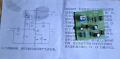
hey!
my oscilloscope is oops. well, it's a fnirsi 1014d . i saw in some forums that it is the hardware, not the firmware, that prevents a lower sensitivity. Well, I don't understand this honestly, but if I use the lowest setting (50mv per div), I can see my signal which i attenuate down and down until at around 40mv it vanishes. It appears to be a firmware cutout because at other settings, if the signal gets very low it cuts out as well, so i'm not necessarily sold that the hardware can't detect an 8mv signal, but just the same, my scope is what it is. I have another one (fnirsi dso153, which I got for 10$ plus shipping) which has a 10mv setting, and detects the 8mv signal fine.
i am building the elenco am/fm superhet radio, where there are lots of tests in the booklet that have you injecting signal which needs to be around 8mv pp, for context. I don't have a proper signal generator, the 1014d produces only 2.5vpp with no option to change it, and my various kits (xr2206 and icl8038 kits) that i have assembled bottom out at around 300mvpp, so I made a little attenuator with a 50k pot and some caps, which is able to reduce the signal to the bottom of detection by the dso153, right around 8mvpp is as far as I can actually make it out on the screen. (funny, I haven't tried to use it but the dso153 Does have the ability to reduce the sig-gen output to .1mvpp according to the menu, but i found this out after all my hoops)
i want to use the 1014d for the same tests, just to do it. I had to make an attentuator to reduce the signal low enough, it was fun, so now I want to make a little single-transistor amplifier to use with the oscilloscope to detect the signals. I will be able to figure out the gain at a higher amplitude, and figure roughly what the signal is after attenuation based on the gain and the measure after probing with the amplifier and reading the output of it with the oscilloscope, is the plan. But, I really want to make the best single transistor amplifier for the job.
I have some kits to put together, and have found some examples and tried some in breadboards, and am learning a bit better about designing the common emitter basic design, I have successfully tested them and seen some amplification, although I haven't tried with this experiment yet, I will try. But, the common base is described in at least a few sources as good for some voltage gain without current gain, and also good as a first stage for faint signals, so I was wondering if this would actually be the best option if I were to go about trying to design my own little module on a perfboard.
does anyone know much about common-base amplifiers? Things like audio are often running a simple common-emitter, but these require some good current gain in the first stage to reduce how many stages are in the stack, while I am just trying to detect signals below the sensitivity cutoff for my oscilloscope. I will of course try all of the various little amplifiers i have as a big experiment, but am more interested in discussing the theory and exactly which single-transistor configuration is the "technical best choice", rather than just running with whichever of my hodgepodge assemblies works best in the first experiment. then I would want to try to learn as much as I could about designing the best one for this use case.
edit2:::: here is one of the kits, they're all about the same. I suppose an advantage here might be the high impedance input.
Last edited: