Yeah, I read the spec sheet before but doesn't necessarily mean in every application. All the example circuits I could find using a single power supply were audio output amplifiers. Can't verify as I don't have a LA6500 to test, but if the OP says it works then I stand corrected.
SG
What I find interesting on this forum,even for the short time I've been a member, is when someone ask for help for some weird problem you usually only get half the story which can lead to a lot of speculation and "grasping at straws" as WBahn said. In this instance where is the photo showing the shunt and load connected to the chip?
SG
I totally agree with AK. But since I am willing to share knowledge it is a chance to explain what else is needed to provide an answer. And sometimes the questions are quite interesting.
I had not realized that the op-amp in this thread was an audio power amp. Those are not a good choice for this sort of application, because they offer too much power gain and are intended to feed a much lower impedance load.
I had not realized that the op-amp in this thread was an audio power amp. Those are not a good choice for this sort of application, because they offer too much power gain and are intended to feed a much lower impedance load.
Disagree. The part does not become less stable with low output currents; that is no different than driving a speaker with a soft music passage. The big package means you probably will not need a heatsink even at relatively high LED currents. It is overkill and expensive, but there are many aspects of this project we do not know, and some of them might be driving the component choice.
An LM386 makes an excellent comparator and 2-LED driver.
Technically speaking, there is nothing wrong with the circuit- the circuit isn't the problem. It's a standard singled-ended non-inverting configuration with a gain of ~9.29
The OpAmp is the problem. This OpAmp will not go closer to the negative rail than 3 volts. See the first page of the datasheet.
Technically speaking, there is nothing wrong with the circuit- the circuit isn't the problem. It's a standard singled-ended non-inverting configuration with a gain of ~9.29
The OpAmp is the problem. This OpAmp will not go closer to the negative rail than 3 volts. See the first page of the datasheet.
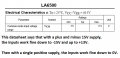
The datasheet of the LA6500 says that its input common mode voltage range includes the negative supply that is 0V in this circuit.
The LM386 is already biased so that its input is at the negative supply that is 0V in this circuit and has the same PNP differential input as the LA6500 and LM324. They all have inputs that work down to 0V.
It's directly on the 1st page. Max inputs .v. differential inputs. The problem is, you're not understanding how to read the datasheet. Max is 36Vp-p. Differential is 30Vp-p. The power & ground pins determine 'rail' or max range of voltage possible. And whatever that range is, you can't get closer to either rail than 3V in either direction. (36V - 30V) / 2 = 3V
You too. The common-mode input voltage range includes the negative supply voltage when the total supply voltage is not as high as the max allowed supply voltages.
Like the LA6500, many amplifiers have PNP darlington inputs that work down to the negative supply voltage: LM386, LM324, LM358, MC3407x and MC3317x.

 Facebook
 Google
 GitHub
 Linkedin