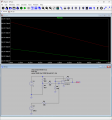
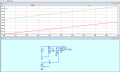
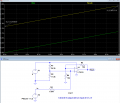
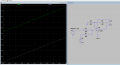
Edit: Select R1 and R2 to give 1.6V offset, and then select R4 to be equal to the parallel equivalent resistance of R1 and R2.
This give a signal attenuation of 1/2 at the op amp (+) input, when is then amplified by the non-inverting gain of two from R5 and R6.
Edit: Select R1 and R2 to give 1.6V offset, and then select R4 to be equal to the parallel equivalent resistance of R1 and R2.
This give a signal attenuation of 1/2 at the op amp (+) input, when is then amplified by the non-inverting gain of two from R5 and R6.
Reasonably simple.
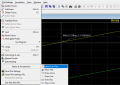
After doing a plot, left-click on the plot title to create a cursor on that plot, and then move the cursor to the point you want to annotate (arbitrarily shown below for 409.6ms).
Now go toPlot Settings and select Label Curs. Pos.
Rinse and repeat for different cursor positions or plot waveforms.
The specification asks to use a unity gain (Av=1.000) non-inverting amplifier, and an input offset voltage of1.600 volts to the non-inverting input, also with unity gain. The op-amp supply voltages must be positive 5.0 volts AND negative 5.0 volts
why 5.0V and not 12 or 15V? why is negative supply a must?
as already shown, one can use classic summing amp and single supply. if one is not deriving 1.6V from supply, resistor values become simple too.
OK, P.M. asks a valid question: I specified +-5 volts because some folks want to go lower, and using 3.3 volts could get into a less perfect portion of the capability of some op-amps. Similar reasoning for the negative supply, being that quite a few op-amps are not adequate towards the lower power supply voltage. Certainly it might be possible that it could be "good enough."
BUT I chose to offer advice that should be sure to work, instead of maybe being good enough, almost.
I don't know of any single-supply or rail-rail op amp that isn't more than just "good enough" when used in this circuit with a single 5V supply voltage.
No need to complicate it with a negative supply.
it would suffice to say that negative supply is preferred or recommended. a 'must' suggests that nothing else is possible, regardless if acceptable or not.
btw, i stopped using LT1013 long ago because of its pinout. when supply chain is strained i would rather have board designs for IC that has drop in substitutes.
Edit: Select R1 and R2 to give 1.6V offset, and then select R4 to be equal to the parallel equivalent resistance of R1 and R2.
This give a signal attenuation of 1/2 at the op amp (+) input, when is then amplified by the non-inverting gain of two from R5 and R6.
That's interesting that you noticed that some of the resistors could be combined and the result is one less resistor, maybe using Thevenin and Norton.
Also interesting is that if we take that one step further, we can eliminate yet one more resistor bringing the total count of resistors down to just 4.
I'll wait to see if you want to try this reduction or not.
Ha ha, well ok, some members here like a challenge sometimes. No problem though.
R2 (11.5k) gets eliminated, but some of the remaining resistor values have to change.
I usually look for this kind of thing in linear networks because the number of impedances often decreases when they are connected together in some way.
If nobody else wants to try it I'll post one of the solutions.
Perhaps close enough is acceptable thru the whole voltage range, but maybe it isn't. There is no reason to not suggest going beyond the barely good enough minimum, since this is not known to be a consumer grade junk project. We did not get repeated orders for machines by delivering barely OK products. That was very much brought home to us with one machine project where we initially lost the order because another company bid a lower price using my description of the performance and accuracy. BUt the competitors machine was not accepted at the buy-off because the accuracy was well outside of the specification. So we got the job a bit late. And our machine was well within the required accuracy, and saved the buyer a great deal because of not needing re-calibration after the quarterly checks.
The point of this tale is that "just barely" is seldom actually good enough. That is one reason that I go for more that just enough.
i hear you but anyone needing help with this type of question is learning basics. that means not ready to design for production. and unless specs/tolerances are stated, 99% solution is ok - or at least worth mentioning since on chosen OpAmp "Input Voltage Range Extends to Ground" and output is not near rails.

 Facebook
 Google
 GitHub
 Linkedin