Protection circuit for operational amplifier input from overvoltages

Thread Starter

White00

Joined May 15, 2025
6
Hello guys, I post this thread because I'm struggling with this problem a lot.
Context: in my application I have to read an analog sensor that can go up to 5V and I'm using an op. amp. in a voltage follower configuration supplied with 5V. The sensor is on an external board so I need an overvoltage protection in case the wire gets cut causing a short to battery (32 V). I was thinking about adding a resistor in series to the signal and a diode with the anode between the resistor pin and the plus input of the op. amp. and the cathode connected to 5V. The idea is that the diode will conduct in case of short to battery by keeping limited the voltage on the op. amp..
Problem: now the problem is that I need to keep the voltage on the op. amp. lower than 5.3V (absolute maximum rating) and to do this I need the diode to allow a very small current to lower the voltage drop. Therefore, the resistor should be high. However, if this one is too high, the error due to the leakage current will be high too. I can't find a good compromise, what can I do? Is there another way to protect against the overvoltage?
 

ronsimpson

Joined Oct 7, 2019
4,664
What op-amp? Part number.
How much current does your 5V supply pull. I need to know if the over voltage power needs to go to a Zener of can it be pushed into the supply.
How fast must the amplifier be?
Input 0 to 5V.
Over voltage up to 32V.
 

ronsimpson

Joined Oct 7, 2019
4,664
I have a data sheet for an op-amp. OPAx376 R-R input, r-r output, 10uA input current below 50C
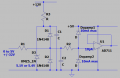
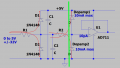
In the schematic U1 and the two diodes are inside a typical op-amp. The input diodes are usually 10mA max. Do not worry about the 0.5V spec.
IN4148 has a forward voltage of 0.75V at 15mA, 1V at 180mA 1.4V at 700mA.
Apply a voltage of 32V on the input. R1 sized for to give us 180mA. The voltage on the left side of R2 will be 1V above/below the supplies. The right side of R2 will be about 0.5V beyond the supply. There is 0.5V across R2. We know the current must be less than 10mA. If R2=500 ohms the current will be 1mA into the op-amp.
You can size R1 to not burn up the resistor at 32V. Also to not kill D1,2.
C2 helps with very fast spikes. C1 is important for fast spikes.
R1+R2 should not have a voltage drop when 10pA is flowing. (small drop)
1747352324273.png
This the math I use.
Many people do not use R2. When R2=0 ohms the incoming current flows into the IC. When (D1,2) are in parallel with the protection diodes in the IC the current has a tendency to enter the IC.
 
Last edited:

Ian0

Joined Aug 7, 2020
13,117
You have a potential (!) source of error in your voltage measurement in that the grounds may not be the same.
So change your non-inverting buffer to a differential amplifier, the inverting input now connects to ground at the sensor.
When operating correctly, the inputs of your op-amp will now be at half supply, so it will be easy to clamp them with 5.1V zeners and cause no error.
Do not use the protection scheme (in post #3) with diodes to the positive supply. If there is an over-voltage on the input, current will be forced into your 5V supply destroying all the IC connected to it.
You may want to adjust the circuit so that you can actually measure voltages up to 32V, so you can determine if there is a fault.
 

Thread Starter

White00

Joined May 15, 2025
6
The operational amplifier part number is LMV824AIPT. I've used a similar scheme to the one in post #3 without the diode between the signal and GND because I only expect an overvoltage of +32V. I did not mention that I need my solution to consider the junction temperature of 125/150 °C. For this value, the leakage current is usually, at least from the diodes I checked, to be in the order of tenths or hundreds of uA. Moreover, I don't understand the sentence " If there is an over-voltage on the input, current will be forced into your 5V supply, destroying all the IC connected to it" of post #4. Isn't the resistor R1 placed there to limit that current?
 

Ian0

Joined Aug 7, 2020
13,117
The operational amplifier part number is LMV824AIPT. I've used a similar scheme to the one in post #3 without the diode between the signal and GND because I only expect an overvoltage of +32V. I did not mention that I need my solution to consider the junction temperature of 125/150 °C. For this value, the leakage current is usually, at least from the diodes I checked, to be in the order of tenths or hundreds of uA. Moreover, I don't understand the sentence " If there is an over-voltage on the input, current will be forced into your 5V supply, destroying all the IC connected to it" of post #4. Isn't the resistor R1 placed there to limit that current?
R1 does limit that current. But what should you limit it to? If nothing on the 5V supply is actually taking any current, then ANY current into the 5V supply is capable of elevating the voltage and damaging things.
 

Thread Starter

White00

Joined May 15, 2025
6
R1 does limit that current. But what should you limit it to? If nothing on the 5V supply is actually taking any current, then ANY current into the 5V supply is capable of elevating the voltage and damaging things.
Oh okay, so you are saying that the current I let to flow when there is overvoltage may increase the output voltage of the supply itself? What parameter should I check to account for this?
 

Ian0

Joined Aug 7, 2020
13,117
Oh okay, so you are saying that the current I let to flow when there is overvoltage may increase the output voltage of the supply itself? What parameter should I check to account for this?
Your over-voltage protection system will always have this problem, unless you have a shunt-regulated supply.
 

Thread Starter

White00

Joined May 15, 2025
6
Well, it is a tracking regulator. So it should keep the voltage pretty stable. So, how can I protect the op. amp. input? The solution in post #3 is not good for me because the voltage drop on the diodes is too high, and it does not take into account uA bias current.
 

Ian0

Joined Aug 7, 2020
13,117
Well, it is a tracking regulator. So it should keep the voltage pretty stable. So, how can I protect the op. amp. input? The solution in post #3 is not good for me because the voltage drop on the diodes is too high, and it does not take into account uA bias current.
Tracking regulators are not shunt regulators. It will be unable to correct an overvoltage siatuation, because it can only source current (it cannot sink current).
 

Thread Starter

White00

Joined May 15, 2025
6
Oh ok, thanks, but it says that it has overvoltage and overcurrent protection. Does this change something? Anyway, any suggestion on a possible protection circuit?
 

ronsimpson

Joined Oct 7, 2019
4,664
There was some talk about the positive current flowing into +5V and lifting it. In some cases the micro runs on 100uA and the input current might get to 50mA. This will lift the +5V.
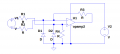
Here is an option. D3 is a Zener. R3 keeps the Zener turned on. The 32V current will flow through R1, D1 and into D3. At high current the Zener voltage might get to 6V. Now R2 and the internal diodes only have to withstand the current from +7V and -1V.
1747411245309.png
I do not like putting the Zener across the +5V supply. In part because the of part tolerances. In SPICE it works where 5V=5.000000 and the Zener is exactly 5.100000000. This is not real life.
 

crutschow

Joined Mar 14, 2008
38,423
If you use Schottky diodes (e.g. Bat54) the forward drop will only be a couple hundred mV for low currents, and if the upper diode goes to the op amp supply then the input will never significantly go above the opamp input limit, even if the overvoltage raises the supply voltage.
 

Ian0

Joined Aug 7, 2020
13,117
This would be my suggestion:
Screenshot from 2025-05-16 17-30-44.png
D1 and D2 are zeners. 5.1V should do, as the voltage across them would be 2.5V for 5V input.
 

Ian0

Joined Aug 7, 2020
13,117
If you use Schottky diodes (e.g. Bat54) the forward drop will only be a couple hundred mV for low currents, and if the upper diode goes to the op amp supply then the input will never significantly go above the opamp input limit, even if the overvoltage raises the supply voltage.
Fine if the op-amp and everything else on the supply can withstand the overvoltage.
 

ronsimpson

Joined Oct 7, 2019
4,664
Look closely at the diodes. Getting a 10nA op-amp and using 2uA leakage diodes does not work.
Some diodes are only rated at 25C and 25V while some show current verses temperature in a graph.
 
Hello guys, I post this thread because I'm struggling with this problem a lot.
Context: in my application I have to read an analog sensor that can go up to 5V and I'm using an op. amp. in a voltage follower configuration supplied with 5V. The sensor is on an external board so I need an overvoltage protection in case the wire gets cut causing a short to battery (32 V). I was thinking about adding a resistor in series to the signal and a diode with the anode between the resistor pin and the plus input of the op. amp. and the cathode connected to 5V. The idea is that the diode will conduct in case of short to battery by keeping limited the voltage on the op. amp..
Problem: now the problem is that I need to keep the voltage on the op. amp. lower than 5.3V (absolute maximum rating) and to do this I need the diode to allow a very small current to lower the voltage drop. Therefore, the resistor should be high. However, if this one is too high, the error due to the leakage current will be high too. I can't find a good compromise, what can I do? Is there another way to protect against the overvoltage?
You posted no circuit diagram...
 
Top