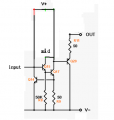
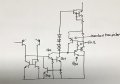
Q15 looks the main driver to output Q20.
Looks like Q17 is overcurrent protection for Q20? But if main current in Q20 PNP emitter current and collector current how would Q17 senses that?
Q14 would normally protect Q17 from overcurrent but only if you put back the stuff you have deleted in your attempt to mess up the schematic. As shown right now Q14 just short circuits the supply rails. Why not show the original?
Q14 would normally protect Q17 from overcurrent but only if you put back the stuff you have deleted in your attempt to mess up the schematic. As shown right now Q14 just short circuits the supply rails. Why not show the original?
Yeah, I deleted the VBE multiplier on top of collector of Q17.
I also deleted the capacitor on collector of Q14.
Why the need to protect Q17? The main output of pull part of push-pull is the Q20. Like the output pin got shorted.
Therefore Q20 should be the one need protection not Q17.
In order to drive Q20 the base voltage must be negative since it's a PNP.
How that negative voltage compared to V-
The intended protection is :-
As the input voltage rises, so does the voltage across R9.
When that voltage reaches about 0.6V Q14 begins to turn on.
That pulls the input voltage back down, so the current through R9 is limited to about 0.6V/50Ω = 12mA.
The base current of Q20 is thus limited to 12mA, protecting Q20 from over-drive.
View attachment 356686
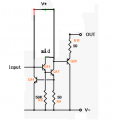
Q15 looks the main driver to output Q20.
Looks like Q17 is overcurrent protection for Q20? But if main current in Q20 PNP emitter current and collector current how would Q17 senses that?
The way you have drawn it makes it look almost like a 'load' not a driver of some kind. Q14 would then affect the total impedance depending on the input signal.
You'll have the show the full circuit.
Q15 and Q17 form a high-gain Darlington transistor pair. Combined with sensing across R9 and feedback through Q14, this form s a constant-current sink. This starves Q20 of the base current it would need to conduct enough collector current to hurt itself.
View attachment 356686
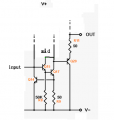
Q15 looks the main driver to output Q20.
Looks like Q17 is overcurrent protection for Q20? But if main current in Q20 PNP emitter current and collector current how would Q17 senses that?
For the circuit in post #4 THERE IS NO PROTECTION. As others have stated, portions have been removed for reasons unknown. That circuit has no protection at all. Also, it is not likely to function.
The question was posed with the circuit in post #4. I was not responding to a different circuit.
AND STILL, showing only a fragment of a circuit does not allow an adequate evaluation. The logical guess was that the "over-current protection" would be for the output transistor, which is a common intention.
Still does not seem to make much sense even if we look at this as a driver circuit.
A Darlington compound to power an output transistor, but then a 50 Ohm resistor in series with the collector of the output transistor Q14. That means that even with just 250ma on the output that resistor drops 12.5 volts.
We really need to see more of this circuit and what it is supposed to accomplish.
It’s the VAS and half the output stage of an audio amplifier. The Darlington made of Q15 and Q17 is the voltage amplifier stage, and they will be small signal devices. Q14 protects Q17 against overcurrent if the output stage goes into clipping.
Q20 is the negative output transistor and it is protected by nothing other than R11.
I suspect it might be a headphone amplifier.
If the need is for protecting against an input over-voltage, then a simple diode clamp with adequate capability diodes is a solution. and if it is anything else, it is only a guess as to what is left out. AND, if the TS has already decided where the problem is, why ask others???
The usual reason to need an overcurrent protection on the VAS, is to protect it from the output protection circuit, but this appears not to have an output protection circuit, unless that 50Ω resistor is across the base and emitter of a big power transistor that is not shown.
as everyone already mentioned, circuit is incomplete leading to guesses rather than answering question.
typical protection scheme would require some current limiting resistors and transistors that clamp signal when needed.
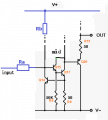
for example consider this:
Here Q14 is off all the time - except when current through R9 is too large. in that case voltage across R9 increases to the point of Q14 conducting. In this case input to Q15/Q17 is starved. This was already explained before. And with limited current through Q15/Q17, base current of Q20 is also limited.
For this to work, Q14 must be able to sink currents arriving through Ra and Rb. That was not possible with circuit as shown initially.

 Facebook
 Google
 GitHub
 Linkedin