Facebook
 Google
 GitHub
 Linkedin
Recently I built a PWM fan controller for a 50 Amp automotive radiator cooling fan. It worked great for 5 years but I decided to add some upgrades recently and one of the things I added was 2 zener diodes on the input power to clamp voltage spikes. It also worked great up until yesterday when I had a transient on the output that took the board out. The way this fan works is 12V power is available at the fan motor at all tomes feed by large 6 ga wires. The fan will not run until it gets a signal from the controller. The controller signals are low current milliamp signals which tell the fan to run and how fast. One of the signals is a straight 12V which is present whenever the key is on. The other is a PWM signal that controls the fans speed. The straight 12 signal provides power in an emergency mode, where if the PWM signal is lost the fan will run at full speed. In any case the 4 conductors come through the same connector, Power, Ground, 12V with key on and PWM. In this case there was a leaking radiator that got into the connector, despite the connector being a weather pack sealed connector. The only way the fan could run would have been if the power from the large power wires got into the smaller signal wires. I had already removed the fan controller from the car when the fan suddenly started to run at full speed with the fan controller removed and the key off. I had to pull the connector to shut it off and break a 5 amp circuit to do so. So in this case, I believe the 12V signal or the PWM signal were seeing intermittent power from the large cables that are directly connected to the battery.
The first picture shows the burn connector. There were originally 2 large pins and 2 signal pins in there. Now the large positive pin is burnt away.
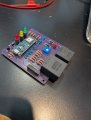
Second picture shows the board as made for reference.
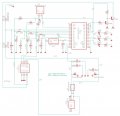
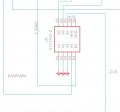
Third picture shows the full schematic. In that schematic pins A4 of the J1 connector is the pin that supplies a PWM signal to one of the small pins in the 4 pin connector. Pin B4 supplies the constant 12V with the key on to the other small pin. These can be better seen in the 4th picture
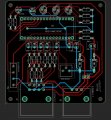
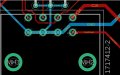
Pictures 5 and 6 are of the board layout with the full size and the blown up section of connector J1
So the question is what can be done to protect this system from such and event of antifreeze getting into the connector. I was thinking of putting the same zener diodes on pins A4 and B4 as I have on the input shown as D1 and D2. I believe that will work for at least the straight 12 signal but I'm not sure what it would do to the PWM signal.
Your thoughts would be greatly appreciated.
Thanks
John
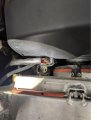
The first picture shows the burn connector. There were originally 2 large pins and 2 signal pins in there. Now the large positive pin is burnt away.
Second picture shows the board as made for reference.
Third picture shows the full schematic. In that schematic pins A4 of the J1 connector is the pin that supplies a PWM signal to one of the small pins in the 4 pin connector. Pin B4 supplies the constant 12V with the key on to the other small pin. These can be better seen in the 4th picture
Pictures 5 and 6 are of the board layout with the full size and the blown up section of connector J1
So the question is what can be done to protect this system from such and event of antifreeze getting into the connector. I was thinking of putting the same zener diodes on pins A4 and B4 as I have on the input shown as D1 and D2. I believe that will work for at least the straight 12 signal but I'm not sure what it would do to the PWM signal.
Your thoughts would be greatly appreciated.
Thanks
John