Facebook
 Google
 GitHub
 Linkedin
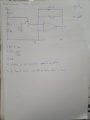
Hello, I have tried to analyse this circuit from an exam in electronics. I forgot to add in the drawing that the Vt = -0,4, so the MOSFET is a PMOS, I assume it's in saturation.
1) Calculate the operating point.
It means finding all the currents and nodes in the DC steady-state circuit. So the capacitor C=1nF is considered as an open circuit, the sinusoidal voltage generator Vin is shorted to ground, the zener diodes Dz1 and Dz2 are considered as DC voltage batteries (the value varies from -4.3V to 0.7V depending on the configuration).
I start from the branch with the zener diodes. Dz1 is in reverse, Dz2 is in direct, so applying the KVL to the entire branch I will have:
10v - i*1k -4,3v - 0,7v = -1v (I solve for the current i, having R1 = 1k ohm)
i*1k = 6
i = 6mA, it is the current that flows in the entire branch.
To find the voltage Vx at the point where the branch is connected to the gate of the MOSFET:
Vx = 10v -i*R1 = 10V - 6V = 4V
Vx coincides with Vg, the Gate voltage of the MOSFET.
Vg = 4V;
Being a PMOS, the current flows from the source to the drain; the source in this case is grounded, so Vs = 0;
Vd is the voltage of the negative input L- of the op amp, which is equal to the voltage of the positive input L+ due to the virtual short circuit principle, so Vd = L- = L+ = -1V
I can now find the current flowing in the MOSFET and going to the resistor R in the negative feedback of the op amp:
Id = k(Vs - Vg- |Vt|)^2 = 5ma/V^2*(-4,4V)^2 = 96,8mA
The voltage in the resistor R in the feedback will be:
Vr =Id*R = 96,8mA * 25k = 2,25k
(I am not very confident in my numbers here, this seems too high)
Finally, the gain is
gm = (2*Id)/Vov = (0,09*2)/4,4= 0,04A/V
2) Find the F(jw)=Vo(jw)/Vi(jw)
Since there is a mosfet in the circuit, I cannot use the normal configurations: inverting configuration or non-inverting configuration, I must use the appropriate KCL and KVL at the nodes concerning the PMOS. The PMOS in this case becomes a dependent generator, Vi is considered on, the zener diodes are considered as short circuits, and the capacitor is considered for its 1/sC impedance. The voltage of L+ is zero, being at ground in AC, same thing for the +10V.
First calculate the impedance in the negative feedback of the amplifier
R//(1/sC) = .. = R/(1+RsC)
I consider the PMOS in Common Source configuration:
Vo = gm*Vsg*[R/(1+RsC)], I expand the Vsg voltage: Vsg = Vin - 0
So:
Vo = gm*Vin*[R/(1+RsC)],
Vo/Vin = gm*[R/(1+RsC)]
is it correct?
3) Bode diagrams:
I don't know how to represent the diagrams here, I briefly describe what I did. Taking the frequency response H(s)=Vo(s)/Vin(s), I applied the limit that tends for s->0, the result came out 1000, from here:
20log(1000) = 20*3 = 60db.
The limit of H(s) that tends for s-> ∞ gives me 0, in short the trend of the signal from the circuit is a low pass.
I only saw one pole
wp= 1/C=1/10^(-9) = 10^9 rad/sec.
In the graph of the module I will start from 60db on the y-axis, until reaching the pole
in the x-axis of the rad/s. Arriving at the pole, the signal drops constantly by 20dca.
In the phase graph, same trend but it will start from 0 on the y-axis, a decade before the pole begins to go down; a decade after the pole will stop going down and continue straight to the phase of -180°.
is it correct?
4) Provide the instantaneous Vc and given Vin = -1V*sca(t), calculate the trend of the voltage and represent in the graph:
the value of the Laplace transform of the step function is sca(t) =1/s.
limit of the time tending to infinity is equal to the limit of s tending to 0 of s*H(s)*[1/s) = H(s) = gm*R
limit of the time tending to zero p equal to the limit of s tending to infinity s*H(s)*[1/s) = 0
In short in the graph in the y I have the voltage Vo, in the x I have the time t
there will be a constant line from the left towards the -1V up to the y-axis, after which it will slowly rise towards 0 infinitesimally.
I kindly ask you to correct me in my steps and possibly also in the values I found please? Thanks and talk to you soon