Electronics exam prep help

Thread Starter

Miges

Joined Jun 27, 2025
6
Hello all,
Sorry new to this forum so please take it easy on me!

Posting on behalf of my girlfriend she’s too shy to ask for help here. She has exam prep for her electronics subject but the professor has a habit to do completely different questions to what he teaches in class so she’s very stuck on solving these and was hoping if I could find some help here.


Many many thanks
 
Last edited by a moderator:

MrChips

Joined Oct 2, 2009
34,628
Welcome to AAC!

The rules for Homework Help is the student must show their best attempt at solving the problem then we can provide guidance. Also it gives us an idea of the level of knowledge already attained and what area is giving trouble.

It would be best to post one question at a time to avoid confusion.
Hence we should focus on Q4.
 

Thread Starter

Miges

Joined Jun 27, 2025
6
Welcome to AAC!

The rules for Homework Help is the student must show their best attempt at solving the problem then we can provide guidance. Also it gives us an idea of the level of knowledge already attained and what area is giving trouble.

It would be best to post one question at a time to avoid confusion.
Hence we should focus on Q4.
Mind just completely deleting this whole thread I posted? I'll repost with one question and the attempted solution. Thanks, can't locate the edit or delete button. I'll make it more clean. Thanks
 

ericgibbs

Joined Jan 29, 2010
21,390
Hi Miges,
Just post the one question to this thread, we can then take a step at a time.
Post your best attempt at answering, and then we can help you.:)
E
 

Thread Starter

Miges

Joined Jun 27, 2025
6
Hi Miges,
Just post the one question to this thread, we can then take a step at a time.
Post your best attempt at answering, and then we can help you.:)
E

Thank you for your attention, since you are here, could you please delete the post as my girlfriend just informed me that she was not suppose to share these exact questions, I'll reformat the question in a different way and repost at a later time (with your requested format of asking questions). I apologise for the inconvenience caused to the moderators. Many thanks
 
Last edited:

MrChips

Joined Oct 2, 2009
34,628
No problem. The attachments have been deleted.
Continue on this thread, one question at a time. We can delete the questions in the original post if desired.
 

Thread Starter

Miges

Joined Jun 27, 2025
6
Wow, colour me impressed! I've never come across such helpful moderators and helpful community! thank you!! I've gone and typed out her solution to avoid recognition of handwriting, ,in case prof is also in this forum.

attempt #2
The question:

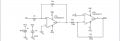
Consider the two-stage electronic circuit with Operational Amplifiers (OAs) from the figure below. We consider the OAs to be ideal, supplied with ±5V and having a saturation voltage equal to ±3.5V. It is required:
a) To determine analytically the expressions for the output voltages of amplifiers U1A and U1B and to specify the type of circuits built around the two OAs.

b) To calculate the peak-to-peak amplitude, the average value (DC component), and the RMS value of the signal at the output of the first amplifier (U1A), when the input signal Vin from the figure below is applied.

c) Apply (via PSpice simulation and representation on paper) the signal from the figure below to the circuit's input Vin and graphically represent (on paper, on the same graph) the input signals Vin and Vout. Experimentally determine the peak-to-peak amplitude of the signal at the output of OA U1A and mark it on the graph. The circuit is supplied with a symmetrical differential voltage of ±5V, and the OA is of type TL072.

(First amp is inverting- Second amp is non-inverting Schmitt trigger)


WhatsApp Image 2025-06-27 at 14.29.45_b08c8789.jpg


Solution which girlfriend attempted:


Part a: Circuit Analysis and Voltage Expressions


- R1 = 1 kΩ, R2 = 7 kΩ
Amp-Op inverting
VO1 = - (R2 / R1) * Vin = - (7k / 1k) * Vin = -7 * Vin

- R3 = 100 kΩ, R4 = 470 kΩ
(Non-inverting Schmitt Trigger)
V = (R3 / (R3 + R4)) * Vout = (100k / (100k + 470k)) * 5V ≈ 0.877 V

Part b:
Part B and C she hasn't solved just yet as she is unsure if part A is correct in order to progress because input is not valid(unsure of validity).


Many many thanks for any knowledge shared/ guidance!
 

MrChips

Joined Oct 2, 2009
34,628
Here are some tips when working with ideal op amps.

1) When the op amp has stabilized in the linear region, the voltage difference between the inverting and non-inverting inputs must be zero.

2) The current flowing in the inputs is zero.
 

Thread Starter

Miges

Joined Jun 27, 2025
6
Here are some tips when working with ideal op amps.

1) When the op amp has stabilized in the linear region, the voltage difference between the inverting and non-inverting inputs must be zero.

2) The current flowing in the inputs is zero.
Thank you!!!

So is part A correct? Should she proceed with b with those given results?
 

MrChips

Joined Oct 2, 2009
34,628
U1A op amp is an inverting amplifier by applying negative feedback.

U1B is an analog comparator with hysteresis by applying positive feedback. In this configuration, the voltages on the inputs are not the same. The output will be at one of two possible states. The answer is incorrect.

The clue to look for, the op amp needs negative feedback in order to stabilize in the operating region, i.e. not in saturation mode.
 

crutschow

Joined Mar 14, 2008
38,316
Think about what happens with the positive feedback of the second op amp.
If the output goes a little positive, then so does the positive (+) input.
This makes the output go more positive along with the input, so the output keeps going positive until it reaches its maximum (saturation) voltage.

Then to make the output go negative, the input voltage has to go negative enough to make the (+) input negative as determined by the voltage divider action of R3 and R4.
The input voltage needed for that is determined by the amount of positive feedback (hysteresis) provided by the resistors and the output saturation voltage.
 

Thread Starter

Miges

Joined Jun 27, 2025
6
Thank you for the guidance!!

A:
using resistor values (R3=100k, R4=470k) and the saturation voltage from that problem (Vsat = ±3.5V):

  • V_UTP = +3.5V * (100k / (100k + 470k)) = +3.5V * (100 / 570) ≈ +0.614 V
  • V_LTP = -3.5V * (100k / (100k + 470k)) = -3.5V * (100 / 570) ≈ -0.614 V

B:
Using the correct formula (V_thresh = V_sat * R4 / (R3 + R4)) and the Vsat of ±3.5V, we get:

  • Upper Threshold (UTP) ≈ +2.88V
  • Lower Threshold (LTP) ≈ -2.88V

If I were to draw this on a graph with all three signals:

  • Vin: A perfect, smooth sine wave oscillating between +1V and -1V.
  • VoutA: An inverted wave that follows Vin but is clipped flat at +3.5V and -3.5V. It looks more like a square wave with rounded edges than a sine wave.
  • Vout: A perfect square wave oscillating between +3.5V and -3.5V. Its transitions will happen after VoutA has started to change, precisely at the moments VoutA reaches the ±2.88V trigger points.


C:
The intermediate signal VoutA (the -7 * sin(t) wave) crosses the +2.88V and -2.88V thresholds. On sine wave gives us the precise timing:

  • The output Vout flips LOW (to -3.5V) at approximately t = 1.35 ms.
  • The output Vout flips HIGH (to +3.5V) at approximately t = 11.35 ms.

Since the total period is 20 ms, the time spent in the high state must be the remaining 20 ms - 10 ms = 10 ms.
The duty cycle:
Duty Cycle = (Time High / Total Period) * 100% Duty Cycle = (10 ms / 20 ms) * 100% = 0.5 * 100% = 50%

So, the final output is a 50 Hz square wave with a 50% duty cycle.

Have we undertaken the correct steps?

Many many thanks!
 

MrChips

Joined Oct 2, 2009
34,628
R3 and R4 do not determine the op amp output voltage.
They determine the input switching thresholds which are different for rising and falling voltages. This is the meaning of hysteresis.

The output will be one of the two saturation voltages.
 

MrAl

Joined Jun 17, 2014
13,667
Wow, colour me impressed! I've never come across such helpful moderators and helpful community! thank you!! I've gone and typed out her solution to avoid recognition of handwriting, ,in case prof is also in this forum.

attempt #2
The question:

Consider the two-stage electronic circuit with Operational Amplifiers (OAs) from the figure below. We consider the OAs to be ideal, supplied with ±5V and having a saturation voltage equal to ±3.5V. It is required:
a) To determine analytically the expressions for the output voltages of amplifiers U1A and U1B and to specify the type of circuits built around the two OAs.

b) To calculate the peak-to-peak amplitude, the average value (DC component), and the RMS value of the signal at the output of the first amplifier (U1A), when the input signal Vin from the figure below is applied.

c) Apply (via PSpice simulation and representation on paper) the signal from the figure below to the circuit's input Vin and graphically represent (on paper, on the same graph) the input signals Vin and Vout. Experimentally determine the peak-to-peak amplitude of the signal at the output of OA U1A and mark it on the graph. The circuit is supplied with a symmetrical differential voltage of ±5V, and the OA is of type TL072.

(First amp is inverting- Second amp is non-inverting Schmitt trigger)


View attachment 351785


Solution which girlfriend attempted:


Part a: Circuit Analysis and Voltage Expressions


- R1 = 1 kΩ, R2 = 7 kΩ
Amp-Op inverting
VO1 = - (R2 / R1) * Vin = - (7k / 1k) * Vin = -7 * Vin

- R3 = 100 kΩ, R4 = 470 kΩ
(Non-inverting Schmitt Trigger)
V = (R3 / (R3 + R4)) * Vout = (100k / (100k + 470k)) * 5V ≈ 0.877 V

Part b:
Part B and C she hasn't solved just yet as she is unsure if part A is correct in order to progress because input is not valid(unsure of validity).


Many many thanks for any knowledge shared/ guidance!
Hello there,

I do not think you calculated the Schmitt Trigger section correctly.

To do that, you have to calculate two values:
1. The Vin threshold when Vout=Vcc (3.5v).
2. The Vin threshold when Vout=Vee (-3.5v).
This gives you two values for Vin so you know what state Vout goes to (+3.5v or -3.5v) when Vin reaches those thresholds.
To help solve this, the thresholds occur when the non-inverting input terminal becomes the same voltage as the inverting input terminal (which is always at 0v).

You don't have to use the numerical values like 3.5 or -3.5 for Vout if you want a symbolic solution, all you have to do then is form the expression for calculating Vin for any Vout.

See if that helps you or her solve this completely.
 

MrAl

Joined Jun 17, 2014
13,667
Thank you for the guidance!!

A:
using resistor values (R3=100k, R4=470k) and the saturation voltage from that problem (Vsat = ±3.5V):

  • V_UTP = +3.5V * (100k / (100k + 470k)) = +3.5V * (100 / 570) ≈ +0.614 V
  • V_LTP = -3.5V * (100k / (100k + 470k)) = -3.5V * (100 / 570) ≈ -0.614 V

B:
Using the correct formula (V_thresh = V_sat * R4 / (R3 + R4)) and the Vsat of ±3.5V, we get:

  • Upper Threshold (UTP) ≈ +2.88V
  • Lower Threshold (LTP) ≈ -2.88V

If I were to draw this on a graph with all three signals:

  • Vin: A perfect, smooth sine wave oscillating between +1V and -1V.
  • VoutA: An inverted wave that follows Vin but is clipped flat at +3.5V and -3.5V. It looks more like a square wave with rounded edges than a sine wave.
  • Vout: A perfect square wave oscillating between +3.5V and -3.5V. Its transitions will happen after VoutA has started to change, precisely at the moments VoutA reaches the ±2.88V trigger points.


C:
The intermediate signal VoutA (the -7 * sin(t) wave) crosses the +2.88V and -2.88V thresholds. On sine wave gives us the precise timing:

  • The output Vout flips LOW (to -3.5V) at approximately t = 1.35 ms.
  • The output Vout flips HIGH (to +3.5V) at approximately t = 11.35 ms.

Since the total period is 20 ms, the time spent in the high state must be the remaining 20 ms - 10 ms = 10 ms.
The duty cycle:
Duty Cycle = (Time High / Total Period) * 100% Duty Cycle = (10 ms / 20 ms) * 100% = 0.5 * 100% = 50%

So, the final output is a 50 Hz square wave with a 50% duty cycle.

Have we undertaken the correct steps?

Many many thanks!
Look like you got a bit farther with this.

2.88 and -2.88 does not look correct.
When you calculate a voltage divider with voltages at BOTH ends of the divider, you have to first subtract one voltage from the other, then you apply the voltage divider formula, then you add the subtracted voltage back to the result.
For examples...
Say we have two resistors 1k each for the voltage divider. If we have 0v at one end and 5v at the other end, it is obvious we have 2.5v at the center node.
However, if we have 1v on one end and 5v on the other end, the center node is no longer 2.5v. We first subtract 1v from 5v which gives us 4v. Then we apply the voltage divider formula which gives us 2v at the center node. Lastly, we add back that 1v we subtracted. That gives us 3v at the center node as the final result.
That is where the mistake had occurred: there was no subtraction first with a later addition of the lower voltage.

Let's check this...
With 1v and 5v on the two ends, the current is 4/2000 amps. With that flowing through the upper resistor, the drop is (4/2000)*1000=2 volts. Since the upper voltage is 5v, 5v minus 2v equals 3v. Thus, 3v is really the correct result so far. Checking with the lower resistor, that end is 1v, and 1v+2v=3v, again we get 3v so 3v is the correct voltage at the center node.
Note if we did not first subtract 1v (and then later add it back) we would have gotten 2.5v at the center node which again is not correct.

One of the reasons we have to do this is because when we have 0v at one end we have the full voltage of the other source across both resistors which gives us a higher current than when that 0v changes to a non zero value. With two non zero voltages we get a different current level though both resistors so the voltage drops must be different.

If you study something like Nodal Analysis you will find the same thing but with a more generalized procedure that covers any case with any number of resistors and any number of voltage sources. You would then never have to ask these kinds of questions again.
 
Last edited:

crutschow

Joined Mar 14, 2008
38,316
Positive feedback is bad. It causes run away and overshoot.
That's a strange blanket comment.
Positive feedback is useful and good for things like providing hysteresis in an analog comparator circuit (as it does here).
It also is a necessary part for the operation of circuits such as a Howland current-pump.
 

MrChips

Joined Oct 2, 2009
34,628
That's a strange blanket comment.
Positive feedback is useful and good for things like providing hysteresis in an analog comparator circuit (as it does here).
It also is a necessary part for the operation of circuits such as a Howland current-pump.
Thanks for your negative feedback.
 
Top