Current Limit for 28A Draw

Thread Starter

GiosefHV

Joined Feb 19, 2026
11
Hi everyone,

I’m working on a design that steps a 12 V supply up to 24 V using a DC‑DC boost converter to drive a motor. The issue I’m running into is that the 12 V supply is rated for 25 A continuous, but during operation, it briefly sees about 28 A and trips offline.

I’ve been researching current‑limiting methods, but most high‑power options I find are either fuses or one‑time protection devices, which don’t really fit this application since the system needs to stay powered. The boost converter we’re using right now is rated for 10 A on the 24 V side, and I’m starting to suspect it may be contributing to the current overshoot. I’m considering whether upgrading to a converter with a higher current rating—or possibly a higher voltage capability—would help reduce these spikes while keeping efficiency reasonable.
If anyone has experience with high‑power DC‑DC converters driving inductive loads, or suggestions on effective current‑limiting strategies for this type of setup, I’d greatly appreciate your insight.

Thanks in advance!
 

ronsimpson

Joined Oct 7, 2019
4,645
The boost converter we’re using right now is rated for 10 A on the 24 V side,
Post your schematic. What are you using to boost 12V to 24V? 10A at 24V will take 21A from 12V. Most likely those numbers are not solid.
It maybe we could change one resistor on the boost converter and back it down by 10% and solve this.
 

ronsimpson

Joined Oct 7, 2019
4,645
We can't make changes to that.
Have you tried putting a large capacitor on the 12V side? (very large)
Do you have a breaker that trips?
Does it trip at turn on? or then the motor is working very hard. or then the motor first starts?
 

Thread Starter

GiosefHV

Joined Feb 19, 2026
11
We can't make changes to that.
Have you tried putting a large capacitor on the 12V side? (very large)
Do you have a breaker that trips?
Does it trip at turn on? or then the motor is working very hard. or then the motor first starts?
I have not. The 12V power supply is also an enclosed system. It’s all supposed to go in a car so we are testing it all with the supplier parts. I could try adding the capacitor in series from the power supply’s connector to the converter?
 

Thread Starter

GiosefHV

Joined Feb 19, 2026
11
We can't make changes to that.
Have you tried putting a large capacitor on the 12V side? (very large)
Do you have a breaker that trips?
Does it trip at turn on? or then the motor is working very hard. or then the motor first starts?
I should also mention that the power supply is a Cosworth IPS Mk2.
 

boostbuck

Joined Oct 5, 2017
1,032
It seems you need a dc soft-start between your psu and your converter. There are a variety available, no doubt something will be suitable for your voltage and load.

Simpler, a vehicle battery is able to provide very large currents if you can use that directly.
 

schmitt trigger

Joined Jul 12, 2010
2,027
I have not. The 12V power supply is also an enclosed system. It’s all supposed to go in a car so we are testing it all with the supplier parts. I could try adding the capacitor in series from the power supply’s connector to the converter?
Not in series, but parallel

EDIT: motors draw large inrush currents, which can be quite lengthy with high inertia loads. Can you soft start the motor?
 
Last edited:

Thread Starter

GiosefHV

Joined Feb 19, 2026
11
So, it is the power supply that is tripping.

The finished product probably goes in a car, truck, or boat with batteries and not a Cosworth IPS Mk2.
Well, the IPS is acting like the power distribution unit. The battery connects to one port, and from there there are 3 different connectors with pins rated for respective amperage. The pin I am allowed to connect to only goes up to the 25A continuos , which explains the tripping at 28A. I could try the capacitor to help, but from the offloaded data it seems like it’s not the inrush current tripping it, as that is closer to 40A but for a much shorter period of time. It’s tripping when the current creeps up to 28A during continuous use
 

ronsimpson

Joined Oct 7, 2019
4,645
If you need 28A to do the job, you will need to find 28A. This gives me the idea that the motor is pulling 12A to 13A.
There is a small chance that the boost converter is overloaded and hot. It may be running inefficient. I am not certain how to test that.
Do you have a way to measure the current of the motor?
 

panic mode

Joined Oct 10, 2011
4,864
how are you obtaining that 28A value? are you sure that current would not go even higher if the circuit wasn't tripping?
what kind of motor? what does it drive? does it have its own controller?
if it is hitting hardstop you WILL get massive current spikes even if running current is much lower.
if it has own controller, reduce acceleration slightly. otherwise try adding 0.1Ohm 100W resistor between PSU and converter.
 

MisterBill2

Joined Jan 23, 2018
27,159
One possible option, maybe, if the motor is able to start on 12 volts, is to start the motor on 12 volts and then switch over to the 24 volt supply. (Dual voltage starting has been done for many years, it is complicated.)

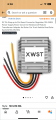
The amazon product is probably not intended for motor starting applications, and certainly your 12 volt power supply is not intended to deliver more than 240 watts for any length of time If the 12 volt current peaks at 28 amps, that is 168 watts, then your 12 volt (120 watt) power supply IS NOT able to supply 288 watts for any length of time.
BUT it may also be that the "step up converter" is terribly inefficient.

Check the fine print on the ratings for that 12 volt supply.
 

Reloadron

Joined Jan 15, 2015
7,850
Hi everyone,

I’m working on a design that steps a 12 V supply up to 24 V using a DC‑DC boost converter to drive a motor. ...
Granted a little late but have you considered the start up current your motor draws? You mention 28 amps? Motor start current well exceeds the normal run current.

Ron
 

MisterBill2

Joined Jan 23, 2018
27,159
Oneother unfortunate problem is that step-up circuits to start and drive motors are seldom accepted as a good design. Either using a 12 volt motor or a 24 volt battery would be the way to go.
NONE of my clients would ever have accepted a step-up system. Not ever. The cost of failure was alwaysthe reason.
 
Last edited:

WBahn

Joined Mar 31, 2012
32,702
Hi everyone,

I’m working on a design that steps a 12 V supply up to 24 V using a DC‑DC boost converter to drive a motor. The issue I’m running into is that the 12 V supply is rated for 25 A continuous, but during operation, it briefly sees about 28 A and trips offline.

I’ve been researching current‑limiting methods, but most high‑power options I find are either fuses or one‑time protection devices, which don’t really fit this application since the system needs to stay powered. The boost converter we’re using right now is rated for 10 A on the 24 V side, and I’m starting to suspect it may be contributing to the current overshoot. I’m considering whether upgrading to a converter with a higher current rating—or possibly a higher voltage capability—would help reduce these spikes while keeping efficiency reasonable.
If anyone has experience with high‑power DC‑DC converters driving inductive loads, or suggestions on effective current‑limiting strategies for this type of setup, I’d greatly appreciate your insight.

Thanks in advance!
Need more information.

Will the motor respond adequately if you manage to limit the current like you want? There's a reason that it is trying to draw that current. Furthermore, how much current would it be trying to draw if your supply didn't trip? You only know that it is more than 28 A, but is it 28.5 A, or 50 A?

Is it the 12 V supply that is tripping, or the DC-DC converter? Whichever it is, can the other handle the spike if the first didn't trip?

How long is the spike? In theory, you could put a large capacitor on one (or both) of the power rails, depending one what can actually handle what, but this is very likely not practical at these current draws unless you are truly only making up a few amps for a small fraction of a second.

More fundamentally, why aren't you using components that are rated for the application, including transients? If it's a matter of trying to do something on the cheap with what you have on hand, you are likely to discover that the value of the time and effort you end up spending to get something that sorta kinda works is more than what just getting the right components would have been. For ~$30 you can get a 24 V / 19 A supply from DigiKey (which means you can almost certainly find it cheaper elsewhere). How much effort are you willing to put forth to avoid a $30 purchase (especially considering that whatever solution you go with will have it's own cost associated with it)?
 

MisterBill2

Joined Jan 23, 2018
27,159
Many motors include on their data tag the "LRA" (Locked Rotor Amps), which is a fair aproximation of the first instant starting current. That current does drop rapidly during the motor start, but it must be considered in the motor's excess current protection scheme. That is why there are a variety of circuit protection devices made specificly for motor starting applications.
 
Top