Inrush current limit using NTC

Thread Starter

andrew74

Joined Jul 25, 2022
204
Let's assume a circuit that receives about 50V power supply when switched on, but with a spike of about 30A (with duration let's assume in 2-3ms)
Let us assume that the power supply distributes 50V throughout the system, consisting of (for example) motors each with its own driver.

I am looking for an Inrush current limit suppressor and, if I understand correctly, there are usually three solutions:

- use a NTC
- use a mosfet circuit
- some integrate circuit like LM5069

Let us assume that we want to use an Inrush current NTC to limit the spike:
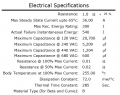
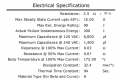
1757497175729.png


From these parameters I have not understood how to calculate/understand whether this current limiter will be able to stop the inrush current spike in time.
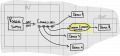
SmartSelect_20250910_101732_Samsung Notes.png
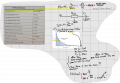
My calculations assuming this:
"Hp" means "hypothesis"
notes.png


Is this ok?

Thank you.
 
Last edited:

Ian0

Joined Aug 7, 2020
13,097
If its 25°C resistance is 1Ω, and the supply is 50V, then the current at the moment of switch-on will be 50A.
But what is the source impedance of the supply? and the resistance and capacitance of the load?
To what value of current do you wish to limit the inrush?
 

crutschow

Joined Mar 14, 2008
38,316
I have not understood how to calculate/understand whether this current limiter will be able to stop the inrush current spike in time.
What is the normal maximum operating current from the 50V supply?
That will determine the maximum nominal operating (hot) resistance for the NTC device you can tolerate, which is how you normally select the proper device.

Obviously, the NTC device you posted, with a 1Ω cold resistance, won't limit the current to below 30A.
 
Last edited:

Thread Starter

andrew74

Joined Jul 25, 2022
204
If its 25°C resistance is 1Ω, and the supply is 50V, then the current at the moment of switch-on will be 50A.
But what is the source impedance of the supply? and the resistance and capacitance of the load?
To what value of current do you wish to limit the inrush?
I have to limit peaks of 30-31A that last a few ms
I don't really know Zsupply, R and C ... I would like to assume data or just use the letters Z, R and C to understand the reasoning behind it

Is that possible?
We can also assume random values.

(see the schematic updated in the main post)
 
Last edited:

Thread Starter

andrew74

Joined Jul 25, 2022
204
What is the normal maximum operating current from the 50V supply?
That will determine the maximum nominal operating (hot) resistance for the NTC device you can tolerate, which is how you normally select the proper device.

Obviously, the NTC device you posted, with a 1Ω cold resistance, won't limit the current to below 30A.
Assume that the power supply unit can deliver a maximum of 60A, but that there are more modules/peripherals attached to the power supply (of motors, displays etc.)

(see the schematic updated in the main post)
 
Last edited:

Thread Starter

andrew74

Joined Jul 25, 2022
204
What is the normal maximum operating current from the 50V supply?
That will determine the maximum nominal operating (hot) resistance for the NTC device you can tolerate, which is how you normally select the proper device.

Obviously, the NTC device you posted, with a 1Ω cold resistance, won't limit the current to below 30A.
So the 36A I read here does not count? Should I rely on R at T=25°C? ..i.e. find NTC such that Vsupply / R (T=25°C) = I_to_limit ??
1757491815093.png
 

drjohsmith

Joined Dec 13, 2021
1,548
Its a common engineering problem .
Trying to specify with half the possible information .
So we make and document our guesses / assumption.

Assume the supply comming in can deliver infinite current at its max voltage is the worst case condition.
You have a working temperature for the unit , find from the data sheet what the lowest ntc resistance would be over that temperature range .
Assume the load is a short circuit .
You then know what the initial max current would be. I = v*v / r .

The other number to look at , is the ntc dissipation . When the unit is running , taking it's normal current, the ntc will still have a resistance , power = I * I * r
Ensure your happy with that heating , and check the voltage drop is ok for your design .

The effect on the load of limiting the current , will be to have a slow rising voltage on the load .ensure your load can start up assuming this condition .
 

Thread Starter

andrew74

Joined Jul 25, 2022
204
Its a common engineering problem .
Trying to specify with half the possible information .
So we make and document our guesses / assumption.

Assume the supply comming in can deliver infinite current at its max voltage is the worst case condition.
You have a working temperature for the unit , find from the data sheet what the lowest ntc resistance would be over that temperature range .
Assume the load is a short circuit .
You then know what the initial max current would be. I = v*v / r .

The other number to look at , is the ntc dissipation . When the unit is running , taking it's normal current, the ntc will still have a resistance , power = I * I * r
Ensure your happy with that heating , and check the voltage drop is ok for your design .

The effect on the load of limiting the current , will be to have a slow rising voltage on the load .ensure your load can start up assuming this condition .
Just updated the main post, thanks
 

Thread Starter

andrew74

Joined Jul 25, 2022
204
Ok. That is not good etiquette , As it now nullifies the follow on posts. . please don't change previous posts once someone's answered.
I only added a picture with my calculations, I didn't delete anything.

Thanks anyway for the advice, next time I will add content in a new reply :)
 

crutschow

Joined Mar 14, 2008
38,316
Assume that the power supply unit can deliver a maximum of 60A, but that there are more modules/peripherals attached to the power supply (of motors, displays etc.)
Okay, but that doesn't answer my question.
What is the normal, steady-state current that will go through the NTC device?
Need that info to properly size it.
 

Thread Starter

andrew74

Joined Jul 25, 2022
204
Okay, but that doesn't answer my question.
What is the normal, steady-state current that will go through the NTC device?
Need that info to properly size it.
You are right.
The steady-state current depends on several factors because the load is a motor driver and the motor runs at different speeds depending on its load (I thought I had written it down but I forgot, sorry)
Approximately 50mA to 0.7A maximum

(P.S.: I tried to do some calculations which you can find in the main post)
 
Last edited:

crutschow

Joined Mar 14, 2008
38,316
Approximately 50mA to 0.7A maximum
Okay.
So pick a device that has a cold resistance that will limit the current to below 30A and will readily pass 0.7A with low resistance.

For example this 2.5Ω device will limit the peak inrush to 50V / 2.5Ω = 20A and has the following characteristics:
Its resistance should be less than an ohm at 0.7A.

1757514827200.png
 

Thread Starter

andrew74

Joined Jul 25, 2022
204
Its resistance should be less than an ohm at 0.7A.
Thank you for your answer!

1) What do you deduce this statement from?
From the specification "Resistance 50% max current = 0.07" on the datasheet ??

2) I suppose then my calculations are correct?

3) Shouldn't we also consider in our calculations/considerations the overall system input resistance and capacitance from the power supply (before ntc inrush) and output resistance and capacitance (after ntc, towards the load) ??
Or maybe I'm complicating things and simply the V/R calculation you did is enough?
 

drjohsmith

Joined Dec 13, 2021
1,548
Thank you for your answer!

1) What do you deduce this statement from?
From the specification "Resistance 50% max current = 0.07" on the datasheet ??

2) I suppose then my calculations are correct?

3) Shouldn't we also consider in our calculations/considerations the overall system input resistance and capacitance from the power supply (before ntc inrush) and output resistance and capacitance (after ntc, towards the load) ??
Or maybe I'm complicating things and simply the V/R calculation you did is enough?
Your designing for the worst case .
If it's less inrush current than the limit , your happy ?
So assume the load is a short circuit at power up, and the volts in are are their max ,then v = ir allows you to find out the minimum resistance the ntc needs at cold.
 

crutschow

Joined Mar 14, 2008
38,316
1) What do you deduce this statement from?
From the specification "Resistance 50% max current = 0.07" on the datasheet ??
Yes.
2) I suppose then my calculations are correct?
I didn't look at them in detail as they are hard to read.
3) Shouldn't we also consider in our calculations/considerations the overall system input resistance and capacitance from the power supply (before ntc inrush) and output resistance and capacitance (after ntc, towards the load) ??
Or maybe I'm complicating things and simply the V/R calculation you did is enough?
Worst-case is if all those are zero, and that's what I would use for calculations.
You can include all those factors if you feel its necessary to have a more exact value for the inrush.
 

Thread Starter

andrew74

Joined Jul 25, 2022
204
Yes.
I didn't look at them in detail as they are hard to read.
Worst-case is if all those are zero, and that's what I would use for calculations.
You can include all those factors if you feel its necessary to have a more exact value for the inrush.
Thank you very much!
If I think of any other questions I will ask you.
 

MrAl

Joined Jun 17, 2014
13,667
Hi,

I am not sure I like the inrush current limiter NTC's thermistors. For one, they can get hot, and that means that a thermal fuse should be incorporated with it like that done with power strips with surge absorber components. If it gets too hot, the fuse blows.

Maybe a more active method would be better. An NTC combined with a cutoff circuit to break the circuit completely or actively limit the current.
 

Thread Starter

andrew74

Joined Jul 25, 2022
204
Hi,

I am not sure I like the inrush current limiter NTC's thermistors. For one, they can get hot, and that means that a thermal fuse should be incorporated with it like that done with power strips with surge absorber components. If it gets too hot, the fuse blows.

Maybe a more active method would be better. An NTC combined with a cutoff circuit to break the circuit completely or actively limit the current.
Thanks for the reply.
Do you mean someting like this?
gor example:

https://share.google/iaw81OKbWE3zfVTye
 
Top