Where to clamp inputs for op-amps with zero headroom?

Thread Starter

Dr. Heinz Doofenshmirtz

Joined Jun 29, 2025
16
In op-amps where the absolute maximum input voltage range is limited to the range of the supply rails, is it sufficient to clamp inputs right at the supply rails or should they be clamped a bit lower/higher to allow for wiggle room?

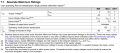
For example, I'm designing a single-supply audio circuit and I'm considering using NE5532's for the bulk of it. Its absolute maximum ratings are given below:
NE5532 maximum ratings.png

Source: Texas Instruments NE5532x Datasheet, January 2015 Revision

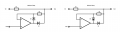
I'm considering using precision clamps like these and I have the option to either feed them the supply voltages (e.g. 5V and 0V) or to use a voltage divider to feed them voltages with a bit of headroom (e.g. 4.9V and 0.1V).
precision clamps.png

Although I know it would be okay to clamp right to the supplies in theory, in a real-world circuit, I figure that there would be cases where the clamp voltage would slightly exceed the supply voltage due to:
1. Various nonidealities between the supply and clamp voltages
2. The possiblity of the virtual ground (for a single-supply circuit) not being at exactly one-half of the supply voltage (due to the second note in the NE5532 absolute maximum ratings).

So, is it okay to clamp right to the supply voltages? If not, is there a rule-of-thumb headroom value I might want to consider using if I don't have a model for all the nonidealities in the circuit?
 

crutschow

Joined Mar 14, 2008
38,392
In op-amps where the absolute maximum input voltage range is limited to the range of the supply rails, is it sufficient to clamp inputs right at the supply rails or should they be clamped a bit lower/higher to allow for wiggle room?
Where is this audio overvoltage coming from?

In general if you keep the voltage no more that 0.6V above the supply rails you should be okay.
That can be done with small Schottky diodes going from the input signal to the rails (along with an input series resistor, of course, to limit the diode current).

Just be aware that Schottky diodes have a small leakage current, higher than standard diodes, that you need to be aware of, as that can cause an offset voltage through the input resistor.
 

Papabravo

Joined Feb 24, 2006
22,065
Where is this audio overvoltage coming from?

In general if you keep the voltage no more that 0.6V above the supply rails you should be okay.
That can be done with small Schottky diodes going from the input signal to the rails (along with an input series resistor, of course, to limit the diode current).

Just be aware that Schottky diodes have a small leakage current, higher than standard diodes, that you need to be aware of, as that can cause an offset voltage through the input resistor.
@Dr. Heinz Doofenshmirtz
Also, diodes have intrinsic capacitance which will affect the AC characteristics of your circuit. In several decades of analog design overvoltage has never been much of a concern for me.
 

panic mode

Joined Oct 10, 2011
4,919
supply rails voltage may experience some variations even if regulated. but (unless i am missing something) my question would be - why pick product that works at or near the maximum limits?

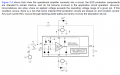
some OpAmps have built in diodes that clamp to supply rails (here taken from OPA2186 datasheet) but one still need to add external TVS or rail voltage may rise uncontrollably:
1753397459140.png
 
Last edited:

ronsimpson

Joined Oct 7, 2019
4,660
" absolute maximum input voltage range " is (in my opinion) much like people's understand of LED voltage. It is not the voltage that kills op-amps input just like it is not the LED's volt that lights them. Current lights the LED and current kills the inputs not voltage.

There are built in diodes on the inputs of most amplifiers. (most ICs of any kind) These diodes are rated for 10mA. (see data sheet) It is too common for people to add diodes to the inputs not knowing that the internal diodes probably turn on first and the external diodes have little current flow.

Add a resistor to the op-amp inputs to limit the current. Any time you have an IC's input (or output) going off the board and off the world, add a current limiting resistor.

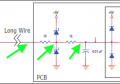
See picture: Right side diodes are internal to the IC. Left side diodes are external.
If you drove directly into the IC, at about 1V beyond the supplies you will reach 10mA.
If you just add the 1K resistor, you will reach 10mA at about 11V beyond the supplies.
If you add all the parts. The first protection is 10 ohms and the external diodes. The voltage at the center green arrow should be limited to only slightly beyond the supplies. The center 1K will limit the current going into the IC to about 1mA. That center resistor is important.

1753397919091.png
Most important thing, add a resistor. (or two)

Next thing to think about is, this limiting current might lift the supplies. If the input is 1A and the entire board consumes 100mA, you have another problem.
 

Ian0

Joined Aug 7, 2020
13,112
Using an NE5532 with ±15V power supplies, you would be very unlucky to get an input signal bigger than that from an audio source, because the audio source will probably be running from a power supply of ±15V or less.
An NE5532 has clamp diodes across its inputs. An RC filter on the input appears to be adequate in most cases to remove any pickup from the input cables. I don't know of many NE5532 failures.
 

Thread Starter

Dr. Heinz Doofenshmirtz

Joined Jun 29, 2025
16
Where is this audio overvoltage coming from?

In general if you keep the voltage no more that 0.6V above the supply rails you should be okay.
That can be done with small Schottky diodes going from the input signal to the rails (along with an input series resistor, of course, to limit the diode current).

Just be aware that Schottky diodes have a small leakage current, higher than standard diodes, that you need to be aware of, as that can cause an offset voltage through the input resistor.
I'm designing a 5V single-supply equalizer. I think 2.5V peak will usually be enough headroom, but it's to my understanding that sometimes audio signals (from DACs, headphone amps, etc.) can come larger. My design at the moment also includes a volume control, that if turned all the way up, might cause an output right at supply level that would enter the next stage (so not immediately overvolting, but possibly cutting it close).

Although I've seen ~0.6V of allowance in datasheets, it's a lot more than I was expecting for cases where the datasheet discourages any overvoltage. Are you able to speak to what assumptions underlie this general case? Or any things that I should look out for indicating that it would be inappropriate to apply this rule of thumb?
 

Thread Starter

Dr. Heinz Doofenshmirtz

Joined Jun 29, 2025
16
supply rails voltage may experience some variations even if regulated. but (unless i am missing something) my question would be - why pick product that works at or near the maximum limits?

some OpAmps have built in diodes that clamp to supply rails (here taken from OPA2186 datasheet) but one still need to add external TVS or rail voltage may rise uncontrollably:
View attachment 353201
I'm designing a 5V single-supply circuit and at the moment I have yet to find an op-amp with the following requirements in conjunction:
1. Comparable noise and price point to NE55532, TL072, LM833, etc.
2. Single-supply compatible with a near rail-to-rail common-mode range at 5V
3. A datasheet allowing inputs to exceed supply voltages by a small amount (thus allowing for protection with Shottkys instead of a precision clamp or similar)
4. A datasheet allowing inputs to exceed supply voltages by a large amount (therefore making input protection a choice)

I might find something that meets the first three requirements if I do a deeper search. But I feel like I'm going to have a lot of trouble finding something that meets all four of these requirements. Please understand that I'm a bit of a newbie so my datasheet scouring skills aren't yet prime.

Besides, since it's so common to see op-amps whose datasheets don't allow inputs to exceed their supply voltages by any amount, I figure it's a good thing to learn to design around.
 

Ian0

Joined Aug 7, 2020
13,112
I'm designing a 5V single-supply equalizer.
Well, you won't be using an NE5532.
There are some low-noise CMOS op-amps, but generally the lowest noise op-amp are designed for ±15V supplies.
To make an op-amp work rail-to-rail at low voltages generally involves running two complementary input stages in parallel, which means 3dB more noise.
If you do use a CMOS op-amp check the 1/f noise corner: it is often much higher than a comparable ±15V supply op-amp, but it will have protection diodes to both rails, so any resistance on the input which would limit the input current to the maximum value permitted in the protection diode will protect it.
However, if you inject too much current through the upper protection diodes you will raise the supply voltage, which may damage things.
There's a reason that most designers use ±15V supplies for audio: headroom. It allows the voltages at intermediate stages to get to +22dBm before anything clips.
 

Thread Starter

Dr. Heinz Doofenshmirtz

Joined Jun 29, 2025
16
@panic mode Taking another look at the OPA2186, it actually does pretty much meet the first 3 requirements, thank you.
@crutschow Thanks. For going within 1V of the rails, which specification are you referring to, by the way? In the datasheet for the LM4562 (TI, Dec. 2013 Revision), I see an absolute maximum input voltage of 0.7V outside of the rails and a common-mode input voltage range of 2.0V inside of the rails. Although I'm not sure if the latter is just for the V_S=+/-15V case.
 

Thread Starter

Dr. Heinz Doofenshmirtz

Joined Jun 29, 2025
16
Well, you won't be using an NE5532.
There are some low-noise CMOS op-amps, but generally the lowest noise op-amp are designed for ±15V supplies.
To make an op-amp work rail-to-rail at low voltages generally involves running two complementary input stages in parallel, which means 3dB more noise.
If you do use a CMOS op-amp check the 1/f noise corner: it is often much higher than a comparable ±15V supply op-amp, but it will have protection diodes to both rails, so any resistance on the input which would limit the input current to the maximum value permitted in the protection diode will protect it.
However, if you inject too much current through the upper protection diodes you will raise the supply voltage, which may damage things.
There's a reason that most designers use ±15V supplies for audio: headroom. It allows the voltages at intermediate stages to get to +22dBm before anything clips.
Well, you won't be using an NE5532.
There are some low-noise CMOS op-amps, but generally the lowest noise op-amp are designed for ±15V supplies.
To make an op-amp work rail-to-rail at low voltages generally involves running two complementary input stages in parallel, which means 3dB more noise.
If you do use a CMOS op-amp check the 1/f noise corner: it is often much higher than a comparable ±15V supply op-amp, but it will have protection diodes to both rails, so any resistance on the input which would limit the input current to the maximum value permitted in the protection diode will protect it.
However, if you inject too much current through the upper protection diodes you will raise the supply voltage, which may damage things.
There's a reason that most designers use ±15V supplies for audio: headroom. It allows the voltages at intermediate stages to get to +22dBm before anything clips.
I see. Do you think +/-2.5V of headroom is okay for a consumer device just meant to tweak levels for listening? Or is it really recommended that I boost or create a negative supply out of my 5V?

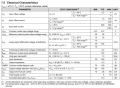
Also, why isn't an NE5532 or similar recommended for low-voltage single supply? Its rated for V_CC+ between 0V and 22V and V_CC- between -22V and 0V. I also thought that the input would be rail to rail since the datasheet says that the minimum common-mode voltage range is +/-12V. But it's possible I misinterpreted this and this figure is only for when the supply voltage is +/-15V.

NE5532 electrical characteristics.png
 

Thread Starter

Dr. Heinz Doofenshmirtz

Joined Jun 29, 2025
16
" absolute maximum input voltage range " is (in my opinion) much like people's understand of LED voltage. It is not the voltage that kills op-amps input just like it is not the LED's volt that lights them. Current lights the LED and current kills the inputs not voltage.

There are built in diodes on the inputs of most amplifiers. (most ICs of any kind) These diodes are rated for 10mA. (see data sheet) It is too common for people to add diodes to the inputs not knowing that the internal diodes probably turn on first and the external diodes have little current flow.

Add a resistor to the op-amp inputs to limit the current. Any time you have an IC's input (or output) going off the board and off the world, add a current limiting resistor.

See picture: Right side diodes are internal to the IC. Left side diodes are external.
If you drove directly into the IC, at about 1V beyond the supplies you will reach 10mA.
If you just add the 1K resistor, you will reach 10mA at about 11V beyond the supplies.
If you add all the parts. The first protection is 10 ohms and the external diodes. The voltage at the center green arrow should be limited to only slightly beyond the supplies. The center 1K will limit the current going into the IC to about 1mA. That center resistor is important.

View attachment 353202
Most important thing, add a resistor. (or two)

Next thing to think about is, this limiting current might lift the supplies. If the input is 1A and the entire board consumes 100mA, you have another problem.
I've got to chew on this a bit more, but thank you, this is some really great info.

To clarify, are you saying that I/O voltage limits don't really matter at all as long as the current specifications are respected?

Or if not, is it okay to exceed the limits by 0.7V or so (again as long as the current specs are respected)?
 

Ian0

Joined Aug 7, 2020
13,112
I see. Do you think +/-2.5V of headroom is okay for a consumer device just meant to tweak levels for listening? Or is it really recommended that I boost or create a negative supply out of my 5V?

Also, why isn't an NE5532 or similar recommended for low-voltage single supply? Its rated for V_CC+ between 0V and 22V and V_CC- between -22V and 0V. I also thought that the input would be rail to rail since the datasheet says that the minimum common-mode voltage range is +/-12V. But it's possible I misinterpreted this and this figure is only for when the supply voltage is +/-15V.

View attachment 353223
Common mode input voltage range is ±12V on a ±15V supply. From that you can surmise that it runs out of common mode input voltage range when it gets closer to either supply than 3V.
0 to 22V is the Absolute Maximum rating. All that tells you is that if you use it beyond ±22V you are likely to kill it, and that is doesn't like its positive supply below 0V nor its negative supply above 0V.
The parameter you need is Recommended Operating Conditions which is between ±5V and ±15V.
 

ronsimpson

Joined Oct 7, 2019
4,660
To clarify, are you saying that I/O voltage limits don't really matter at all as long as the current specifications are respected?
There are two 10mA diodes in the inputs. When the current is too much the diodes shorts. (melts down) The diodes overheat and die. These diodes might be 5 to 10mW diodes. (on_voltage X Current = Watts)
I know the data sheet is in volts beyond supply, but the diodes fail by heat. There can't be heat without current and voltage.

I wish the data sheets would say "input current of <10mA". (The data sheet does often say that but not clearly)
I wish the data sheets would say "one diode drop beyond the supply voltages".
I wish the input diodes had a data sheet with normal diode ratings. Some amplifiers actually almost have that. Capacitance, current, leakage current, forward voltage vs current, etc.

I have seen comments like "max input voltage +12.7V to -0.7V. Then there is a foot note somewhere that never gets read saying that the supply is 0V and 12V. I think this is a wrong way.
 
Last edited:

Ian0

Joined Aug 7, 2020
13,112
I wish the input diodes had a data sheet with normal diode ratings. Some amplifiers actually almost have that. Capacitance, current, leakage current, forward voltage vs current, etc.
Short term current ratings for the protection diodes would be good. e.g. 1us, 10us, 1ms
 

Thread Starter

Dr. Heinz Doofenshmirtz

Joined Jun 29, 2025
16
Okay I just want to thank everyone who's given their input--I understand the input protection stuff now and also I've learned how to find op-amps that actually meet my requirements (unlike the NE5532, seriously thank you @Ian0 for pointing out that it wouldn't work). Turns out the secret is just to skip Octopart and Digikey and use the filters on the manufacturers' websites. I've found a few options now and I'll have to double check but I think the OPA2377 will work best for me.

Currently 81 US cents/amp at Digikey, it allows for supply voltages between 2.2V and 5.5V, voltage noise density is 7.5nV/sqrt(Hz) at 1kHZ, inputs are rated 0.5V above their rails, and max input current is +/-10 mA. The datasheet doesn't have detailed info about the diode ratings but it does have a footnote explaining that you can go over the voltage rating if you respect the current, so that's something.

I also think some interesting mentions are the mcp6292 and mcp6L92. Currently 48 and 55 US cents/amp respectively at Digikey, they allow for supply voltages between 2.4V and 6V and voltage noise density is 8.7nV/sqrt(Hz) at 10kHz. From Microchip, their inputs are rated to go 1V above the supplies but the max input current is 2mA. What's interesting is TI also makes the mcp6292 but they rate the voltage at 0.5V above the supplies with a max input current of 10mA.
 

Ian0

Joined Aug 7, 2020
13,112
Okay I just want to thank everyone who's given their input--I understand the input protection stuff now and also I've learned how to find op-amps that actually meet my requirements (unlike the NE5532, seriously thank you @Ian0 for pointing out that it wouldn't work). Turns out the secret is just to skip Octopart and Digikey and use the filters on the manufacturers' websites. I've found a few options now and I'll have to double check but I think the OPA2377 will work best for me.

Currently 81 US cents/amp at Digikey, it allows for supply voltages between 2.2V and 5.5V, voltage noise density is 7.5nV/sqrt(Hz) at 1kHZ, inputs are rated 0.5V above their rails, and max input current is +/-10 mA. The datasheet doesn't have detailed info about the diode ratings but it does have a footnote explaining that you can go over the voltage rating if you respect the current, so that's something.

I also think some interesting mentions are the mcp6292 and mcp6L92. Currently 48 and 55 US cents/amp respectively at Digikey, they allow for supply voltages between 2.4V and 6V and voltage noise density is 8.7nV/sqrt(Hz) at 10kHz. From Microchip, their inputs are rated to go 1V above the supplies but the max input current is 2mA. What's interesting is TI also makes the mcp6292 but they rate the voltage at 0.5V above the supplies with a max input current of 10mA.
Don't forget to check that your choice of op-amp has enough output current for the job. Fortunately OPA2377 is pretty good in that respect. I once decided to use a TLV4333 because of its DC accuracy, but it's output current capability was rubbish.

Microchip is good enough to give you a circuit diagram of the input protection (fig. 4.2) so you can actually see why the figures come from. There is a series resistor and a diode to the positive supply. Texas doesn't tell you this.

One point I would make about the MCP6292 and its suitability for audio is its 1/f noise corner, which is a decade higher than the NE5532 and OPA2377.

Also, when considering noise, don't forget to check the current noise. As you have looked at FET input amplifier it won't generally be a problem, but if you choose a really low noise bipolar op-amp for a job with a high source impedance you'll come unstuck if you don't check the current noise.
 
Top