Op amp, I want to use LM358

Thread Starter

monika.duccoli

Joined Jan 12, 2024
72
hi I should amplify a signal in the range between -1.5 V and -1, into an output signal between 0 and 5 V, using amplifiers.
with the frequency response which must have a low pass characteristic with the cut-off frequency equal to 40kHz.
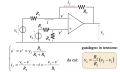
I wanted to create this circuit with 3 stages but it is complicated, the overall gain must be -10 V/V.
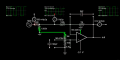
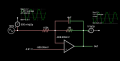
in the first stage I wanted to put a buffer, in the second a low-pass filter with RC in parallel, and in the third I wanted to put a summing amplifier to obtain the desired gain.
To do this I wanted to use LM358, in your opinion it could be an idea.
I need help with the calculations
 

tonyStewart

Joined May 8, 2012
231
Given: Input -1.5 to -1 V, Output 0 to 5V, gain = -10
(edit) You cannot achieve 0 to 5=Vou with Vcc=5V on any BJT style Op Amp. Thus either choose CMOS or reduce swing to 3V.,

Average = -1.25V=in, 2.5V=out therefore offset = 2.5+1.25= 3.75V (depending on above changes)
Range = 0.5Vpp in and 5.0Vpp out from your gain design spec.

LM358 inputs must be within 0 and 3V for supplies=5, 0 V so a Vref of 3.75 is too high over the whole temp range but if we attenuate the input then add gain to compensate, we can reduce the offset to 3V.

1706283337813.png

Thus attenuation = 3/3.75= 0.8 and gain becomes 1/0.8=12.5 to restore Vpp.

Can you now design R values for attenuation and gain using Vref+ = Voffset/attenuation?
You will need to know or specify source impedance up to 40 kHz AND a negative Vref. What is avail?

This can all be done with filtering in one stage. BTW the LM358B is a better choice than LM358, but CMOS is best.

However you cannot achieve 0 to 5V out with an LM358B nor with the gain you specified. So some other offset is required and the output swing is about 0 to 3.5V out unless you choose a Rail to Rail type CMOS Op Amp.


1706285291093.png

So you must change your design constraints.

You must also specify tolerances on output gain and offset as any reference errors will be amplified by your gain as an output offset error.
 
Last edited:

Thread Starter

monika.duccoli

Joined Jan 12, 2024
72
my v1 is the signal between -1.5 and -1 V, my v2 is 3.75 V, the Vo is a signal between 0 and 5 V, I should size the resistors in such a way as to have a gain of 10 V/ V, right?
perè devo tener conto anche della stadio in cui ho una caratteristica passa basso
however I also have to take into account the stage in which I have a low pass characteristic
 

schmitt trigger

Joined Jul 12, 2010
2,036
At 40 Khz the LM358 doesn’t have the necessary bandwidth-gain product to output a 5 Vpk-pk signal. If you want to stick with low-cost, ubiquitous opamps, then use a TL072.

And before anyone complains, I know the TL072 is not a RRIO opamp. But with the -1.5 input and 5.0 output, he would still require a bipolar supply, regardless of the selected opamp. Thus use something like +/-9V, which can be achieved with a pair of low cost and ubiquitous PP3 batteries.
 

Ian0

Joined Aug 7, 2020
13,100
You want to use the LM358? You poor misguided soul!
There has has been half a century of improvements in op-amp design since the LM358 arrived on the scene.
 

Ian0

Joined Aug 7, 2020
13,100
I can use only OP07, AU741 , MCP6292 and LM358
MCP6292 is the only one that will still have useful amounts of gain at 40kHz, but you are limited to a single 5V supply.
The OP07 is very high precision, but it is not fast, and needs ±15V supplies.
MCP6292 is fast, low-current, but not too precise and only works up to 5V
LM358 is cheap (nothing much else in its favour). It is neither accurate or fast, but will work off a large range of supply voltages.
I can't think of anything good to say about the 741.
 

tonyStewart

Joined May 8, 2012
231
All these constraints on a poor little M358 make your tolerance costs go up on Vref or Vcc

Even an LM741 has bigger swing. You have not defined your budget or tolerances.
Limiting your choices of Op Amps is a severe limit unless you do not care about tolerances.
 

tonyStewart

Joined May 8, 2012
231
This is the best I could do with 0.1% 5V and 0.1% resistor with a gain of 5 and 2.5Vpp out.
And that uses a small negative Vee since Vol is 100mV max
1706290306784.png
 

tonyStewart

Joined May 8, 2012
231
Explain why you are limited on choices with your specs for tolerances.

Of those, your best choice is the
MCP6292
• Gain bandwidth product: 10-MHz typical
• Operating supply voltage: 2.4 V to 5.5 V

What do you have for a -Vref?
 
Last edited:

Thread Starter

monika.duccoli

Joined Jan 12, 2024
72
Explain why you are limited on choices with your specs for tolerances.

Of those, your best choice is the
MCP6292
• Gain bandwidth product: 10-MHz typical
• Operating supply voltage: 2.4 V to 5.5 V

What do you have for a -Vref?
they are limited because I only have these opamps and LM358 seemed like a good choice,
but did I set the calculations correctly to start the project?
 

tonyStewart

Joined May 8, 2012
231
here there is some calculus there is something wrong
Hi Monika,

I read your calculations. I see a couple of things.
Always compute with results for gain and offset. In your last stage you are doing both gain and offset and I believe your offset is incorrect in the last stage.

1. If you have an input offset of -1.25 and a end-gain of 10, the last stage non-inverting gain will be 1+|Av-| times your Vref attenuation.

2. Every resistor adds up to your worst case errors for gain and offset in high volume production. So we use tolerance specs and minimize the number of resistors used that affect errors. You have 3 stages with 8 resistors in ratios, so if you used 1% then you get 8% "tolerance stackup" error. Now your hypothetical 12 bit ADC with 4096 steps is reduced to 125 steps of equivalent quantization accuracy worst-case. So remember to consider tolerances required which includes internal bias currents and offsets

3. If you say 40kHz is that 1st order -3dB or 2nd order or you want full swing at 40kHz sine. I might assume just 70.7% amplitude at 40 kHz but lab questions are often just simplified.

4. Gain is easy. 10=Rf/Rin for inverting input using 1M/100k,, 9pF*1Meg = 9 us and BW(-3dB)=0.35/T(10 to 90% _/ ) ~ 0.25/RC
so C = 0.25/Rf*40kHz = 5pF. With stray capacitance over a ground plane you might subtract 1pF for the Rf path and use 4pF. (Your lab support might know this or not) This Op Amp has GBW =10 MHz so no problems here.

5. Offset correction: (-1.25)in * Av- = Voo=12.5V so to correct this for output offset of 2.5V we must reduce the Voo offset by 10V using Av+ =11 and we obtain Vin+ = 0.90909 V Choose any R ratio from your stable -10V or any suitable -Vref.
 
Top