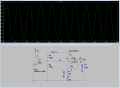
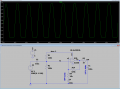
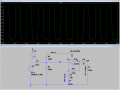
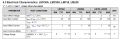
I have this simulation of an LM358 with a HPF and LPF on both sides. I'd like to look at the common mode voltage rejection of the LM358. It should be Vcc-1.7. How would I see this?
Do you want to look at the voltage rejection (its ability to ignore changes in common-mode voltage) or the actual voltage?
The common-move voltage is just V1 or V3 (which should be essentially equal if the op amp is in its linear region), so just run a .op (DC Op Pnt) simulation.
I'd like to send it a sine wave that max peak exceeds 3.3v and look at it's response. I'm wanting to use this to limit the signal into an esp32. Powering the LM358 off 5v, knowing that it shouldn't output anything more than 3v3 which is the limit of the input to an exp32. I don't think that's the .op, it just shows the dc voltages.
I'd like to send it a sine wave that max peak exceeds 3.3v and look at it's response. I'm wanting to use this to limit the signal into an esp32. Powering the LM358 off 5v, knowing that it shouldn't output anything more than 3v3 which is the limit of the input to an exp32. I don't think that's the .op, it just shows the dc voltages.
Okay, now you are asking for something completely different from what I understand in your first post.
This question has nothing to do with common-mode rejection.
So just change V3 to a sinewave of the desired frequency and amplitude, and then do a transient response for a time to show a few cycles of the sinewave.
The datasheet or model may assume a particular output current. Try with a greater load, e.g. short out C1 temporarily and see what the op-amp output node voltage is.
What is the voltage that is common to the (+) and (-) inputs of your op amp? In your case that voltage is primarily determined by the DC voltage you bias the (+) input with, which depends upon Vcc and the ratio R1/R2. This voltage, incl. the AC voltage applied at the input of the amplifier, floating on top of the DC bias voltage, should never leave the CM voltage range (0...3.5V @ Vcc=5V) stated in the datasheet.
The output clipping levels depend upon the specs of the output stage. If you are looking for a more symmetrical clipping, raise the level of the input bias voltage (R1/R2 ratio) somewhat until you are satisfied with the outcome.

 Facebook
 Google
 GitHub
 Linkedin