Need ideas for circuit given some characteristics

Thread Starter

userhangaar

Joined Sep 16, 2024
12
Hello AAC,

I have a laboratory requirement about making a circuit with the following characteristics:
  • With good variety of components (Say, 12 unique components, but there is no specific number)
  • With 741/358 and/or a 555 timer
  • With 3 analog sensing elements (Say, a LDR)
  • No microcontrollers
  • No need for a sensible purpose, as long as individual parts are technically justifiable

I have ideas about a 741 comparator with a LDR and thermistor on each input, but this only has 2 sensing elements (3 if I count a potentiometer as one for displacement) and maybe ~7 unique parts (i.e. 741, LDR, thermistor, potentiometer, resistors, LED, battery). I don't have experience with using capacitors, diodes, transistors, or relays purposefully, but I reckon they have a place in this circuit.

Please help me get things moving through discussions and suggestions. Thanks. ☺
 

dl324

Joined Mar 30, 2015
18,216
Welcome to AAC!

Unless you're required to use a LM741, I wouldn't. It was a fine opamp when it was first designed (and still is if you know how to use it), but there are too many limitations for newbies. LM358 is about as old as LM741, but I still use it unless something better is needed. Unless you're not allowed to use comparators, don't use an opamp as a comparator.

What types of things have you learned about? What are you interested in pursuing further?

There was a recent thread on using a thermistor and comparators as a thermometer that might give you some ideas. There was some discussion about making the thermistor resistance more linear. I suggested using a transistor junction as the sensor.
 

Thread Starter

userhangaar

Joined Sep 16, 2024
12
I should add another characteristic:
  • With DC inputs/power only

Unless you're required to use a LM741, I wouldn't.
We are required to use either a 741 or a NE555, but not necessarily as a comparator. That said, we are allowed to use comparators so long as there is a 741/NE555 elsewhere in the circuit

dl324 said:
What types of things have you learned about? What are you interested in pursuing further?
Realistically, I just want to meet the requirements as simply as I can. Though, I do want to use capacitors and semiconductors purposefully this time. I've used capacitors for filtering in an AC-DC power supply, but it was mostly just following schematics and less actually understanding of what they do. For semiconductors, I had immense trouble passing my transistors class and am still not familiar with their operation, so I definitely want to use those as well

dl324 said:
There was a recent thread on using a thermistor and comparators as a thermometer that might give you some ideas.
Thanks for the lead! I browsed the thread until I couldn't understand anything anymore, and here's what I got from it: you can use a transistor in place of a thermistor as a heat sensing element, because the increase in Vbe is more linear than the resistance change in thermistors. How correct/enough is this?

I do want to say, after looking at your circuit/s from that thread, that I might not know enough about circuits to calibrate or troubleshoot by switching out different values of certain components to give an output for, say, a specific temperature
 

dl324

Joined Mar 30, 2015
18,216
We are required to use either a 741 or a NE555, but not necessarily as a comparator. That said, we are allowed to use comparators so long as there is a 741/NE555 elsewhere in the circuit
Are there any restrictions on the voltages you can use for power supplies?
I do want to use capacitors and semiconductors purposefully this time. I've used capacitors for filtering in an AC-DC power supply, but it was mostly just following schematics and less actually understanding of what they do.
You're going to have to use a few capacitors if you use a NE555.
For semiconductors, I had immense trouble passing my transistors class and am still not familiar with their operation, so I definitely want to use those as well
Do you want to use them as a switch? Or an amplifier?
I browsed the thread until I couldn't understand anything anymore, and here's what I got from it: you can use a transistor in place of a thermistor as a heat sensing element, because the increase in Vbe is more linear than the resistance change in thermistors. How correct/enough is this?
The change in Vbe is linear, but determining what the temperature coefficient is takes more than simply referring to a datasheet. I took references to the temperature coefficient as correct for all conditions and, until working on circuits for that thread, didn't realize it changed so much with current. The BC457 datasheet I referenced gave some typical values for different currents. That was the only datasheet that gave any meaningful data (checked 2N3904 and 2N3096 too, even Texas Instruments didn't have any data). Picking the wrong value and not measuring temperature correctly complicate things further.
 

MrChips

Joined Oct 2, 2009
34,626
Here are two ideas:

1) A robot that follows a white line on the floor

2) Transmission and reception of sound signal using a light beam.
 

Thread Starter

userhangaar

Joined Sep 16, 2024
12
Do you want to use them as a switch? Or an amplifier?
An amplifier

Here are two ideas:

1) A robot that follows a white line on the floor

2) Transmission and reception of sound signal using a light beam.
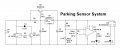
Thank you for the suggestions, but I'll save them for future projects. I ended up going with a garage/parking sensor system of sorts. Below is the schematic.

I've breadboarded this without the regulator current booster and struggled with powering the comparator and IR sensor portions of the circuit. I'm still waiting for the TIP2955. In the meantime, are there any obvious flaws in this circuit? I'm positive there are many so I was hoping to hear your thoughts

1726929705540.png
 

dl324

Joined Mar 30, 2015
18,216
In the meantime, are there any obvious flaws in this circuit?
Why do you think you need an external pass transistor on the voltage regulator? You can get LM7805 that can handle 1A.

Take a closer look at LED1 (compare to the other LEDs) and C1 (if the power source is actually a 9V battery). Read the datasheet for the voltage regulator to see what they recommend for caps on the input and output.

Have you determined what range of voltages you'll have on the inputs to the LM741 and the range that it will actually allow?
 

Thread Starter

userhangaar

Joined Sep 16, 2024
12
Why do you think you need an external pass transistor on the voltage regulator? You can get LM7805 that can handle 1A.

Take a closer look at LED1 (compare to the other LEDs) and C1 (if the power source is actually a 9V battery). Read the datasheet for the voltage regulator to see what they recommend for caps on the input and output.

Have you determined what range of voltages you'll have on the inputs to the LM741 and the range that it will actually allow?
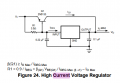
Thanks. It might be the 5V supply causing the LM741 to not work, since I recall the IR circuit working well and reading somewhere that +-15V is used in most 741 performance values. As for the capacitor values, I'll look into the one below from the datsheet. Thanks for the heads up.

As for LED1 and C1, can I ask for more clues? I reckon the LED1 is missing the resistor, but I'm blank on C1; Is it because a battery voltage shouldn't need an input capacitor?

1726932655402.png
 
Last edited:

dl324

Joined Mar 30, 2015
18,216
It might be the 5V supply causing the LM741 to not work
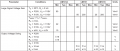
Read the section of the datasheet about common mode input voltage and output voltage swing and you'll see why using a 741 from a single low voltage supply can be problematic.

From National Semiconductor (this is using +/- 15V supplies:
1726933541152.png
1726933632286.png

I'm blank on C1; Is it because a battery voltage shouldn't need an input capacitor?
That's my thinking. Unless your 9V battery is one of those Li-ion things with an internal voltage regulator, there shouldn't be any source of "ripple" from the battery.

Incidentally, I don't recommend buying any of the 9V batteries I mentioned. I bought some to see what all of the fuss was about, and it turned out to be a waste of money. They self-discharge in about a month and the capacities are vastly overstated. And then there's the output ripple. Nice idea, but poorly implemented.
 

Thread Starter

userhangaar

Joined Sep 16, 2024
12
Read the section of the datasheet about common mode input voltage and output voltage swing and you'll see why using a 741 from a single low voltage supply can be problematic.

From National Semiconductor (this is using +/- 15V supplies:
View attachment 332164
View attachment 332165


That's my thinking. Unless your 9V battery is one of those Li-ion things with an internal voltage regulator, there shouldn't be any source of "ripple" from the battery.

Incidentally, I don't recommend buying any of the 9V batteries I mentioned. I bought some to see what all of the fuss was about, and it turned out to be a waste of money. They self-discharge in about a month and the capacities are vastly overstated. And then there's the output ripple. Nice idea, but poorly implemented.
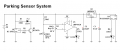
Is this better? I kept the ripple capacitors around the regulator because now that I'll use the 9V battery for the op-amp, I'll likely use my noisy cheap-o bench supply for the rest of the circuit. At the moment, I don't have a way to power the op-amp above 9V but I'll figure something out if a 9V battery doesnt work

1726934150147.png
 
Top