Facebook
 Google
 GitHub
 Linkedin

Im experimenting with a NTC thermistor that is looking exactly like this: 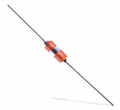 I have them brand new for awhile for different values. The cct works fine but it is shifting the temperature reading left or right and this is a big error that I partially close my eyes to it but I want another better and stable solution than this sh*t.
- I tested the cct back and forth and the conclusions lead me that this thermistor is the sh*t that is actually shifting, and not some other component in the cct. I even put long wires in the idea that temperature of the diode legs might interfere with the input reading. It is not the legs. And many other experiments, and nothing, no remedy or explanation of the shifting.
- I read that a simple 1N4148 might play a very secure thermistor role. I haven't test it yet.
I found these 4 categories:
1. Negative Temperature Coefficient (NTC) thermistor
2. Resistance Temperature Detector (RTD)
3. Thermocouples
4. Semiconductor-based temperature sensors (with the 1N4148)
- I want your input about this subject... your experience, what do you think is best to test for-- stability-- and --precise-- temperature reading. Without any kind of drifting. Or at least how to combat the drifting?
I used a 2k thermistor instead of that 100k.
---
With this occasion I discovered an inconvenience.
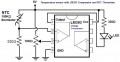
You can observe in the cct here, that the LED is powered from the (+)5V rail and surging into the Output pin1 of the LM393.
- LM393 is having a floating state on the output and a negative one when is triggered from its inputs. It does not have a positive output state at all. Some people here suggested this IC to buy, but they didn't tell me at all about this very important detail. I assume probably like me, they are also shocked by this details for the first time too. I also looked into LM393 datasheet and indeed it is having a single NPN (T8) on its output, otherwise stays floating. I presumed its like a 555 with + and - states on the output. What a waste of money. This will be good only to drive very small signals. I just tested with 1k to +VCC on its output pin and a LED surging to 0V rail. The LED is powered by the 1k and shut off when output goes to 0V. The led must be sensitive enough to lit up from 1k or even 10k. It's an annoyance to remember from now on to add that 1k to (+) on its output every time. It's only a single resistor to remember to add after all. I searched for other comparator ICs that has the 'normal' (+) and (-) output switch. I already got a suggestion for TLC3702 or the TLV1812. They are 1$ per 1pcs or some offers of 10pcs at 5$. Not that cheap. The idea is to get 100pcs at about 1to5$ like these LM393. See if you can find something better price/quantity/quality. If possible.
---
And back to the circuit, I already build 4 ccts in my simulator, that are using 1 single NTC thermistor sensor, and 4 or 6 comparators that are reading it. They will lit up a led for 30,40,50,60,70,80*C. The last cct I made is the best in tweaking the values and I got very good results in simulator. But in reality...a ton of drifting and way more errors than I expected. For some reason this turns out to be a very hard project. Thats why Im coming to you.
Here is the last cct I made and it is very easy to tweak (the other ccts before this, were extremely hard to tweak - trust my word).
That voltage on the (+) input, theoretically, I can tweak it from a voltage divider with 2 resistors.
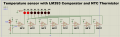
In reality, the measured and expected resistor values, didnt worked at all. Possibly because of the drifting problem?!?
I only tested with 1 comparator, and with very bad results and bad luck.
- I dont think is the fault of the comparator. I think is the heat sensor, drifting up when Im increasing the temp and drifting down when Im decreasing the temp. I also think the resistors in the cct are influenced by the temperature and further skewing the result.
I looked for other temperature sensors and there are 4 types, while mine, are between the good ones. I have no idea what to do.
- Lets see, maybe you guys have a better, more consacrated circuit than mine here? Mine maybe is too experimental? It might be that too, a reason for why is not working.
Thank you.
I have them brand new for awhile for different values. The cct works fine but it is shifting the temperature reading left or right and this is a big error that I partially close my eyes to it but I want another better and stable solution than this sh*t.- I tested the cct back and forth and the conclusions lead me that this thermistor is the sh*t that is actually shifting, and not some other component in the cct. I even put long wires in the idea that temperature of the diode legs might interfere with the input reading. It is not the legs. And many other experiments, and nothing, no remedy or explanation of the shifting.
- I read that a simple 1N4148 might play a very secure thermistor role. I haven't test it yet.
I found these 4 categories:
1. Negative Temperature Coefficient (NTC) thermistor
2. Resistance Temperature Detector (RTD)
3. Thermocouples
4. Semiconductor-based temperature sensors (with the 1N4148)
- I want your input about this subject... your experience, what do you think is best to test for-- stability-- and --precise-- temperature reading. Without any kind of drifting. Or at least how to combat the drifting?
I used a 2k thermistor instead of that 100k.
---
With this occasion I discovered an inconvenience.
You can observe in the cct here, that the LED is powered from the (+)5V rail and surging into the Output pin1 of the LM393.
- LM393 is having a floating state on the output and a negative one when is triggered from its inputs. It does not have a positive output state at all. Some people here suggested this IC to buy, but they didn't tell me at all about this very important detail. I assume probably like me, they are also shocked by this details for the first time too. I also looked into LM393 datasheet and indeed it is having a single NPN (T8) on its output, otherwise stays floating. I presumed its like a 555 with + and - states on the output. What a waste of money. This will be good only to drive very small signals. I just tested with 1k to +VCC on its output pin and a LED surging to 0V rail. The LED is powered by the 1k and shut off when output goes to 0V. The led must be sensitive enough to lit up from 1k or even 10k. It's an annoyance to remember from now on to add that 1k to (+) on its output every time. It's only a single resistor to remember to add after all. I searched for other comparator ICs that has the 'normal' (+) and (-) output switch. I already got a suggestion for TLC3702 or the TLV1812. They are 1$ per 1pcs or some offers of 10pcs at 5$. Not that cheap. The idea is to get 100pcs at about 1to5$ like these LM393. See if you can find something better price/quantity/quality. If possible.
---
And back to the circuit, I already build 4 ccts in my simulator, that are using 1 single NTC thermistor sensor, and 4 or 6 comparators that are reading it. They will lit up a led for 30,40,50,60,70,80*C. The last cct I made is the best in tweaking the values and I got very good results in simulator. But in reality...a ton of drifting and way more errors than I expected. For some reason this turns out to be a very hard project. Thats why Im coming to you.
Here is the last cct I made and it is very easy to tweak (the other ccts before this, were extremely hard to tweak - trust my word).
That voltage on the (+) input, theoretically, I can tweak it from a voltage divider with 2 resistors.
In reality, the measured and expected resistor values, didnt worked at all. Possibly because of the drifting problem?!?
I only tested with 1 comparator, and with very bad results and bad luck.
- I dont think is the fault of the comparator. I think is the heat sensor, drifting up when Im increasing the temp and drifting down when Im decreasing the temp. I also think the resistors in the cct are influenced by the temperature and further skewing the result.
I looked for other temperature sensors and there are 4 types, while mine, are between the good ones. I have no idea what to do.
- Lets see, maybe you guys have a better, more consacrated circuit than mine here? Mine maybe is too experimental? It might be that too, a reason for why is not working.
Thank you.
Last edited: