mechanism to shutdown feeding when sensor temperature rises

Thread Starter

yef smith

Joined Aug 2, 2020
1,445
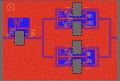
Hello ,I am building a system which is biasing 5 amplifiers as shown below in the link.

each amplifier can take 16A so at peak I will use 80A.So I need to supply from a single source 80A.
I need to think of an analog mechanism which would sense the temperature convert it to votage and shut down the main current source when things will be too hot.

few questions:
1. what sensor component you reccomend to use ?

2.where should I place them ?

3.I am using the connector shown in the link to use some kind of "relay" to shutdown if needed.

I have another +-12V source which I could try and create some reference and compare voltage temperature .
What analoh mechanism you reccomend to implement such idea?
Thanks.

https://cdn.macom.com/datasheets/CGHV1A250F.pdf

https://www.digikey.com/en/products/detail/molex/0705450038/1643377
Hello ,I am building a system which is biasing 5 amplifiers as shown below in the link.

each amplifier can take 16A so at peak I will use 80A.So I need to supply from a single source 80A.
I need to think of an analog mechanism which would sense the temperature convert it to votage and shut down the main current source when things will be too hot.

few questions:
1. what sensor component you reccomend to use ?

2.where should I place them ?

3.I am using the connector shown in the link to use some kind of "relay" to shutdown if needed.

I have another +-12V source which I could try and create some reference and compare voltage temperature .
What analoh mechanism you reccomend to implement such idea?
Thanks.

https://cdn.macom.com/datasheets/CGHV1A250F.pdf

https://www.digikey.com/en/products/detail/molex/0705450038/1643377

1764533311702.png
 

ronsimpson

Joined Oct 7, 2019
4,645
I think you have 4 amps driving an antenna or something. The first amp is just to get some gain.
Amp-1 probably will never see a strange load, and you probably do not need to know its temperature.
The last 4 amps might see a short or open. They probably will see bad SWR at some point. If you are going to use one sensor, put it in the middle of the board to pick up heat from the two center amps. They will be the hottest.

You can use an IC like MCP9509/10. Then use a transistor and relay to kill the power.
T-resistor Here are resistors that change value with temp. You will need a voltage comparator and relay.

I understand you want to kill the power to the amps at high temp. 80A is a lot of current to switch. You might find a way to shut down the power supply using a "TTL level signal". That might save you money.
 

Thread Starter

yef smith

Joined Aug 2, 2020
1,445
Hello ronsimpson, what relay you reccomend to use to shut the current?
Could you reccomend a circuit so I could try to simulate it?
Thanks.
 

wayneh

Joined Sep 9, 2010
18,085
1. what sensor component you reccomend to use ?
I've used the LM35 with a (dual) comparator such as LM393 to function together as a thermostat. On the other hand, most commercial appliances use a thermal fuse as the final step of protection. They can be resettable but usually are single use when used in that way, as a backup to whatever normally does the switching.
2.where should I place them ?
I'd place them where you think the weakest link is, the thing most likely to fail due to thermal overload. I can't tell if that's your main supply or the individual amplifiers.
3.I am using the connector shown in the link to use some kind of "relay" to shutdown if needed.
This is unclear. I don't think that connector can handle 80A, or even 16A, if that's what you mean. I have the same concern about the traces on your PCB.
I have another +-12V source which I could try and create some reference and compare voltage temperature .
Your call. A battery is another option. You don't need a negative supply, if that helps. If you end up using a relay (it'll be a big and expensive one), whatever you use to power that would be a logical choice for powering the thermostat. As @ronsimpson has suggested, switching something other than the main current circuit may be possible and much cheaper to implement.

What do you want all this to do in case of thermal overload, shut off until manually reset? Turn back on when it has cooled off?
 
Last edited:

panic mode

Joined Oct 10, 2011
4,864
the connection is just a pin header... in general they are meant for up to some 3A. relays are robust option but not the only option. response time is not too much of a concern since thermal response is slow but - this is cumulative with sensor response time. some sensors are reacting particularly slow such as general purpose thermistors (some 10 seconds or so). thermistors are nice because they are so stable. response time can be improved if bead is smaller and one using special type for faster response. that should get you to about 1 sec. normally for fast response one would consider thermocouple or IR. nice thing with IR is that does not need to be in contact with target. .
 

Thread Starter

yef smith

Joined Aug 2, 2020
1,445
Hello , I understand that the pulse will be 100ns so it will not affect the system.I need to sense the temperature rise with because of quecent current which is much low.
Using LM35 and compartator and relay I need to shut down the current.
The current consumption in total with a little extra is 7.5A 50V.
I have found a relay component shown below.
What relay circuit you reccomend to shut the current?

https://www.digikey.dk/en/products/...CqAvqwDyqALK502AK49cYwgFoE0BVF73VJSOQArIyioUA
 

panic mode

Joined Oct 10, 2011
4,864
if the current is up to 80A, you will want relay that can handle more (G9KB-1A-E DC24 or similar).
to simulate overtemperature, just interrupt coil circuit using toggle switch for example. if this works to your liking, build comparator circuit with temperature sensor to drive it.
 

Thread Starter

yef smith

Joined Aug 2, 2020
1,445
Hello , No no I was mistaken , the amplifier has 1A quecent current and 16A for pulses of 100ns.
I understand that I need to dissregard of the 100ns 16A phase and focus on 1A continues phase.
I am thinking a using a FET device instead of a relay .like the mosfet shown below.
I will shut the current down with it.
The problem is that its a semiconductor device,and I am afraind it will not last for long it will heat up itself and burn.
Can I use such mosfet?or is there other mosfet with is more suitable?
Thanks.

https://eu.mouser.com/ProductDetail...MIkaXVxv2gkQMVKctEBx3MFhADEAAYASAAEgIR6fD_BwE
 

Thread Starter

yef smith

Joined Aug 2, 2020
1,445
UPDATE:
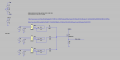
Hello, I have tried another idea where I will use a mosfet to turn on and off the current.
I put several comparators to simulate and situation where I need to cutoff the power.
I connected outputs of comperator to LED because I will see where is the problem and LED has high Vf so it wont turn on for no reason.
The problem with this when I connect the other ends of the LED's to the mosfet gate then the mosfet is not opening .
Where did I go wrong? how can I make the LED output to open the gate of the mosfet?
simulation files and photos are attached.

1764765403581.png
 

Attachments

ronsimpson

Joined Oct 7, 2019
4,645
On "electro-tech-online.com" we commented on the many pieces that do not work
---------------------------------------------------------------------------------------------
The output of the LM339 is 0 to12V. (actually slightly less than that)

The way you are using the MOSFET the Gate needs to go from 0V to 65 volts. A MOSFET does not care that the voltage on the Gate is, but it can only see the Gate to Source voltage. You want a Source voltage of 50V so you need 65V to get it on well. To put 80A through this part you need a G-S voltage of 10V min and rally 15V is better. At 80A you will lose about 1V across the D-S. 50V will become 49V.

There is no turn off function.

Do you want the LEDs to light? Those will not.

If you are going to drive an MOSFET like that here is an option.
TLP3905
There is a Solid State Relay which has no moving parts. They use a Photovoltaic Optoisolators to drive the MOSFET.
Digikey
You probably want a Photovoltaic Isolator that outputs at least 10V.
OR
You could look at Solid State Relay which will have all functions you want.
 
Last edited:
Top