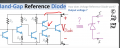
Hello , In the manual shown in the link the author says that the point I sighed in red arrow is floating at 2:46 and 32:20 time of the video.
How is this floating happening?
for me floating is when we dont ha a load.
Thanks.
Sorry at 2:46 he says that the node I was talking about is a “float node”
Later in 32:20 he talks about it more .
Could you please explain the mechanism of this node ?
Thanks.
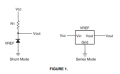
Series and Shunt Mode Operation First, voltage references are designed to operate in either series mode or shunt mode as shown in Figure 1.
Shunt mode references are typically less accurate than Series mode, but require lower operating current. They can be operated from very high input voltage (Vcc) because only the resistor R1 sees the high voltage. Shunt references can be used to generate negative reference voltages or a reference voltage that is floating between potentials.
Usually for voltage references, a floating reference is a voltage not referenced to ground. Not sure what the video is explaining as I didn't watch much of it.
Without looking too closely, here is my 2 cents that's likely wrong in some stupid way. You have a series pass transistor Vdiode that can be OFF (open switch) or ON (closed switch) conducting depending on the base input voltage coming from those stacked transistors before Vdiode that I assume acts as a floating reference (not to ground but to +/- across Vdiode) that can drive Vdiode into conduction (ON). at some voltage, at varying currents, much like a Zener diode.
This concept is intresting because potential is always has to be with reference to somthing.
suppose in bjt Vbe needs to be 0.7 to open ,so base needs to be 0.7 larger then Vbe.
What is the meaning of floating in this issue?
Why there is no reference to the potential of the red node?
Thanks.
"those stacked transistors before Vdiode that I assume acts as a floating reference"
This concept is intresting because potential is always has to be with reference to somthing.
suppose in bjt Vbe needs to be 0.7 to open ,so base needs to be 0.7 larger then Vbe.
What is the meaning of floating in this issue?
Why there is no reference to the potential of the red node?
Thanks.
"those stacked transistors before Vdiode that I assume acts as a floating reference"
Correct. There is a reference to something, it's not to the ground potential reference point of the complete circuit using the device. The reference points here would across Vbe, the potentials to the ground/reference could easily be thousands of volts to Vbe or no volts. In either case the 'floating reference' is not affected by that with the proper design considerations.

 Facebook
 Google
 GitHub
 Linkedin