Odd Question for an Odd Problem: Making an Old Scoreboard into a Clock

Thread Starter

r8f1k

Joined Oct 1, 2023
164
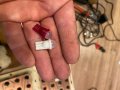
Can you find a part number for the red LED bulb? Better yet a spec sheet.

So, I usually buy my bulbs from Pinball Life in Huntley, IL. I don't have a spec sheet on the bulbs, but here is the link to the page where I buy them.

https://www.pinballlife.com/ablaze-low-profile-1-smd-led-555-wedge-base-lamp-with-frosted-dome.html


Please measure the hole diameter on the digit boards (that the plastic bases fit into). Finding information about automotive products is just impossible.

Hole is .600-.610. I'm betting the link below is the same socket.
https://www.amazon.com/PA-pieces-Socket-Instrument-Cluster/dp/B01MXW8WXU


What are the bulbs in the period, home & visitor and bonus windows?
They are a mix of E26 bulbs. Everything from 10 watt to 40 watt. I'm thinking whatever the maintenance guy found laying around. They have very nice Leviton ceramic sockets.
 

Thread Starter

r8f1k

Joined Oct 1, 2023
164
Did you calculate the resistance values for the currrnt limiting resistor of each color LED you’re using? LEDs are current driven; not voltage. So, do you have different current limiting resistors for each color?
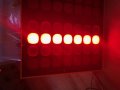
I did not calculate the resistance of the bulbs. I was simply seeing what bulb would LOOK the best. I literally hooked up 6v to the bulb in the socket and took a photo. The red frosted LED looked the best AND the most like original. The anemic look of the white I think is that it is TOO white, maybe a warm white would look better?

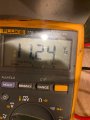
The RED LED is metered @ .900M ohm
The WHITE LED is metered @ 3.900M ohm
The 161 stock bulb is metered @ 4.6 ohm

Red LEDs need less current so without differing resistors, a Red LED should be brighter than a White LED. You can make the white LED as bright as the Red with a different resistor.
 

Thread Starter

r8f1k

Joined Oct 1, 2023
164
Is this discussion about the new purpose for the two digit displays? Or something else? I thought that date and month would be good. And not too challenging to implement. Except for leap year.
The displays are for date and month. The PERIODS 1, 2, 3, 4 would be for the solstices and equinox's
 

MisterBill2

Joined Jan 23, 2018
27,647
OK on "periods", I had not noticed that was part of the scoreboard. I will go back and look again. Certainly they could also be different colors. Now I see that I had a different image stuck in my mind. Pardon my error, please.
Those quarter turn sockets look a lot like the ones in my Plymouth instrument clusters. So they are probably available at auto parts stores, and other places as well.
And the challenge with any processor is learning to program it so that it does what you want it to do. That is much simpler with discrete logic ICs, usually. And then being able to get a replacement for it a few years later.
 
Last edited:

Thread Starter

r8f1k

Joined Oct 1, 2023
164
I should also note that my grandfather was a tremendous influence in my life. He was an attorney, a high school teacher, a circuit court judge, a farmer, an horologist and a collector of MANY things. His interest in horology has helped lead me down this path. He was an excellent clock repairman. For 60 years he repaired and advised others on how to repair their own timepieces. He was a guest speaker many times for horology seminars as well as a lifetime Fellow in the National Association of Watch and Clock Collectors (NAWCC) of which he was also president from 1971 to 1974. I think he would get a kick out of the repurposing of the scoreboard. I was almost 16 years old when he revealed to me that he also played NCAA ball in college, hence the basketball scoreboard. This revelation was, of course, after I challenged him to a game of H.O.R.S.E......I don't think I was able to put a letter on him.69472321694__06911236-0F11-438B-962F-72337CC2B4FF.jpeg
He is the gentleman on the left. He also specialized in 30 day clocks with phased movements as well as calendar movements. Extremely complex and very finicky to get them to run correctly.
 

djsfantasi

Joined Apr 11, 2010
9,237
The LEDs in question are "bulb replacement LEDs", which already include the current limiting resistor for the specified voltage. A "6 volt LED bulb" includes the resistor (or in some cases, even a constant current circuit) to operate from the stated voltage.
After 100 posts, I begin to forget earlier posts.
 

Thread Starter

r8f1k

Joined Oct 1, 2023
164
Simple, and automatic with a microcontroller and DS3231 clock chip.

As would be displaying any possible symbol with the bulbs.
With the DS3231 chip, I see that the specs have both commercial (0°C to +70°C) and industrial (-40°C to +85°C)
temperature ranges. This will be inside, but it will be in an unheated building. This will be in SE Wisconsin and the temps during the winter get into the ranges shown in the industrial version of the chip. How does one know that the chip is a commercial unit vs. an industrial unit?
 

Thread Starter

r8f1k

Joined Oct 1, 2023
164
I have some time this evening to make measurements, photos, etc. Jon put together a potential driver board in POST #32, should that be the method to use in order to make this work, what other information is needed from me? Or if we explore MisterBill's idea of diode decoding, what other information is needed from me? IMG_8496.jpeg
After testing the LED bulbs and the 161/194 original bulbs, I am going to use the RED LED bulbs. They are good for both 6.3V AC/DC.

IMG_8495.jpeg
This is the metered voltage of the low side of the transformer no under load. If it can be used for this project, great. If not, no sweat.
 

MisterBill2

Joined Jan 23, 2018
27,647
Diode decoding in the most common arrangement consists of one line in enabled for each digit or character to be displayed, The outputs to each segment typically are at right angles to the input lines, and for each segment of the character to be displayed, a diode is connected from the character line to the segment line.
So the critical knowledge required is which segments are illuminated for each character. It is also important to not get any diodes backward.
The function is close to identical to a PROM, (Programmable Read Only Memory), except that the programming is done by installing diodes.
 

Thread Starter

r8f1k

Joined Oct 1, 2023
164
Diode decoding in the most common arrangement consists of one line in enabled for each digit or character to be displayed, The outputs to each segment typically are at right angles to the input lines, and for each segment of the character to be displayed, a diode is connected from the character line to the segment line.
So the critical knowledge required is which segments are illuminated for each character. It is also important to not get any diodes backward.
The function is close to identical to a PROM, (Programmable Read Only Memory), except that the programming is done by installing diodes.
Ok, how can I assist in making that happen?
 

MrChips

Joined Oct 2, 2009
34,866
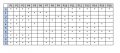
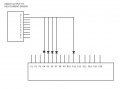
Here is the diode matrix. The left column is the numeral to be displayed. The pin numbers P1-P16 are the connections using Jon's notation. Each asterisk * represents one diode. There are 88 diodes in total for a single digit display.

Lamp diode matrix.jpg
 

MrChips

Joined Oct 2, 2009
34,866
I was afraid you would ask.

I will do a simple one. P4, P5, P6, P7, and P11 are activated when numeral "1" is being displayed. So we connect forward biased diodes from "1" to P4, P5, P6, P7, and P11.

Now you have to do this for each numeral for a total of 88 diodes. And you have to do this for all the other displays.
An MCU solution is still a lot easier.

Lamp diode matrix wiring.jpg
 

Thread Starter

r8f1k

Joined Oct 1, 2023
164
I was afraid you would ask.

I will do a simple one. P4, P5, P6, P7, and P11 are activated when numeral "1" is being displayed. So we connect forward biased diodes from "1" to P4, P5, P6, P7, and P11.

Now you have to do this for each numeral for a total of 88 diodes. And you have to do this for all the other displays.
An MCU solution is still a lot easier.

View attachment 305077
Ha! I appreciate your patience!
 

Thread Starter

r8f1k

Joined Oct 1, 2023
164
I was afraid you would ask.

I will do a simple one. P4, P5, P6, P7, and P11 are activated when numeral "1" is being displayed. So we connect forward biased diodes from "1" to P4, P5, P6, P7, and P11.

Now you have to do this for each numeral for a total of 88 diodes. And you have to do this for all the other displays.
An MCU solution is still a lot easier.

View attachment 305077
Ok, I dug into my TTL collection, no 4017. I'm 99% I have some at my shop. I'll get into this tomorrow evening and post
 
Top