Odd Question for an Odd Problem: Making an Old Scoreboard into a Clock

AnalogKid

Joined Aug 1, 2013
12,154
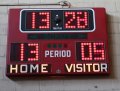
There are 28 bulbs per digit, but some of them always go on in small groups. Without drawing up a truth table, it looks like around 15 - 16 drivers will cover the digits as they were formed originally, including the non-standard 1, 2, 4, and 7. With standard 7-segment decoder chips, it would take only 7 drivers, but you would lose the shifted "1".

ak
 

MrChips

Joined Oct 2, 2009
34,865
If you reduce the supply voltage on the incandescent lamps that will extend their lifetime.

Another thing that is done is to have a low current flowing through the lamps instead of turning them off completely, but that complicates the circuit slightly.
 

MisterBill2

Joined Jan 23, 2018
27,639
I had not considered anything except hat the electronics would be at least sort of close to the digits, like the stepper packages were. The easy way to avoid rip and regret. Leave the display and wires in place, maybe LEDs instead of bulbs, possibly multiple LEDs in series in place of bulbs. And the driver/counter/decoder all connected by that same "Jones" plug. avoiding most of the rewiring. OR, running the 12 volt bulbs on 5 or 6 volts , a quarter of the power and half the current and not so very bright. The lights could even be run dimmer during the night. The added benefit is that working on the electronics portion can be done sitting at a bench. (I forgot to mention that.)
 
Last edited:

Thread Starter

r8f1k

Joined Oct 1, 2023
164
A few, that's for sure....

First, the bulbs don't care whether it's 12VAC or 12VDC, but DC will be a lot simpler to control. But each digit potentially draws 5 amps, if all 8 digits have every bulb on, that's 40 amps. That's going to be difficult to supply.

In the scheme I've suggested, adding dimming is a not-too-difficult option. I agree with @BobTPH that the bulbs may be too bright.

One way to deal with the large power demand and the probably way-to-bright issue, since printed circuit boards need to be made anyway, would be to design new digit boards using LEDs mounted directly to the board.

Electronically, this is straight forward. Mechanically, it might be a challenge to get the LEDs positioned the correct distance from the lenses.

Questions to determine practicality of this approach:

1. Are all 8 complete digits the same size?

2. Do you want/need the leading "1" on the score box numbers?

3. What is the physical size of the individual digit boards? What is the physical size of the pair of digit boards (i.e., is a single larger board for a pair of digits practical?)

4. How do the existing digit boards mount? I don't see any hardware to fix them in place.

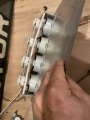
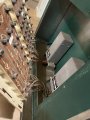
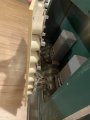
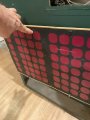
Can you take pictures of the front of a digit board, as the assembly looks when pulled out from the scoreboard? Don't take anything apart, I just want to see the front of the digit assembly if possible. And a view of one digit one the scoreboard, looking back to front? If possible.
Here are some shots of the scoreboard
 

Attachments

MrChips

Joined Oct 2, 2009
34,865
Nice model railroad collection you have there. Start another thread showing your track and set. There are some model railroad buffs here.
 

Thread Starter

r8f1k

Joined Oct 1, 2023
164
Nice model railroad collection you have there. Start another thread showing your track and set. There are some model railroad buffs here.
Thank you! I have been collecting for 30 years, my grandfather was a lifetime collector and enjoyed Lionel. I recently inherited his collection of post-war trains. Lots of good stuff!!!
 

Thread Starter

r8f1k

Joined Oct 1, 2023
164
The spec I've seen for #161 bulbs is about 2.7 watts. 2.7/12 = 225mA.

That means a digit with all bulbs illuminated draws almost 5 amps. 20 amps for 4 digits.

It's going to take a hefty ATX power supply to operate this clock.
Any idea of what specs for a transformer I should look for? This would be 110-120 input, but I am not sure what the output should be for this 'system'. What voltage should the boards be running at? Most of the stuff I encounter is 5-6.3v from the boards for pinball and then 10.3v for standup arcades. I'm sure I can pull a good transformer from something and build a heavy duty unit. I would use an AC line filter, fuse block, high to low transformer, a bridge rectifier or a switching power supply, whichever is recommended.
 

Jon Chandler

Joined Jun 12, 2008
1,606
What other information can I supply to keep the ball rolling? Anything I should measure, test, buy?

One way to deal with the large power demand and the probably way-to-bright issue, since printed circuit boards need to be made anyway, would be to design new digit boards using LEDs mounted directly to the board.


Electronically, this is straight forward. Mechanically, it might be a challenge to get the LEDs positioned the correct distance from the lenses.

Questions to determine practicality of this approach:

1. Are all 8 complete digits the same size?

2. Do you want/need the leading "1" on the score box numbers?

3. What is the physical size of the individual digit boards? What is the physical size of the pair of digit boards (i.e., is a single larger board for a pair of digits practical?)

4. How do the existing digit boards mount? I don't see any hardware to fix them in place.

Can you take pictures of the front of a digit board, as the assembly looks when pulled out from the scoreboard? Don't take anything apart, I just want to see the front of the digit assembly if possible. And a view of one digit one the scoreboard, looking back to front? If possible.
Many ideas have been presented here. Until you decide what you want to do, don't buy anything. Don't start planning a power supply.

Nobody here has a complete understanding of all of the pieces here. My comments above are trying to get a better picture.

My suggestions are for a microcontroller-based approach. Are you up for writing code to make it work; if you use an Arduino, there are tutorials for most of the tasks involved. The main tasks are reading the time from a clock chip and then displaying the information.

"I'm sure I can get lower power LEDs...." To design a driver circuit, what it's driving makes a difference. You need to decide on what you want to do. I haven't found an off-the-shelf LED bulb in that holder that draws less current than the incandescent bulbs (as I'll stated several times). It might be possible to graft LEDs to the plastic lamp bases, but if not, then you need to figure out how you're going to mount some other kind of LED. But I don't even know if the "time" digits are the same as the "score" digits.

Sift through all the ideas here, narrow down what approach you want to take, and list exactly what you want to do with each section of the scoreboard, with complete details about what each piece is now.
 

MrChips

Joined Oct 2, 2009
34,865
Let's list all the options suggested so far, while avoiding Rip & Regret.

1 - You want to keep the physical package for its geek appeal.
2A - Leave the lamps as they are. 2B - Run the lamps at lower voltage.
3 - Replace the lamps with LED, use the wring as is.
4 - Rewire all the LEDs to suit your design, e.g. use standard 7-segment layout (which may not be feasible with the 4x7 array)
5 - Replace all LEDs with addressable string LEDs.
6 - Whether lamps or LEDs, use discrete digital logic ICs, counters, decoders, drivers.
7 - Use microcontroller solution, e.g. Arduino

Only you can decide which route you want to take.
 

AnalogKid

Joined Aug 1, 2013
12,154
Since the bulbs are behind colored lenses, the only advantage to keeping incandescents is the built-in fade-in / fade-out appearance during changes.

IF retaining that look is not a goal, THEN the next question is can you get LED bulbs in the same base so you can keep the original pc boards.

IF yes, then this phase becomes a wiring problem.

IF no, then things get more complex.

ak
 

Thread Starter

r8f1k

Joined Oct 1, 2023
164
Many ideas have been presented here. Until you decide what you want to do, don't buy anything. Don't start planning a power supply.

Nobody here has a complete understanding of all of the pieces here. My comments above are trying to get a better picture.

My suggestions are for a microcontroller-based approach. Are you up for writing code to make it work; if you use an Arduino, there are tutorials for most of the tasks involved. The main tasks are reading the time from a clock chip and then displaying the information.

"I'm sure I can get lower power LEDs...." To design a driver circuit, what it's driving makes a difference. You need to decide on what you want to do. I haven't found an off-the-shelf LED bulb in that holder that draws less current than the incandescent bulbs (as I'll stated several times). It might be possible to graft LEDs to the plastic lamp bases, but if not, then you need to figure out how you're going to mount some other kind of LED. But I don't even know if the "time" digits are the same as the "score" digits.

Sift through all the ideas here, narrow down what approach you want to take, and list exactly what you want to do with each section of the scoreboard, with complete details about what each piece is now.
I feel that making boards that control individual digits as you proposed would be the best option. I understand the 'rip and regret' side, I have done HUNDREDS of restorations over the years. From ATV's, cars, jukeboxes, pinball machines, model trains, vintage woodworking and metal working machines, soda machines, gas pumps, arcades, even furniture. I would LOVE to keep the old stepper motors vs. trying to make new boards. HOWEVER, I know that if in 5 years I need another stepper, I will have to buy another scoreboard to get the parts. That being said, I would like to have new boards made to do the functions as described. Regular 12 hour clock, AM/PM changes from VISITOR/HOME, PERIOD has four sections, changing with the equinox and solstice (if possible), Scores are Month/Day. I would be very interested in having the attached boards made if they will do what is needed.
 

Attachments

Thread Starter

r8f1k

Joined Oct 1, 2023
164
Since the bulbs are behind colored lenses, the only advantage to keeping incandescents is the built-in fade-in / fade-out appearance during changes.

IF retaining that look is not a goal, THEN the next question is can you get LED bulbs in the same base so you can keep the original pc boards.

IF yes, then this phase becomes a wiring problem.

IF no, then things get more complex.

ak
I think bulbs with 555 bases available with anti-ghosting/anti-strobing effects are available. Not sure how phasing would affect it
 

AnalogKid

Joined Aug 1, 2013
12,154
With LED bulbs, is it a goal to keep the lightbulb boards and figure out new drivers, or scrap them? If you scrap them, then a new board could have logic-level drivers built in. With that, just about any clock chip could work.

Separate from that, what about the corner bulbs? In terms of a classic 7-segment display, the corners share two segments. It is simple to assign a corner bulb to only one segment, but it is not a big circuit increase to share it.

ak
 

Thread Starter

r8f1k

Joined Oct 1, 2023
164
With LED bulbs, is it a goal to keep the lightbulb boards and figure out new drivers, or scrap them? If you scrap them, then a new board could have logic-level drivers built in. With that, just about any clock chip could work.

Separate from that, what about the corner bulbs? In terms of a classic 7-segment display, the corners share two segments. It is simple to assign a corner bulb to only one segment, but it is not a big circuit increase to share it.

ak
I would like to keep the current light boards and have new drivers made
 

Jon Chandler

Joined Jun 12, 2008
1,606
Information PLEASE:

1. Are the TIME digits EXACTLY the same as the SCORE digits? Labeled pictures of each showing the entire digit PCBs and a closeup of the connection area.

2. Measurement of the digit board size (both types if not the same). And of the "1" board.

3. Labeled pictures of the period, home/visitor and bonus lights. One of the pictures looks like it shows nightlight bulbs?

This information determines the practicality of replacing the digit boards in their entirely. Replacing the boards in their entirety means you could have LEDs in every position and not be limited to the pre-defined characters.

I'm not trying to be difficult. Without the above information, the design is stalled. This is the 3rd time I've asked. Engineers get cranky when requested info is not forthcoming

SmartSelect_20231013_115433_Edge.jpg
 

Thread Starter

r8f1k

Joined Oct 1, 2023
164
Information PLEASE:

1. Are the TIME digits EXACTLY the same as the SCORE digits? Labeled pictures of each showing the entire digit PCBs and a closeup of the connection area.

2. Measurement of the digit board size (both types if not the same). And of the "1" board.

3. Labeled pictures of the period, home/visitor and bonus lights. One of the pictures looks like it shows nightlight bulbs?

This information determines the practicality of replacing the digit boards in their entirely. Replacing the boards in their entirety means you could have LEDs in every position and not be limited to the pre-defined characters.

I'm not trying to be difficult. Without the above information, the design is stalled. This is the 3rd time I've asked. Engineers get cranky when requested info is not forthcoming

View attachment 304879
I think I have missed your request, not trying to avoid giving you an answer. I will get all the information ASAP this evening.
 

MisterBill2

Joined Jan 23, 2018
27,639
What other information can I supply to keep the ball rolling? Anything I should measure, test, buy?
Do you have the control box that was used with the scoreboard? Or the power supply, if that was separate from the control box.

AND, I am wondering if the display would be bright enough if the bulbs were powered with 5 or six volts. That could be a simple option to greatly reduce the power. It is probably a wise plan to know what the different options would look like prior to building the drivers.
Also, using unfiltered DC will allow control with a single power transistor for each light group.
 

Thread Starter

r8f1k

Joined Oct 1, 2023
164
Do you have the control box that was used with the scoreboard? Or the power supply, if that was separate from the control box.

AND, I am wondering if the display would be bright enough if the bulbs were powered with 5 or six volts. That could be a simple option to greatly reduce the power. It is probably a wise plan to know what the different options would look like prior to building the drivers.
Also, using unfiltered DC will allow control with a single power transistor for each light group.
I have a pretty good variable power supply that I use for testing. It will do 0-150VAC and 0-300VDC, I'll send a video later of it running the bulbs at lower voltages.
 
Top