Odd Question for an Odd Problem: Making an Old Scoreboard into a Clock

MisterBill2

Joined Jan 23, 2018
27,611
OK, those are indeed stepper relays probably wired to display the digits in sequence, based on the fuse labels.So the first step will be to locate the connections to the solenoids that advance the switches , and know what voltages are involved.
What is sort of handy is that each box has a connector to allow for easy replacement.Now what you need is a circuit schematic diagram.The means to decode the minutes and hours roll-over remain to be determined. The HOME/ VISITOR can be changed to AM /PM, or DAYTIME/ NIGHT TIME just to be cool.
And the really big question is how much effort and expense is the TS willing to provide?
The project can be either a relatively simple rework, or a complete rip-out and rebuild from the digits back to the time base.
The TS will need a spray can of contact cleaner.
 

Jon Chandler

Joined Jun 12, 2008
1,600
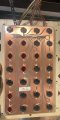
I think you actually have an easy task ahead. Let's look at the digits. Looking at the two notches of the bulb hole, you can trace the connections. On the left side of the circuit board, see how the copper strip connects to the entire column on the left side? And if you trace this around, it's common to one side of every socket?

Now look at the top holes on the first to columns on the left. See how the copper connects the non-common side of those holes to a single pin on the connector? Supply power between that pin and common, and those two bulbs will light. The non-common sides of the right-most holes each go to an individual pin – each of those bulbs can be controlled separately.

It looks like the bulbs for one digit are broken into 16 groups, which is ideal. If you want to make a clock in the most straightforward way, I suggest creating a "driver board" for each digit which would have:

An MCP23017 16 bit port expander

16 N-channel MOSFETs to drive the 16 bulb groups.

The MCP23017 is controlled from a microcontroller using I2C, a two wire interface where up to 8 can be connected to the same bus.

A "control" board would have an Arduino, ESP32 or some other microcontroller and a DS3231 real-time clock chip. These clock chips are extremely accurate, with maybe a minute or two of error per year maximum.

The hardest part will be mapping to bulb groups to form digits.

IMG_8399.jpg
 

Attachments

Thread Starter

r8f1k

Joined Oct 1, 2023
164
OK, those are indeed stepper relays probably wired to display the digits in sequence, based on the fuse labels.So the first step will be to locate the connections to the solenoids that advance the switches , and know what voltages are involved.
What is sort of handy is that each box has a connector to allow for easy replacement.Now what you need is a circuit schematic diagram.The means to decode the minutes and hours roll-over remain to be determined. The HOME/ VISITOR can be changed to AM /PM, or DAYTIME/ NIGHT TIME just to be cool.
And the really big question is how much effort and expense is the TS willing to provide?
The project can be either a relatively simple rework, or a complete rip-out and rebuild from the digits back to the time base.
The TS will need a spray can of contact cleaner.
Does TS mean "Thread Starter"? I am willing to do quite a bit. I have plenty of contact cleaner. I will see if I can find a diagram.
 

Thread Starter

r8f1k

Joined Oct 1, 2023
164
I think you actually have an easy task ahead. Let's look at the digits. Looking at the two notches of the bulb hole, you can trace the connections. On the left side of the circuit board, see how the copper strip connects to the entire column on the left side? And if you trace this around, it's common to one side of every socket?

Now look at the top holes on the first to columns on the left. See how the copper connects the non-common side of those holes to a single pin on the connector? Supply power between that pin and common, and those two bulbs will light. The non-common sides of the right-most holes each go to an individual pin – each of those bulbs can be controlled separately.

It looks like the bulbs for one digit are broken into 16 groups, which is ideal. If you want to make a clock in the most straightforward way, I suggest creating a "driver board" for each digit which would have:

An MCP23017 16 bit port expander

16 N-channel MOSFETs to drive the 16 bulb groups.

The MCP23017 is controlled from a microcontroller using I2C, a two wire interface where up to 8 can be connected to the same bus.

A "control" board would have an Arduino, ESP32 or some other microcontroller and a DS3231 real-time clock chip. These clock chips are extremely accurate, with maybe a minute or two of error per year maximum.

The hardest part will be mapping to bulb groups to form digits.

View attachment 304586
Not going to lie, I would need a diagram. Most of the electronic work I have done in the past is repair of an existing system. I am out of my depth in the RD part of this task. I learn quick, so send me whatever you think will work.
 

MisterBill2

Joined Jan 23, 2018
27,611
YES!! "TS" is short for "Thread Starter" around here. "OP" will reference "Original Poster", used occasionally, also.
Before ripping things apart, consider that the whole thing may be in working condition right now. So one thing to check is what works so far. There must be a connector to a control box and all the connections to check the operation are included on that connector. So gaining information is a first step, no matter what you decide to do. "RIP AND REGRET" would certainly apply at this point, until you understand exactly what you have and what you can do with it. If everything works correctly, the clock could function with adding a one pulse per minute time base and adding a roll-over function after each 12 hours. The other displays like AM and PM, month and day, will take some additional effort, but not replacing very much.
 

Jon Chandler

Joined Jun 12, 2008
1,600
If power is connected between the red pin and any other pin, the bulb(s) connected to that pin will illuminate. If multiple bulbs are connected to one pin, they are controlled as a group.

In the 3rd column from the left, my beautiful drawing has an error. The bottom two bulbs and the top bulb in this column are connected together.

The holes circled in black don't appear to be connected anywhere, so can't be used without soldering wires to them (on the circuit board).

I'll sketch up a circuit you could use later today.

Ledex switches (your motorized switches) are cool I must admit. There are some shortcomings – they are loud operating, you can't change the patterns of the lights, and they cost a FORTUNE to replace. Oh, and they can only count up. They may have a reset feature to reset them to zero by rapidly cycling them....which sounds like a machine gun.
 

Thread Starter

r8f1k

Joined Oct 1, 2023
164
I understand the lights and how to illuminate individual bulbs, thank you for the drawing! Your previous post indicated
An MCP23017 16 bit port expander and a 16 N-channel MOSFETs to drive the 16 bulb groups, I do not know where to start with these components. I also agree that the Ledex switches are super sweet, but they are 50 years old. I would prefer to bypass them if at all possible and drive the lamps from a central board. In pinball machines, lamps are controlled by a lamp driver that is loaded with transistors NPN and FET transistors. Could something like that be used or am I starting from scratch? I am not afraid of doing LOTS of wiring, I have restored plenty of pinball machines (50 or so) and I have repaired many a damaged PCB boards over the years.
 

MrChips

Joined Oct 2, 2009
34,842
I have mapped out which pin controls which lamps.
Next I can draw up a truth table for which pins need to be energized for each numeral 0-9. It is really messy. I am going to assume that they used diode logic to do the decoding. It would be much easier to use a look-up table on an MCU.
 

MisterBill2

Joined Jan 23, 2018
27,611
Even it those LEDEX steppers are 50years old, it is not likely that they are anywhere near end of life. Industrial reliability is rather different from consumer toys reliability, where the hope is that it can last 90 days without serious failure, but it is intended to be obsolete in 8 months, so failure then is OK.

The first thing to design will be the digit decoder/driver, because that will be required for every figure. That can decode the 4-bit binary to the seven, or possibly 11 segments.
And before designing the drivers you will need to decide what elements will replace the little 12 volt lights.
 

MrChips

Joined Oct 2, 2009
34,842
There are 7 x 4 = 28 lamps. Three lamp positions are never used. The remaining 25 lamps are wired to 16 terminals, in other words some lamps are wired to the same terminal. I have mapped out the 7 x 4 pixel set to display the numerals 0-9.
 

Jon Chandler

Joined Jun 12, 2008
1,600
Here's a take on how I would go about it. There are an infinite number of ways to approach this, and what's "best" is what you can understand and build.

I would build a board per digit as shown in this schematic. An MCP23017 port expander controls the 16 groups of lamps on each digit, which are driven by 16 n-channel mosfets. The boards for all the digits are connected together by a 4 conductor cable (+5v, ground, SCL and SDA), with separate connections for the +12vdc lamp power...which could be as high as 5.4 amps PER DIGIT. The MCP23017s each have a separate address, allowing all digits to be controlled by a microcontroller like an Arduino.

A real-time clock chip, read by the Arduino, gives the time and the Arduino sets all the bits of the MCP23017s to display the needed digits.

As far as making the circuit boards, JLCPCB will build a batch of 10 boards for almost the cost of the parts.

I hope @MrChips bulb mapping agrees with mine. That was a pain in the butt. Note the my pin numbers refer to the position on the board rather than the numbers shown on the board, which I couldn't read.
 

Attachments

MrChips

Joined Oct 2, 2009
34,842
Jon's numbering
P1 P2 P3 P4 P5 P6 P7 P8 P9 P10 P11 P12 P13 P14 P15 P16 P17

MrChip's numbering (based on what I can see etched on the board)
1 2 10 7 6 5 4 9 8 16 3 11 15 14 13 12 COM

I will post the character layout and the pin mapping a bit later.
 

Thread Starter

r8f1k

Joined Oct 1, 2023
164
There are 7 x 4 = 28 lamps. Three lamp positions are never used. The remaining 25 lamps are wired to 16 terminals, in other words some lamps are wired to the same terminal. I have mapped out the 7 x 4 pixel set to display the numerals 0-9.
What should I be doing in the meantime? I feel like I am useless......
 

MisterBill2

Joined Jan 23, 2018
27,611
The important part is mapping the segments illuminated to each digit. Evidently there is much more than the standard seven segments, so the binary to display map will be more complex, and probably not able to use a standard decoder IC. Also, there will be more than seven drivers, probably.
 

MrChips

Joined Oct 2, 2009
34,842
What should I be doing in the meantime? I feel like I am useless......
You will have to figure out how you will design the controller and then drive the display.
I imagine it will look something like this.

Setting Switches -> MCU -> Transistors -> Display Board
 

Thread Starter

r8f1k

Joined Oct 1, 2023
164
Here's a take on how I would go about it. There are an infinite number of ways to approach this, and what's "best" is what you can understand and build.

I would build a board per digit as shown in this schematic. An MCP23017 port expander controls the 16 groups of lamps on each digit, which are driven by 16 n-channel mosfets. The boards for all the digits are connected together by a 4 conductor cable (+5v, ground, SCL and SDA), with separate connections for the +12vdc lamp power...which could be as high as 5.4 amps PER DIGIT. The MCP23017s each have a separate address, allowing all digits to be controlled by a microcontroller like an Arduino.

A real-time clock chip, read by the Arduino, gives the time and the Arduino sets all the bits of the MCP23017s to display the needed digits.

As far as making the circuit boards, JLCPCB will build a batch of 10 boards for almost the cost of the parts.

I hope @MrChips bulb mapping agrees with mine. That was a pain in the butt. Note the my pin numbers refer to the position on the board rather than the numbers shown on the board, which I couldn't read.
Should I order universal boards? Or is it best to use JLCPCB? Last time I ordered a custom board was for an opto sensor. I am experienced putting on and making Molex connectors, I assume there will be a connection to make between the boards and the light matrix.
 

MrChips

Joined Oct 2, 2009
34,842
We are not yet at any stage to order anything. We still have some design work to do.
We also have to look at the connections on the other display modules.
 

Thread Starter

r8f1k

Joined Oct 1, 2023
164
You will have to figure out how you will design the controller and then drive the display.
I imagine it will look something like this.

Setting Switches -> MCU -> Transistors -> Display Board
Tell you guys what, I know I am out of my depth. You let me know what to buy, where to get it from and how many and I will do it.
 
Top