Odd Question for an Odd Problem: Making an Old Scoreboard into a Clock

Thread Starter

r8f1k

Joined Oct 1, 2023
164
Information PLEASE:

1. Are the TIME digits EXACTLY the same as the SCORE digits? Labeled pictures of each showing the entire digit PCBs and a closeup of the connection area.

The TIME and SCORE are the same. They are the same boards, light, etc.
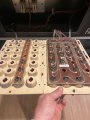
IMG_8441.jpeg
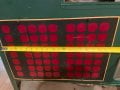
TIME hour digits

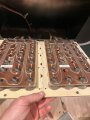
IMG_8443.jpeg
TIME minute digits

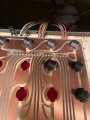
IMG_8445.jpeg
The connection of each board is the same. EXCEPT the single board.

IMG_8447.jpeg
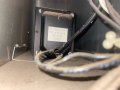
Single board connection


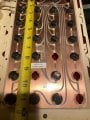
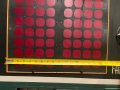
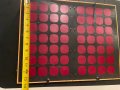
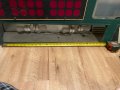
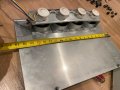
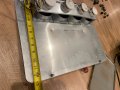
2. Measurement of the digit board size (both types if not the same). And of the "1" board.

IMG_8459.jpeg
Board height

IMG_8460.jpegBoard width

IMG_8458.jpegBoard width of SINGLE digit board, same HEIGHT as all other boards.


3. Labeled pictures of the period, home/visitor and bonus lights. One of the pictures looks like it shows nightlight bulbs?


This information determines the practicality of replacing the digit boards in their entirely. Replacing the boards in their entirety means you could have LEDs in every position and not be limited to the pre-defined characters.

I'm not trying to be difficult. Without the above information, the design is stalled. This is the 3rd time I've asked. Engineers get cranky when requested info is not forthcoming

View attachment 304879
 

Thread Starter

r8f1k

Joined Oct 1, 2023
164
Information PLEASE:

1. Are the TIME digits EXACTLY the same as the SCORE digits? Labeled pictures of each showing the entire digit PCBs and a closeup of the connection area.

2. Measurement of the digit board size (both types if not the same). And of the "1" board.

IMG_8469.jpeg
SCORE digit dimensions, same height as the TIME digit.

IMG_8467.jpeg
TIME digit dimensions

IMG_8468.jpeg
TIME digit dimensions

3. Labeled pictures of the period, home/visitor and bonus lights. One of the pictures looks like it shows nightlight bulbs?
IMG_8462.jpeg
The HOME and VISITOR signs are the same dimensions with the same number of bulbs. Haven't considered using the BONUS lights, no reason not to, haven't come up with anything yet. Maybe the BONUS arrows are better AM/PM indicators? Not sure what other two time/calendar indications to make?

IMG_8466.jpeg

IMG_8463.jpeg
PERIOD panel dimensions. It does have small E26 base bulbs, very similar to night lights. I would like to keep the sockets, I am sure I cam make something work with a different voltage if I have to.
IMG_8464.jpeg


This information determines the practicality of replacing the digit boards in their entirely. Replacing the boards in their entirety means you could have LEDs in every position and not be limited to the pre-defined characters.

The boards are ALL identical except for the single row unit. I would not think removing or eliminating the old bulb boards is necessary. I think coming up with a connection to the board is the most intelligent way to go. I have many 6.3v bulbs (555 incandescent and LED) That would cut the voltage in half from where it is now. IMG_8471.jpeg
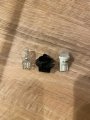
Left bulb is an original 161 from the scoreboard, the socket for the scoreboard and an LED that is 6.3v that fits right in.


I'm not trying to be difficult. Without the above information, the design is stalled. This is the 3rd time I've asked. Engineers get cranky when requested info is not forthcoming

View attachment 304879
 

Jon Chandler

Joined Jun 12, 2008
1,608
Do you know if the different digits have IDENTICALLY the same connections and layout? I don't. That's rather important to know and why I specifically asks for pictures a number of times.


When operating the bulbs on 6 volts was mentioned, the brightness and current draw were reduced because the 12 volt bulbs would be operating at 6 volts. Who knows what a random 6 volt bulb operating on 6 volts will do.

And I know nothing about the other bulbs so nothing about what is required to operate them


I don't think this project has much chance of success via long distance engineering. It's time to keep my frustrations local.

Good luck.
 

Thread Starter

r8f1k

Joined Oct 1, 2023
164
Do you know if the different digits have IDENTICALLY the same connections and layout? I don't. That's rather important to know and why I specifically asks for pictures a number of times.

The boards all have the same number on them B0231, I think it is very likely they are connected all the same. They all have the same layout. The soldered connections on the boards are all the same, in POST #101, (There had to be two responses to your post to get all the photos), I sent photos of the connections, they simply go from soldered wires to a Jones plug. What am I missing and what else would you be looking for? I am happy to take photos.
1697249295954.jpeg

When operating the bulbs on 6 volts was mentioned, the brightness and current draw were reduced because the 12 volt bulbs would be operating at 6 volts. Who knows what a random 6 volt bulb operating on 6 volts will do.

I only bring up the 6 volt bulbs because I have a large quantity of them and it would bring the wattage draw down. If it just adds another layer of problems, no sweat, let it go.

And I know nothing about the other bulbs so nothing about what is required to operate them


I don't think this project has much chance of success via long distance engineering. It's time to keep my frustrations local.
I appreciate your help up to this point. There has been over 100 posts on this topic to this point and there is a lot of information to sort through at once. Forgive my electronic ignorance and please reconsider.
Good luck.
 

Thread Starter

r8f1k

Joined Oct 1, 2023
164
Do you have the control box that was used with the scoreboard? Or the power supply, if that was separate from the control box.

AND, I am wondering if the display would be bright enough if the bulbs were powered with 5 or six volts. That could be a simple option to greatly reduce the power. It is probably a wise plan to know what the different options would look like prior to building the drivers.
Also, using unfiltered DC will allow control with a single power transistor for each light group.
I do NOT have the controls. It will light up when plugged in, but not much else. I haven't torn into the whole machine yet to see everything. I would really like to take it all apart, clean it, etc. but I have a full time job and I farm full time, so it is a balancing act to tear into projects. I have yet to find a transformer/power supply in it.
 

AnalogKid

Joined Aug 1, 2013
12,158
The big digit boards have 17 connections that look like 1 or 2 commons and 15-16 for various bulbs and groups. With a panel full of working bulbs and the display *not* connected to its controller, you should be able to determine the common pins and the resistance of each of the other pins' circuits. That tells you how many bulbs are in parallel for each circuit. and that tells you things about the power supply requirements for whatever you decide to do about LEDs.

To be clear, you do not have the mating controller for this thing, only the wall-mount display, correct? Everything begins and ends at the Jones plug(s)?

ak
 

Jon Chandler

Joined Jun 12, 2008
1,608
The big digit boards have 17 connections that look like 1 or 2 commons and 15-16 for various bulbs and groups.
The connections have been mapped out. 16 light circuits, one common. Post #43 maps the connections....but the board is upside down because I failed to notice the tiny label.

There are several groups of 2 or 3 bulbs.

My suggested circuit is attached to post #32. A 16 bit port expander controls 16 mosfets, which each control one group. This approach should be simpler than trying to force the digits into a 7 segment arrangement.

I'm out, tried of playing 20 questions and not getting answers.
 

MisterBill2

Joined Jan 23, 2018
27,650
I do NOT have the controls. It will light up when plugged in, but not much else. I haven't torn into the whole machine yet to see everything. I would really like to take it all apart, clean it, etc. but I have a full time job and I farm full time, so it is a balancing act to tear into projects. I have yet to find a transformer/power supply in it.
Oh Wow!!! Farming by itself is a full time job, I am well aware of THAT. My summer after high school I worked on my uncles farm for a while, and that was hard work.
So I am guessing that this project will not get a full focus until after harvest and getting ready for winter are past. That leaves time for thinking about the different options.
Already we know, from the transformer ratings, that the bulbs did not run full voltage.
Forming each digit in the most legible style will apparently involve more than the standard seven segment scheme, which is fine. The most reasonable approach, which is also quite flexible, would be diode decoding, either from a binary counter or from a decoded counter such as the CD4017.It would take up some room, but it would be very easy to revise, and simple to modify. The added advantage is that it would consume no power, nor need any reset input.
Not close to current technology, but easy to use, and very reliable. Plus, the same design can work for each digit, and no software to deal with. The second advantage is no fragile experimenter-grade electronics to fight with and having to learn all the programming details. and mounting all of that hobby class stuff will not be simple, either. And every bit of it takes assorted regulated voltages. AND they seem to be rather sensitive to electrical noise.
 
Last edited:

Thread Starter

r8f1k

Joined Oct 1, 2023
164
Oh Wow!!! Farming by itself is a full time job, I am well aware of THAT. My summer after high school I worked on my uncles farm for a while, and that was hard work.
So I am guessing that this project will not get a full focus until after harvest and getting ready for winter are past. That leaves time for thinking about the different options.
Already we know, from the transformer ratings, that the bulbs did not run full voltage.
Forming each digit in the most legible style will apparently involve more than the standard seven segment scheme, which is fine. The most reasonable approach, which is also quite flexible, would be diode decoding, either from a binary counter or from a decoded counter such as the CD4017.It would take up some room, but it would be very easy to revise, and simple to modify. The added advantage is that it would consume no power, nor need any reset input.
Not close to current technology, but easy to use, and very reliable. Plus, the same design can work for each digit, and no software to deal with. The second advantage is no fragile experimenter-grade electronics to fight with and having to learn all the programming details. and mounting all of that hobby class stuff will not be simple, either. And every bit of it takes assorted regulated voltages. AND they seem to be rather sensitive to electrical noise.
I am a high school shop teacher and a farmer. My wife and I have an orchard that takes up quite a bit of time. It’s like having a 3 year old for the rest of your life. I check in on this forum between jobs and on my breaks, so catching everything is tough. Regrettably, Jon has left along with his talent. I liked the idea of mounting a driver board right on the back of the light board and his design seemed very well thought out and concise. Given that I have no way to program anything, I’m happy that a method could be used that doesn’t require any software. I can build just about anything if I have the parts and a map. I hope I can keep answering all the questions in a timely manner and with the required details.
 

BobTPH

Joined Jun 5, 2013
11,554
equinox and solstice (if possible)
I would go for phases of the moon. From Wikipedia:

There are four principal (primary, or major) lunar phases: the new moon, first quarter, full moon, and last quarter (also known as third or final quarter), when the Moon's ecliptic longitude is at an angle to the Sun (as viewed from the center of the Earth) of 0°, 90°, 180°, and 270° respectively.
 

Thread Starter

r8f1k

Joined Oct 1, 2023
164
I would go for phases of the moon. From Wikipedia:
I like that, however, I do (for some reason) have an affinity for the solstices and equinox cycles. I think marking the days on the calendar in respect to farming has influenced that interest.
 

Thread Starter

r8f1k

Joined Oct 1, 2023
164
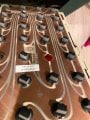
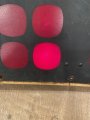
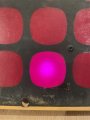
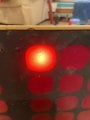
Ok, todays weather is terrible. Not much to do today on the farm. Animals are fed and that’s it for now. My daughter wanted to do some cleaning so, why not tear into the scoreboard. Gave it a good wipe down/vacuum. Lots of random trash and little black pieces of plastic. Those little bits of plastic happen to be one half of the quarter turn bulb sockets. About 50% of the sockets are no good. So, I am going to have to find a large group of those. I sampled using the original bulbs vs a 6.3 LED. A white LED is very anemic looking. The incandescent looks much better, HOWEVER a RED LED is very nice. My only real proclivity to using LEDs is the need to change bulbs.
 

Attachments

Jon Chandler

Joined Jun 12, 2008
1,608
Can you find a part number for the red LED bulb? Better yet a spec sheet.

Please measure the hole diameter on the digit boards (that the plastic bases fit into). Finding information about automotive products is just impossible.

What are the bulbs in the period, home & visitor and bonus windows?
 

djsfantasi

Joined Apr 11, 2010
9,237
View attachment 30496710.7v @ incandescent 161 bulb
View attachment 3049686.3v @ white LED
View attachment 3049706.3v @ red LED
Did you calculate the resistance values for the currrnt limiting resistor of each color LED you’re using? LEDs are current driven; not voltage. So, do you have different current limiting resistors for each color?

Red LEDs need less current so without differing resistors, a Red LED should be brighter than a White LED. You can make the white LED as bright as the Red with a different resistor.
 

Jon Chandler

Joined Jun 12, 2008
1,608
Did you calculate the resistance values for the currrnt limiting resistor of each color LED you’re using?
The LEDs in question are "bulb replacement LEDs", which already include the current limiting resistor for the specified voltage. A "6 volt LED bulb" includes the resistor (or in some cases, even a constant current circuit) to operate from the stated voltage.
 

MisterBill2

Joined Jan 23, 2018
27,650
I like that, however, I do (for some reason) have an affinity for the solstices and equinox cycles. I think marking the days on the calendar in respect to farming has influenced that interest.
Is this discussion about the new purpose for the two digit displays? Or something else? I thought that date and month would be good. And not too challenging to implement. Except for leap year.
 

BobTPH

Joined Jun 5, 2013
11,554
The red LED looks like it might be a narrow angle one. You want a diffused, wider angle one to illuminate the lens more uniformly.
 
Top