Odd Question for an Odd Problem: Making an Old Scoreboard into a Clock

Jon Chandler

Joined Jun 12, 2008
1,607
Is multiplexing acceptable for the rebuild? If so, it opens up a different logical approach to the decoding problem.
Let's revise the question:

Is multiplexing possible for the rebuild?

No. It is not.

1. The bulbs are connected with one side in common.

2. A number of the bulbs are wired in groups of two or three.

Multiplexing simply is not possible with the existing digit boards. The poster has said he wants to retain the original boards.
 
Last edited:

Jon Chandler

Joined Jun 12, 2008
1,607
Because the neopixel idea hasn't been properly praised?

I can see a number of problems with it.

1. The scoreboard bulbs are behind red lenses. I Don't think neopixels would be bright enough.

2. The neopixels would have to be positioned in the holes of the original digit boards, and alignment is critical if the original look is to be maintained.

3. Running neopixel take between all the digits may be difficult or impossible. Somehow the digits are exposed without removing the back panel of the scoreboard. As the digits may pull out separately, it may be impractical to run neopixel tape between the different digits.

4. As the LEDs are behind red lenses, the neopixel's ability to change colors is not useful.

Sorry others don't share your vision.
 

Thread Starter

r8f1k

Joined Oct 1, 2023
164
Since the bulbs may be nailed down and a realistic power supply has been identified, I can start nailing down the digit driver boards. A picture of a rough layout is shown below.

> One of these boards per digit.
> Removable terminal blocks for connections to the wires from the digit boards.
> RJ45 cables daisy-chain the control signal from microcontroller to the digit boards. These cables must be kept as short as possible.
> The board shown is 100mm x 100mm, but can be reduced in size.
> Dip switches set the address of each driver board. A maximum of 8 are allowed.
> An additional mosfet is included to control the two "ones" digits from the microcontroller.

Ten of these boards can be assembled by JLCPCB for $50 or less (<$5 per board).

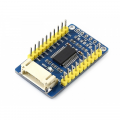
The MCP23017 port expander is a widely used component, with drivers for Arduino very available. Each group of bulbs on the digit board is controlled by one bit in the MCP23017 control register. Any combination of groups may be illuminated by a single command.

Doesn't look so complex compared to a massive diode matrix per digit, or a bunch of logic "simplifying" the diode matrix, does it? Neither MrBill nor MrChips has explained anything beyond controlling the digits - I'm looking forward to hearing how simple that's going to be.

View attachment 305144
1) How do I order the boards from JLCPCB?

2) The bulbs I found for a reasonable price are specified as follows:
* Output: 0.03A @ 12V
* Voltage: 12V
* Base Type: T10 spotlight
* Lumens: 80LM
What is odd, is that the lens is glass.
 

BobTPH

Joined Jun 5, 2013
11,553
1. The scoreboard bulbs are behind red lenses. I Don't think neopixels would be bright enough.
As I mentioned, that is something that would need to be evaluated, as it would with ANY replacement for the original bulbs. The TS has already shown that a standard red indicator LED would be sufficient.
2. The neopixels would have to be positioned in the holes of the original digit boards, and alignment is critical if the original look is to be maintained.
As it would any replacements.
3. Running neopixel take between all the digits may be difficult or impossible. Somehow the digits are exposed without removing the back panel of the scoreboard. As the digits may pull out separately, it may be impractical to run neopixel tape between the different digits.
Did you even look at the linked devices? You seem to think I am talking about the strips WS2812 usually come on.

These are individual pixels connected together in a single string of 3 wires, with any length possible between pixels. If the boards need to be removed, inline connectors could easily be used between digits. I have one installation with a seven foot gap between adjacent pixels, with connectors in each end, and it works fine.

How are your 8 digit boards connected that is so superior to that?
4. As the LEDs are behind red lenses, the neopixel's ability to change colors is not useful
I will grant you that the full range of colors would not be available. Boo hoo. How is that worse than one color, like it or not?

Please give a full parts list for your solution, including any custom PCBs that need to be made.

Here is my complete parts list based on the WS2811 pixels linked by @Sensacell:

1 stock Arduino board.
188 WS2811 pixels.
A couple of push buttons for time setting.
1 power supply.
 

Jon Chandler

Joined Jun 12, 2008
1,607
The bulbs I found for a reasonable price are specified as follows:
* Output: 0.03A @ 12V
* Voltage: 12V
* Base Type: T10 spotlight
* Lumens: 80LM
Those bulbs look like they should work well. They are 80 lumens vs 13 for a #161 bulb so they should look great at a reasonable current draw.

I suggest getting a few and making sure they'll fit the holders ok.

As far as making boards, we need to evaluate a few things first.

● Is there enough space to mount the boards as shown (100mm x 100mm)?

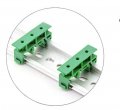
● How will the boards be mounted in the scoreboard? A good way might be to mount a DIM rail in the scoreboard and rail-mount clips on the circuit boards, like shown in this picture.

SmartSelect_20231016_175727_Edge.jpg

Once we decide on the board size and mounting, I'll be happy to lay out the board for you. Since the schematic is done, laying out the board won't be too difficult. If the "design committee" here approves of course.

I'd like to figure out the switching of the 120V AC bulbs before sending the boards for fabrication. I'd like to have all the details nailed down before proceeding with building somewhat costly parts.
 

Thread Starter

r8f1k

Joined Oct 1, 2023
164
Um, first you design the board using a PCB CAD program. Then you upload the Gerber files to its website, then order. But with the right solution you don’t need to do any of that.
Got it. Anything I have ordered from them in the past (quite a while ago), I sent them the old board and they built a new one. Small optical sensor board with eddy switches.
 

Thread Starter

r8f1k

Joined Oct 1, 2023
164
Those bulbs look like they should work well. They are 80 lumens vs 13 for a #161 bulb so they should look great at a reasonable current draw.

I suggest getting a few and making sure they'll fit the holders ok.

I can do that.

As far as making boards, we need to evaluate a few things first.

● Is there enough space to mount the boards as shown (100mm x 100mm)?

The is more than enough, the inside of the scoreboard is 95% empty at this point.

● How will the boards be mounted in the scoreboard? A good way might be to mount a DIM rail in the scoreboard and rail-mount clips on the circuit boards, like shown in this picture.

DIM rail is perfect
View attachment 305153

Once we decide on the board size and mounting, I'll be happy to lay out the board for you. Since the schematic is done, laying out the board won't be too difficult. If the "design committee" here approves of course.

I'd like to figure out the switching of the 120V AC bulbs before sending the boards for fabrication. I'd like to have all the details nailed down before proceeding with building somewhat costly parts.

I plan on using 120v E26 LED bulbs, 10 watts MAX
 

AnalogKid

Joined Aug 1, 2013
12,155
r8f1k - where are you located? If in the US, I'll gladly contribute some parts to this effort.

Jon - if you are going to do a driver board layout based on the well known "buncha-diodes" decoding method, two suggestions:

1. Replace the string of output transistors with 3 ULN2003 drivers in sockets

2. Use a PTH diode decal with 0.4" pitch.

Diodes: I have over 1000 already cut and bent that I'll never use, free to the project.

Drivers: Same, lotsa overrun parts getting dusty. And - they come with pull-down resistors for the diode-OR's built in. And you get a free lamp test function.

If you think about it, the open collector outputs can be paralleled for an OR (actually, at that point in the signal stream, NOR) function just as with diodes. In fact, you could replace all of the decoding diodes with ULN2003 stages (using a 2003 to replace 7 diodes takes up the same amount of board space), but I'm not suggesting that; better to keep the decoding and driving functions separate.

Update:

Re-reading #159 - is it a firm design decision to go with a uC for all clock and control functions? If yes, I still recommend the ULN2003 drivers in sockets. The only thing worse than hand-soldering SMT parts is removing/reworking them. In fact, given the highly experimental / developmental nature of this project, I'm kinda surprised SMT parts are being considered.

ak
 
Last edited:

BobTPH

Joined Jun 5, 2013
11,553
A EE friend of mine used to tell a story. A customer showed him a design he had received from another engineer and said “it must take a good engineer to design something this complex”. He looked at the design, and replied, “No, any engineer can do a complex design, it takes a good engineer to do a simple one.”
 

Jon Chandler

Joined Jun 12, 2008
1,607
Using ULN2003 or ULN2803 drivers is a good idea, and those have in fact been one of my go-to parts for years. Those were actually my initial thought, but the #161 bulb current was too much for those.

If a DIP MCP23017 is also used, the boards are hand-solderable – otherwise I was going to recommend JLC do it.

@AnalogKid thanks for contributing to the effort!
 

Thread Starter

r8f1k

Joined Oct 1, 2023
164
Since the bulbs may be nailed down and a realistic power supply has been identified, I can start nailing down the digit driver boards. A picture of a rough layout is shown below.

> One of these boards per digit.
> Removable terminal blocks for connections to the wires from the digit boards.
> RJ45 cables daisy-chain the control signal from microcontroller to the digit boards. These cables must be kept as short as possible.
> The board shown is 100mm x 100mm, but can be reduced in size.
> Dip switches set the address of each driver board. A maximum of 8 are allowed.
> An additional mosfet is included to control the two "ones" digits from the microcontroller.

Ten of these boards can be assembled by JLCPCB for $50 or less (<$5 per board).

The MCP23017 port expander is a widely used component, with drivers for Arduino very available. Each group of bulbs on the digit board is controlled by one bit in the MCP23017 control register. Any combination of groups may be illuminated by a single command.

Doesn't look so complex compared to a massive diode matrix per digit, or a bunch of logic "simplifying" the diode matrix, does it? Neither MrBill nor MrChips has explained anything beyond controlling the digits - I'm looking forward to hearing how simple that's going to be.

View attachment 305144
Is this what you are referring to for a MCP23017 port expander, should I order one of these?1697565279837.png
 

Jon Chandler

Joined Jun 12, 2008
1,607
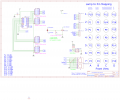
Here is a revised schematic using ULN2003s as suggested by @AnalogKid. I like the design this way, and it's all through-hole parts so the board will be easy to assemble.

I've divided the bulb groups across four ULN2003As to be slightly conservative in the current load. The ULN2003s are cheap so I don't feel bad about "wasting" one. And just for sake of argument, the price of a 8 channel ULN2803A is more than twice that of a 7 channel ULN2003A. The digit mapping on the schematic is upside-down, but the pin arrangement, numbering and bulb groupings are correct.

Connections to the digit boards are via 5mm removable terminal blocks. The I2C connection between boards and microcontroller is via RJ45 cables, which should be as short as possible

This design is intended to drive LED bulbs of 50mA or less, using a 12VDC supply. Bulbs drawing more current will result in death, destruction and releasing the magic smoke from the driver chips.

Schematic_SCORE Board Digit Driver Rev A_2023-10-17.png
 

AnalogKid

Joined Aug 1, 2013
12,155
Neither MrBill nor MrChips has explained anything beyond controlling the digits
I was leaning toward a similar small driver board per digit, but one that took in 7-segment signals and decoded them to the 16 lamp outputs. Should take a lot fewer diodes (love me some diodes). In this way, just about any digital clock chip could be used. Or just pull the board out of a small, cheap, LED digital clock, and wire that in directly This approach might be seen as a bit of a kludge, but you are starting with a clock that works, there is zero firmware development (compilers, drivers, programmer, etc.), and you get a free alarm function.

Note that this approach probably (depending on the clock chip being used) has a multiplexed drive to the display boards. With the shift to LED bulbs I don't see this as a problem, but the TS might not like the esthetics. I guess the question is - how far removed from the original design and function do you want to be?

ak

I probably missed this back in the thread - what is the timebase for the original clock? What generated the timing signals to the rotary solenoids? Is there a synchronous motor and cam assembly in there somewhere?
 

AnalogKid

Joined Aug 1, 2013
12,155
This design is intended to drive LED bulbs of 50mA or less, using a 12VDC supply. Bulbs drawing more current will result in death, destruction and releasing the magic smoke from the driver chips.
Per the datasheet for the DIP part, it is rated for up to 225 mA per channel, 4 channels simultaneously, 100% duty cycle. With five channels driven it still is above 200 mA per channel. In this application, I think the part is good for anything up to 100 mA.

To drive the "1" digit, consider using 3 or 4 channels in parallel. This has worked very well for me in the past. If you are worried about a hotspot inside a chip, use 2 unused channels each in two different chips.

I agree about the 280x parts price and availability. Also, given the relatively low output current requirement, you can use ULN2004's even though the circuit is running on 5 V. It lowers the input current significantly.

ak
 
Last edited:
Top