New LED lighting project Project New Guy

Irving

Joined Jan 30, 2016
5,132
I think you worry too much about the current control. A 5V supply and resistor should be fine. Each mug is going to filter a different amount of light through it anyway, so I think they will need to be individually calibrated via the PWM to make the effect consistent. The WS2811 makes that easy to do.
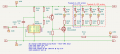
Agreed, but that only works if you put all the LED in parallel and assume a fairly constant Vf for each, so you have a dropper resistor for each LED - though the TS' approach has been for LED in series so far. Even so, the resistor for 5v @ 350mA is (5-3.2)/0.35 = 5.1ohm @ 0.63W (2W resistor) which is a lot of heat to shift on the 5-LED version. Maybe need to go back to THT parts off board, though messy?

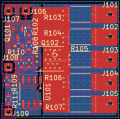
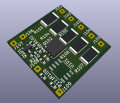
1753467626566.png1753467705527.png

1753467755469.png
 

ElectricSpidey

Joined Dec 2, 2017
3,335
Someone needs to talk to the OP, because I believe they wish to continue building the LED modules, and that will not work with the latest design.

Other things need to be pointed out such as where the chip modules would be located and whether the power is daisy chained, or power blocked, and the different number of wires needed to go into each jug depending on the choices. (placing the modules inside the small jugs could be a problem, or maybe not)

Personally, I think this is a clever design, but I don't like the wiring logistics or issues involving adding more jugs that are not at the beginning or end of the line, changing from one size jug to another...etc.

I would also worry about testing the system without building an actual prototype.

I don't see any consideration for daisy chaining the power in those modules so they would have to be modified to accommodate if that was chosen.

I'm also not sure the OP is going to agree with 350mA.

Ok, that's enough pooping on the parade for me.
 

Thread Starter

BeerMaker

Joined Oct 3, 2009
23
The acronyms are mostly Greek to me.
Am I the OP? The TS?
The 1,2 and 5 bulb modules I’ve been building work good enough at 350mA.
I’m less than $200 in, with parts, tools and gear…so if I have to scrap everything, so be it.
Without all the jugs set up in a proper display, I cannot say for sure how or when they’ll be ready.
I have no problem taking the time to build this stuff. This is not a professional installation, if there are limitations, again, so be it. Even though I don’t understand most of what you guys are saying, I appreciate you thinking about it and really enjoy reading your banter.
 

Irving

Joined Jan 30, 2016
5,132
Someone needs to talk to the OP, because I believe they wish to continue building the LED modules, and that will not work with the latest design.

Other things need to be pointed out such as where the chip modules would be located and whether the power is daisy chained, or power blocked, and the different number of wires needed to go into each jug depending on the choices. (placing the modules inside the small jugs could be a problem, or maybe not)

Personally, I think this is a clever design, but I don't like the wiring logistics or issues involving adding more jugs that are not at the beginning or end of the line, changing from one size jug to another...etc.

I would also worry about testing the system without building an actual prototype.

I don't see any consideration for daisy chaining the power in those modules so they would have to be modified to accommodate if that was chosen.

I'm also not sure the OP is going to agree with 350mA.

Ok, that's enough pooping on the parade for me.
I don't see it as pooping; these are the sorts of questions that will drive the thinking forward. Also, as with any project, there's always a balance between functionality, practicality and budget. This project is typically one where the idea is simple but the implementation is complex.

I'm not worried about building a prototype; the parts are cheap and a module can be breadboarded on some perfboard easily.

My big concern is the 5v-only module involves some serious heat losses, plus the 5-LED module will take 1.75A or more (as well as generating >3W of heat) so a few of those will easily start racking up serious cabling concerns unless star wired. Personally I don't think this is the way forward..

I think one way forward is to have daisy chains of similar sized jugs, ie 5v, 9v and 24v each driven by a CC buck with a variable CC output of say,6 steps ie 350mA, 700, 1050, 1400, 1750, and 2100mA. This would accommodate between 1 and 6 jugs at each size being on with no upper limit of the number of daisy-chained jugs on each power chain. All the jugs on a power chain would have their WS2811s daisy chained. Jugs can be added to beginning or end of a chain, but also within the chain relatively easily. The software would have a database of jugs, their size, the chain number and position in the chain, Given the pattern of illumination it can then work out the sequence of RGB triplets (though only one colour is used) needed and also the current requirements of each chain so when is sends the reset pulse it can also instruct the relevant chain's CC buck what current setting is needed. Its not perfect, as if one jugs is set to low brightness in the sequence ie ramping up or down, it will have some effect on the brightness of the other LEDs on that chain.

I have some other ideas - watch this space....
 

be80be

Joined Jul 5, 2008
2,395
40 watts of LEDs is a lot of led lighting 35 will light up a whole room most 60 watt so called LED light bulbs are only 7 watts I think you was using 3 watt LEDs so 2 of them in a jug would be lots of light
 

BobTPH

Joined Jun 5, 2013
11,524
My big concern is the 5v-only module involves some serious heat losses, plus the 5-LED module will take 1.75A or more (as well as generating >3W of heat) so a few of those will easily start racking up serious cabling concerns unless star wired.
This is not a problem if only one is on at a time as the TS has stated. A typical phone charger can supply 2A at 5V.

12V for 2 in series wastes more power than 2 in parallel at 5 and 24 V for 5 wastes only marginally less than 5V (24/25).
 
Last edited:

ElectricSpidey

Joined Dec 2, 2017
3,335
Only one on at a time, I must have missed that, well that changes everything. (I thought we were going for a Pink Floyd light show)

Here are the rough requirements: (in reference to my original concept) And keeping the LEDs in series.

Per Shelf Unit:
Same 25-volt supply, except with a much lower current requirement.
Same DC/DC buck converter (5-volt)
1 PSoC development board. (others will probably work as well, but I never used anything else) The one I use would support about 40 jugs per shelf unit.
1 free "Creator" IDE download.
1 Short USB cable.
1 CC LED driver.
N number of MOSFETs. (N being the number of jugs)
1 Proto board or professional PC board. (for the MOSFETs)
Misc hardware, wire, terminals, connectors...etc.

Basically, one pin of the controller provides the PWM signal to the LED driver and the MOSFETs are used to switch loads with the other GPIO pins.

One thing I have to point out here, this is only a concept as I have never actually tried switching loads attached to a CC driver using MOSFETs and there could be some issues. (sounds good in theory, but may not work in practice)

I won't get into the coding here, but it's really simple.
 

Irving

Joined Jan 30, 2016
5,132
12V for 2 in series wastes more power than 2 in parallel at 5 and 24 V for 5 wastes only marginally less than 5V (24/25).
Not with a CC Buck. Assuming 3.2v & 350mA per LED, losses are:

1753619499283.png

Assuming like for like PCB** and assembly costs, the component cost for the buck CC (LCSC Catalog price per PCB, 10 up) is $0.58 v $0.60 for the parallel LED version as 2W SMD resistors are not cheap, though this does drop to $0.50 with off-board THT resistors (but with added complexity to wire and support them).

** Based on a 25 x 25mm board; is likely the parallel LED with SMD resistors will be more like 25 x 40+mm to allow for extra heat sinking on 2 and 5 LED populated versions, or to bring THT resistors on-board.
 

Thread Starter

BeerMaker

Joined Oct 3, 2009
23
I know you guys are still trying to figure out the best, most efficient and cheapest way to put this all together and I appreciate it greatly. I’d like to reintroduce an original request that hasn’t been talked about.
Can each jug have a manual On/Off button? This does not need to be part of the random flashing display. I could even live without the “random”…but that is control issues, which I’m assuming comes later. Each character will have a small information sign associated with it. Most characters are 1,2 or 3 jugs. I’d like the ability to turn some on for comparison and discussion purposes.
Just something to think about because it is another parameter.
 

ElectricSpidey

Joined Dec 2, 2017
3,335
In my first design concept you could configure some kind of switching on the output of each MCU to choose between three different states.

Pass the PWM
Driver output full on
Driver output disabled

EDIT: had to remove the info for the second design, I forgot that there is only one driver in that design.
 
Last edited:

Irving

Joined Jan 30, 2016
5,132
Each character will have a small information sign associated with it. Most characters are 1,2 or 3 jugs. I’d like the ability to turn some on for comparison and discussion purposes.
With the WS2811 chip, we are using only one output (of 3) to control the main LEDs. Therefore you have the ability to use another output to control a short white LED string (low power, 4 to 6 LED, max 16mA) to illuminate a sign with no added cost (other than the LEDs for the sign).

Is the on/off button related to the jug LEDs or the sign?
 
Last edited:

ElectricSpidey

Joined Dec 2, 2017
3,335
Regarding your ON/OFF requirement and my second design.

I'm thinking your ON/OFF requirement would probably require more than one jug illuminated at one time, so that design is probably incompatible.
 
Top