New LED lighting project Project New Guy

Irving

Joined Jan 30, 2016
5,132
Tried to add text to photos but couldn’t figure that out either.
No problem, great photo's and an amazing collection. Neat setup with the LEDs too. Do you have a link to them?

I don’t even know how to use forums. I don’t know how to address your questions one at a time.
You're doing OK! Highlight the text you want to reply to... a little box will appear, click 'quote', then go to your message, click where you want the quote to be and then click insert quotes (which has magically appeared).. then type your reply below that...
 

Thread Starter

BeerMaker

Joined Oct 3, 2009
23
No problem, great photo's and an amazing collection. Neat setup with the LEDs too. Do you have a link to them?
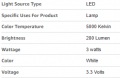
DEWIN 3W LED Chip Bulb, 25PCS COB Light Bead 3.2-3.4V High Bright Integrated Chip Light Source LED Bead
No real link, just this Amazon description. No data included with bulbs.
 

ElectricSpidey

Joined Dec 2, 2017
3,335
I think you are looking at the following:

Multiple 20-volt supplies.
Multiple micros.
A step-down buck regulator for the micros.
Each jug, 1 CC 700mA dimmable LED driver with an output voltage of between about 3-volts to about 18-volts.
Assorted other hardware, wire, terminals, enclosures if wanted...etc.

Of course, you could combine some of the jugs to eliminate some of the drivers.

The ambient lighting is another system altogether.

The requirements here are based on something I can imagine, based on your stated requirements, this is certainly going to be a huge challenge for someone of your knowledge level...so good luck, I mean that most sincerely. (a PF reference :))

EDIT: I just wanted to add, I'm imagining a system where each shelf unit plugs into a standard outlet and has no wires running from unit to unit.
 
Last edited:

Irving

Joined Jan 30, 2016
5,132
I think you are looking at the following:

Multiple 20-volt supplies.
Multiple micros.
A step-down buck regulator for the micros.
Each jug, 1 CC 700mA dimmable LED driver with an output voltage of between about 3-volts to about 18-volts.
Assorted other hardware, wire, terminals, enclosures if wanted...etc.

Of course, you could combine some of the jugs to eliminate some of the drivers.

The ambient lighting is another system altogether.

The requirements here are based on something I can imagine, based on your stated requirements, this is certainly going to be a huge challenge for someone of your knowledge level...so good luck, I mean that most sincerely. (a PF reference :))

EDIT: I just wanted to add, I'm imagining a system where each shelf unit plugs into a standard outlet and has no wires running from unit to unit.
Yeah, pretty on track with where I'm thinking. I've been playing with the idea of a low-loss mini-buck for each jug which doubles as a remotely controlled (1-wire) dimmer/sequencer too. In bulk it could be very cost effective and has the advantage of repeatability across jug-sizes to take some complexity out of the equation. The new Microchip tiny 8-bit AVR MCUs have a built-in 'motor controller' that could be used as a mini-buck.
 

ElectricSpidey

Joined Dec 2, 2017
3,335
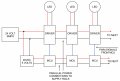
Let me flesh out my concept a little more.

Each Shelf unit:
1 24-volt switch mode power supply.
1 DC/DC buck regulator. (for the controller board)
1 Controller board. (MCU array)
1 Driver board. (driver array)

Each jug:
1 MCU (to be determined)
1 LED driver, for example LDD-700LW (Mean Well)

Code:
For example, create 10 different effects and code each as a separate function.
Examples:
Flash on/off.
Flash on/off multiple times.
Fade up/fade down.
Fade up/delay/off/on/fade down.
On/fade down.
Fade up/off.
You get the idea.
Then...
In Main you randomize the selection of the functions and the delays between them.
You then program all of the MCUs with the same code EXCEPT for the random function seed which you make each one different.

This will create a pseudo-random display, if true random display is required that is a different fish to fry.
Construction is pretty straight forward, and I can post a wiring diagram if you are interested but will take some time as I need to get to my other PC.
I know this is probably not the cheapest design concept, but it is simple and straight forward and should be easy to conceptualize.
 

ElectricSpidey

Joined Dec 2, 2017
3,335
Very true, but if I understand your concept correctly (and I probably don't) I think having to construct like 200 of those modules would be a deal breaker for me.
 

Thread Starter

BeerMaker

Joined Oct 3, 2009
23
I couldn’t be happier that you guys have picked up on this. I sort of see where you headed but some of the lingo is lost on me. No worries, keep it up.
Even though I’ve started building LEDs for jugs, it doesn’t mean I’m anywhere near ready to jump. Half of my collection is in storage because I’d really really like to get out of Illinois in the next year.
Budget is definitely a concern BUT this will hopefully be my forever display. I probably could muster up building one or two shelves as a starting/learning base.
 

Irving

Joined Jan 30, 2016
5,132
I’m currently testing each “bulb array” with a Wanptek bench supply. It is set to a limit of 700mA.
You should verify how good the illumination is at 350mA as that's their normal static operating current. 700mA pulsed 50% may be ok, but continuously is asking a lot of them and may lead to premature failure.
 

Thread Starter

BeerMaker

Joined Oct 3, 2009
23
Tested all 3 sizes at 350mA instead of 700. Illumination is good but not great. It would probably work out ok in a low light environment AND if I figure out a way to seal off the top of each damn jug to reflect the escaping light back in.
 
Last edited:

Irving

Joined Jan 30, 2016
5,132
Tested all 3 sizes at 350mA with areas of 700. Illumination is good but not great. It would probably work out ok in a low light environment AND if I figure out a way to seal off the top of each damn jug to reflect the escaping light back in.
OK, can probably run them a bit hotter when pulsed.

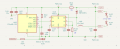
Here is a first pass on what we've been discussing. First, the circuit schematic: U101 (tx6122) is a buck LED driver that generates a constant current for the LED chain for up to 5 LEDs and up to 1A. Its DIM input is connected to a microcontroller that manages brightness, ramp speed, up & down, and on/off sequencing, the details and timing are sent to it by a central controller via the CONTROL input.

1753291427829.png

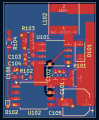
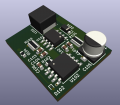
This can all be squeezed onto a 20mm * 25mm * board that looks something like this (not perfect yet, might make it a little larger):

1753294947673.png1753294985361.png


The circuit board, parts and assembly, all supplied by JLCPCB, including 8-15 day shipping for 10 boards initially would be around $45 which isn't bad... under $5 a board. On top of that you'd need a 24v 200W power supply, LEDs, wiring and the central controller (I reckon about $30 for the controller)
 
Last edited:

Irving

Joined Jan 30, 2016
5,132
So is this board needed for each jug?
The design and cost seem reasonable to me, but X 300 is a death knell.
In larger quantities the cost per board comes down. But there's no easy solution to achieve what you want to do at scale.

You could use 1 driver to drive more than 1 jug, but they'd all need to be co-located, which would seriously hamper the look you're aiming for.

x300, even if only 1/3 were active at once, you'd be using close to a kW of electricity, 150W or more being lost as heat - those shelves better have good ventilation!
 
Top