MOSFET Positive side switching circuit

Thread Starter

sab201

Joined Nov 18, 2023
297
If you are driving an inductor with a switching waveform, you have to deal with significant inductive flyback kicks when the current is switched off. Almost certainly hundreds of volts.

ak
I connect a resistor in parallel to the MOSFET switch. So the current does not hit zero. When MOSFET is open, current flows through the resistor and when MOSFET closes, current will take the shortest path. So it is not a complete switching circuit that hits zero and set value.

So far I havent came across any such issues, still I use a free wheeling diode.
 

sarahMCML

Joined May 11, 2019
697
The closest one similar to STD46P4LLF6h that is available in my place is a STD45P4LLF6AG. I suppose it cant be used because data shows negative voltage and currents.
It's normal to show P-Channel MOSFET voltages in datasheets as negative values because they are all with respect to the Source, which is the most positive pin!
 

B-JoJo-S

Joined Jan 3, 2026
315
the direction of the current is the same whether it is switched high side or low side.
That's exactly what I was going to say. Switching a light bulb from the positive side or from the negative side - it's all the same. The same current flows whether you use a BJT, MOSFET or a light switch. But I still don't understand the reason for all the regulation, the PS, the PWM, what else was there? I think I'm missing something.
The ONLY difference I can possibly imagine is the full on state of the FET, the P-FET versus the N-FET. Your very setup can skew your results.
And how are you measuring the magnetic field? What changes do you expect to find? The fields emanate from the ends and loop back to the middle of a perfect magnet. Even a cheap dime store magnet is going to be virtually the same. Maybe very slight changes in the composition of the metals. Using a coil will still generate the same magnetic flux lines. A figure 8.
 

Thread Starter

sab201

Joined Nov 18, 2023
297
The fields emanate from the ends and loop back to the middle of a perfect magnet. Even a cheap dime store magnet is going to be virtually the same. Maybe very slight changes in the composition of the metals. Using a coil will still generate the same magnetic flux lines. A figure 8.
I am using a long flexible coil, I am studying the field pattern variations at different shapes. The project is a big one it wouldn't be practical to explain the whole of it as it would take too much time to explain. Also I am using other types of coils on the low side and high side all connected in series.
 

B-JoJo-S

Joined Jan 3, 2026
315
I am using a long flexible coil, I am studying the field pattern variations at different shapes.
The things that would make any difference is not the shape but the size of the coil and the number of turns it has.
How are you determining the field patterns? Are you talking about a flexible coil similar to how a hose is flexible, laying in the grass?
 

Thread Starter

sab201

Joined Nov 18, 2023
297
Something like this?
This is why I told it will not be practical to explain it. Too many questions arise and it is difficult to explain and clear each and every doubt. I use a flexible metal wire rope. I hope you can search and find what a wire rope is. I wound around it and made a flexible electromagnet. The winding is uniform. I hope this should suffice. Any more questions will confuse it further.
 

Thread Starter

sab201

Joined Nov 18, 2023
297
That should work just fine.
sghioto,

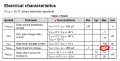
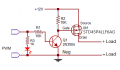
I made the circuit. Unfortunately it is not working. I found that the datasheet says that the gate threshold voltage is -2.5 Volts

sketch-1769369437738.jpgfor the STD45P4LLF6AG which I am using.

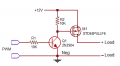
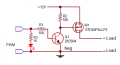
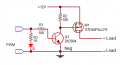
I wired this circuit
1768934548907.pngthe one you mentioned STD46P4LLF6 has a positive gate threshold voltage +2.5 in the data sheet.

So I suppose the output from the mcu needs to be -ve. Can any modifications be done to the pwm input circuit.

Or can you suggest a different component.

Thanks.
 
Last edited:

Thread Starter

sab201

Joined Nov 18, 2023
297
That is the correct P channel mosfet
Does the LED light up?
Yes that is the one you gave in your circuit
the STD46P4LLF6 MOSFET. It has positive threshold voltage.

But that is not available in my place so I used a STD45P4LLF6AG. I have attached the datasheet below. This has a negative threshold voltage. I used this in my circuit instead of a STD46P4LLF6.

The LED lights up. I connected the supply and load sides and powered on. The LED blinks but there is no switching.
 

Attachments

sghioto

Joined Dec 31, 2017
8,634
But that is not available in my place so I used a STD45P4LLF6AG. I have attached the datasheet below. This has a negative threshold voltage. I used this in my circuit instead of a STD46P4LLF6.
The LED lights up. I connected the supply and load sides and powered on. The LED blinks but there is no switching.
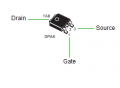
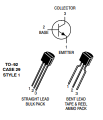
Are you sure the mosfet and transistor are connected correctly?
1769375301373.png
1769374998009.png
1769375115804.png
 

Thread Starter

sab201

Joined Nov 18, 2023
297
Are you sure the mosfet and transistor are connected correctly?
Yes I connected them correctly.

There is supply voltage and load voltage always present regardless of whether there is pwm or not.

Are you sure STD45P4LLF6AG can be used in place of STD46P4LLF6. If so I can make it once again just in case there is defect in the components.
 

sghioto

Joined Dec 31, 2017
8,634
Should be a direct substitute.
The mosfet might be shorted.
Or, what does the voltage read on the gate of the mosfet with no PWM?
 
Last edited:

Thread Starter

sab201

Joined Nov 18, 2023
297
Should be a direct substitute.
The mosfet might be shorted.
Or, what does the voltage read on the gate of the mosfet with no PWM?
I will check voltage and let you know.

But when I checked the resistance of mosfet terminals there was no short when supply was not there. Only when mains supply is there there seems to be a short.
 
Top