MOSFET Positive side switching circuit

Thread Starter

sab201

Joined Nov 18, 2023
297
You said previously that your max current was 3A. With what I see now, the switching is not doing anything because I=V/R which returns I=60/20= 3!! Your entire current goes thru that variable resistor. In addition, if the resistor is always there, your inductor is always saturated and there is nothing to measure/observe about the inductor.
The max current through the circuit without the resistor is 3 A, which is when the MOSFET is ON. When the MOSFET is OFF, current does not flow through the MOSFET, it flows through the variable resistor to the load which I adjust to make it 1.5 A. So for example, at 0.1 Hz, for 5 seconds the current through the load will be 3 A and for next five seconds it will be 1.5 A and the waveform continues at 50 percent duty cycle.

I know its a bit confusing but this is how I made it.

The high side switching circuit is working now without any problems. Thanks crutschow, vandveuser16776, sghioto, eetech00 for your circuits and assistance and all others for helping out.
 

Thread Starter

sab201

Joined Nov 18, 2023
297
Why is your MOSFET circuit shown supplied from the buck output, not from the 60V supply??
To set a constant setpoint current to the load.

Edit: In the initial stage of the project I used only the electromagnet so I used a step down buck converter to step down the voltage and increase and send a constant current. Now the output of buck converter is around 43 Volts, I adjusted the max current to 2.75 A using the buck converter potentiomer and min current to 1.37 A using the variable resistor I wanted to try it out without the buck converter, to give the 60 Volt supply directly to the inductive load and the heating coil. Because the heating coil is drawing a higher current.

The buck conerter and the variable resistor allows me to make current adjustments.
 
Last edited:

ElectricSpidey

Joined Dec 2, 2017
3,335
That doesn't look like a constant current converter to me.

Looks more like an adjustable regulated constant voltage converter.

As I suspected much earlier in this thread, seems like a misuse of terminology.
 

Thread Starter

sab201

Joined Nov 18, 2023
297
That doesn't look like a constant current converter to me.

Looks more like an adjustable regulated constant voltage converter.

As I suspected much earlier in this thread, seems like a misuse of terminology.
Yes that could be true I am not a pro in electronics.

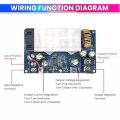
For my application, I need constant current and one of the pot allows me to adjust the current output and keep it at a set value. I am not sure how it is done. Apologize for the misuse of terminology. For adjusting the current I turn the pot next to the output terminals which says output voltage regulation. However the current regulation pot does not seem to do much.
sketch-1773584163766.jpg
 
Last edited:

crutschow

Joined Mar 14, 2008
38,532
However the current regulation pot does not seem to do much.
It should, depending upon its adjust point.
It's basically a current-limit adjust, which limits the current to a specific value independent of a load resistance or voltage setting that might try to cause it to go to a higher value.
So the output current will rise as you raise the voltage or lower the load resistance until it reaches the current-limit setting, at which point the current should stay constant.
 
Last edited:

ElectricSpidey

Joined Dec 2, 2017
3,335
Yea, it's difficult to criticize someone for using the wrong terminology when the Mfg. of the device uses the wrong terminology.

The fact is, you cannot regulate current and voltage at the same time, so the current control pot should have been listed as a "limit".
 

crutschow

Joined Mar 14, 2008
38,532
The fact is, you cannot regulate current and voltage at the same time, so the current control pot should have been listed as a "limit".
Why prioritize voltage?
The two controls have equal standing electrically.
If you want to call the current control pot "limit" then the voltage control pot should also be "limit".
 

MisterBill2

Joined Jan 23, 2018
27,591
For some applcations it is quite important to LIMIT the current, while the actual current does not need to be limited in many applications that demand VOLTAGE REGULATION. The reason is often that excess voltage breakdown is usually a rapid fault process, while mostly, overcurrent failure is a heating process that moves more slowly, at least with slight excess current conditions. In many instances, an over-voltage caused failure leads rapidly to an excess current condition because whatever had been limiting the current suddenly is no longer limiting it. A capacitor excess voltage breakdown is the classic example.
 

crutschow

Joined Mar 14, 2008
38,532
For some applcations it is quite important to LIMIT the current, while the actual current does not need to be limited in many applications that demand VOLTAGE REGULATION.
Of course it can be important to LIMIT the current and provide VOLTAGE REGULATION (why are you shouting?) in some applications.
In powering an LED, the opposite is true.
But the convention in power supplies is to treat both controls as equal in importance and label the two controls Voltage and Current.
 
Last edited:
Top