MOSFET Positive side switching circuit

Thread Starter

sab201

Joined Nov 18, 2023
297
Good Day,

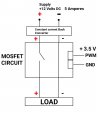
I need help in making a MOSFET switching circuit for switching the + ve side of the supply to load wire and not the GND wire. The trigger signal will be about 3.5 Volts PWM from a Raspberry Pi.

The load Voltage is 12 Volts DC and maximum current is 5 A. The switching frequency will be upto 2 kHz.

Please suggest the circuit, MOSFET components and LED switching indicator.
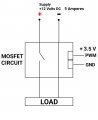
sketch-1768769688653.jpg

I bought one switching module online, it is switching on the negative/GND side.

Another one I bought it is switching on the positive side but the current keeps fluctuating going up and down without staying steady. Current is supplied from a constant current buck converter. So it is possible to make one.

Thanks.
 

Thread Starter

sab201

Joined Nov 18, 2023
297
Why do you want/need PWM? Are you planning on using the 12V PS as a variable PS?
12 Volt PS supplies to a buck converter which supplies constant current to the load. I want to add the switching MOSFET in the positive side of the buck converter output.

sketch-1768797956656.jpg

The load I want to run with PWM waveform.

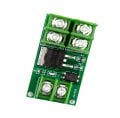
This is the MOSFET module I am using now:
Screenshot_2026-01-19-10-40-24-258_com.tmstore.robu.in-edit.jpg
Product Description

The F5305S Power Mosfet Module is based on the FET model of the new original F5305S. We can input PWM signal for motor control Speed, lightness, etc.

Features:

1. In the FET module, the input and output are completely isolated from each other.

2. FET module, the input, and output are completely isolated.

3. Signal trigger terminal: digital high and low level. Can be connected to the microcontroller 10 port, PLC interface, DC power supply, etc.

4. The output can control high-power equipment, motors, bulbs, LED strips, DC motors, micro pumps, solenoid valves, etc.

5. Using the original F5305S power FET, you can input PWM, control motor speed, the brightness of the lamp, etc.

6. Trigger signal: digital high/weak signal, can be connected to 10 microcontroller, plc interface, DC power supply, and so on.

7. Output data can control powerful devices: motor, light bulb, light and strips, DC motor, small pumps, solenoid valve.


This works but the current is not steady. But another module I bought it gives steady current but it switches the ground side.
 
Last edited:

B-JoJo-S

Joined Jan 3, 2026
208
So high switching is unstable while low switching isn't?
Why do you need to switch the high side? I'm sure you have a reason, but I'm not coming up with anything. And as for why the high side switching is being unstable, perhaps it's not as isolated as you might think. Or bad solder joints. Or bad component(s).
The Opto: Is it grounded to ground or grounded to the load?
And I still don't understand why you need PWM to control it.
 

B-JoJo-S

Joined Jan 3, 2026
208
As I re-read your comment it seems like you're using a PS to a Buck for current control into a MOSFET that is PWM controlled. Another way to describe it is you're using a regulator to control a regulator to regulate a load. Seems like overkill. I could be wrong. Likely you have a clear picture of what you want to achieve. I don't.
 

Thread Starter

sab201

Joined Nov 18, 2023
297
As I re-read your comment it seems like you're using a PS to a Buck for current control into a MOSFET that is PWM controlled. Another way to describe it is you're using a regulator to control a regulator to regulate a load. Seems like overkill. I could be wrong. Likely you have a clear picture of what you want to achieve. I don't.
I have to pass PWM current through an electromagnet which is an inductive load so I use a buck converter which supplies higher current while reducing the PS voltage. Now I am trying to PWM this current into the load which is the electromagnet. I use low side switching module it works fine.

I want to study the effects using a high side MOSFET switching circuit. I have one module the one I mentioned above but the current fluctuates during PWM operation while on low side switching it was steady.

I have searched and found high side switching circuits but am not sure which MOSFETS and components to use.

All components have common ground.

Thanks.
 

Thread Starter

sab201

Joined Nov 18, 2023
297
What's wrong with using the ground side?
Post a link to the buck converter.
Does constant current mean a set limit?
I want to use the high side switching to study what difference it makes on the magnetic field patterns of electromagnet under PWM current.

I use different set limits for current and the pot on the buck converter allows to do that easily.

This is how the current fuctuates:

When I set a 0.1 Hz frequency where the current is set to 1.5 Amperes, it goes on for 5 seconds supplying 1.5 A current and goes off for 5 seconds. When I use low side switching the current is pretty steady. But when I use the high side switching module, when MOSFET goes ON, current starts at 1.2 A when switched ON and slowly after 4 seconds reaches the 1.5 A set point. Like it goes 1.2, 1.3, 1.4 and then 1.5. This does not happen on the low side switching module.

So I wanted to make a circuit myself to test it instead of using a readymade module.

This is the buck converter

https://quartzcomponents.com/produc...0WILFI-e1YynV287poz2Y_HKpianMMORoCdEkQAvD_BwE
 

Thread Starter

sab201

Joined Nov 18, 2023
297
Does the PWM from the micro need to be isolated?
Right now I am using a Raspberry Pi to generate PWM. I have connected the ground of the Raspberry Pi to the ground of the Buck Converter, Power supply, MOSFET module, all grounds are shorted together and are common.

Please correct me if I am doing anything wrong. Isolation does not matter as long as the PWM works fine and the pulsed current goes to the electromagnet, and there is an LED indication of the PWM from the micro.

Thank you.
 

Thread Starter

sab201

Joined Nov 18, 2023
297
Please explain your thinking as to why there would be any difference.
Electromagnets and magnets in general have North and South poles. In a simple coil current enters and exits, half of the coil is North and other half will be South.

I am trying to experiment and study the variation in the patterns of the magnetic field when it is switched from both sides.
 
Top