I did the post #13 checks. Or did I miss something? See post #18 and attachment... looked several places, with no success. ... Assume that the circuits are proprietary, company secrets, even after many years.
... advise follow up on post #13.
I did the post #13 checks. Or did I miss something? See post #18 and attachment... looked several places, with no success. ... Assume that the circuits are proprietary, company secrets, even after many years.
... advise follow up on post #13.
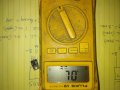
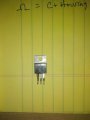
Using the diode function on my fluke meter. Yes. First I verified what pin was base (neg or positive) and then went to the other 2 terminals. I then new which pin E was because it had a slightly higher reading then the oth pin. So I determined whether it was a PNP or NPN. Then I reversed lead polarity to make sure current wasn't going both ways. Then I tested E to C using diode and regular OHM functions. Both read open. Then I tested each terminal to the aluminum housing on the top of the transistors. Only C has continuity. So I'm saying they are not at fault. Seem legit? Also, I made sure I only got 2 reading from base pin to the others.How are you testing the transistors?
Are you checking the back to back diodes using the multi-meter diode test?
... So for each of the two diode junctions, within a transistor, your meter gives a value of something like 0.6 for the base to emitter junction, and also for the base to collector junction? Is that right?Using the diode function on my fluke meter. Yes. First I verified what pin was base (neg or positive) and then went to the other 2 terminals. I then new which pin E was because it had a slightly higher reading then the oth pin. So I determined whether it was a PNP or NPN. Then I reversed lead polarity to make sure current wasn't going both ways. Then I tested E to C using diode and regular OHM functions. Both read open. Then I tested each terminal to the aluminum housing on the top of the transistors. Only C has continuity. So I'm saying they are not at fault. Seem legit? Also, I made sure I only got 2 reading from base pin to the others.
Yes. Did you see my worksheet I posted? They were all around .612 v give or take. Amd only give that reading from base to C and E. And only if you have the correct polarity meter lead on the base pin.... So for each of the two diode junctions, within a transistor, your meter gives a value of something like 0.6 for the base to emitter junction, and also for the base to collector junction? Is that right?
That value is just approximate, but it should be a number something like that for it to be a good diode test.
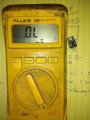
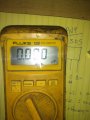
These are the 2 diode test functions. Note the v or the square in the left on the display. Sorry for upside down photo. Also have this third function. The UF icon on the right of third photo. I think it's for testing capacitor.The dial selector on the meter should be on the diode test icon, however that is labeled.
Ahhh..I see. Yes I get those readings. That makes it easier to find the base but won't tell you whether it's PNP or NPN...yeah?The circle and square tell you it is in auto-range. Ignore it. Put the NEG on the base and you should see ~.7V to emit or collect. Put POS on base and it should be OL to emit or collect. Yup, uF is for caps.
I see. Yeah man. These transistors are good. Reads just like you say. And I did it also in the other diode mode ( not auto range) with same resultsPNP is the opposite. What you don't want to see is an open both ways or a short.
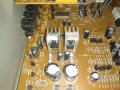
There has never been a blown fuse. The unit will not stay on with the fuses in place on the main driver board. The resistors burnt up till it was open circuit. I soldered a new one in the other day...and it instantly smoked it. With that resistor out,and the fuses or the ribbon connector from the display PCB to the main PCB disconnected, I can get it to stay on and display the tuner/cd/tv ETC like it should. But there isn't any speaker output. I posted a pic of that connector previously. I'm assuming it's bypassing the protection mode . If everything it connected like normal, when you power on, 2 seconds later it shuts off and only the red led standby light is on. Otherwise it's dead. I don't know how to test the capacitors. I have tested most of them different ways and compared the values to other ones just like it. Nothing was obviously off. But I didn't remove any of them.... A possible clue as to which particular component has failed is heat build-up.
If there is a fuse through which DC current is flowing, and blows immediately when power is applied, then some part, maybe a power transistor, has shorted out and is allowing excess current to pass through it. So see if there is some way to determine if one of the large heat sink mounted transistors is over-heating in a short time interval. This might be an infrared thermometer device, or maybe some freezer spray compound, out of a can. The use of finger-tips is a little dubious, due to possible burns.
... This method is not fool-proof or conclusive, since the actual failed component, may not be one of the large heatsink mounted transistors, but one of the electrolytic capacitors (the large cylindrical ones) or even a small transistor.
... To summarize, try to locate one if the circuit parts that seem to over-heat, immediately as soon as that fuse you described blows.