Hi BitsNBytes,
Thanks for your reply.
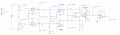
Did you get the same outcomes as I did when you ran a simulation. As in, 5 Volts out via a time sim, but not a zero to 5 if you swept R2?
I'm certainly no expert, and I'm happy to take on advice. This was the best I could do with what was required.
I would like to know it you believe I have missed something, or do something different?
When you mention the common mode range, I have not checked the data sheet just yet, however would you mind explaining how to read the input common mode voltage vs supply voltage?
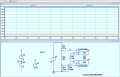
In TINA, I get a railed output from OA4 regardless of a transient or DC node calculation. I did catch a mistake on my part. I originally had R8 = R9 = 5.1k, but I changed them to 1k to match your schematic.
I will need to look at your Circuit Lab schematic and try to run it. I am not familiar with Circuit Lab, but overall this is an academic exercise, and would be a PITA to implement in the real world.
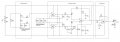
If you are using a combination of one inverting and one non-inverting intermediate stage (OA5/OA6) then the final stage should be a summing amplifier not a differential amplifier.
As you have it at the moment, it will add double the common mode voltage instead of subtracting it to eliminate it.
That's why no-one else ever uses an intermediate stage, and the three-op-amp instrumentation amplifier is ubiquitous.
Hi Ian,
Thank you for your feedback. I do not have a vast amount of knowledge, so I am wondering how this could be achieved with just one of the summing amplifiers? I'm a little bit lost and unsure. Do you have any suggestions?
Hi Ian,
Thank you for your feedback. I do not have a vast amount of knowledge, so I am wondering how this could be achieved with just one of the summing amplifiers? I'm a little bit lost and unsure. Do you have any suggestions?
Nothing, however we have been asked by out teacher to introduce a level shift for this application. This is due to the transducer having an offset.
I did try this with a potentiometer which seems to work ok, however we were asked to use an Op-Amp.
I have attached the other circuit to view.
Hi Eric,
It is an assignment. The specification does mention to speak to the issues and problems that you encountered. From the positive feedback, it is clear we are being asked to do something that you would not usually do, but I think it could be due becoming more familiar with the limitations of the device rather than anything else.
I am wondering about trying to implement the level shift on one input, Obviously it could not be set to output zero or else the difference will be large on the inputs. I require only a difference of 3mV. The other thought was to raise the voltage so they are common, but being DC how would it ever detect a difference in that scenario?
Not sure.
Sure. It is simulating a pitot tube link below. I have to re-arrange the pressure equation to solve for Vi. I was give a Mach value which based on calculations gives me a DC voltage of 1.4585V at Mach zero, while at the upper Mach end I have 1.4615V Ultimately I have a difference of 3mV. We were asked to use a 3 op-Amp IA, but to also include a levels hift before the IA. Pitot Tube Airspeed Sensor for Arduino and Raspberry Pi — Maker Portal (makersportal.com)
Hi Dan,
Thanks for the info.
As others have said, it is better practice to cancel out any differential zero offset voltage before the differential inputs.
For the 1.4585v at Mach Zero, that is cancelled out by inputting a Zero offset voltage in the 3rd OPA.
E
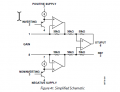
Image of a regular IA amp.
Note pin #5 is the Vref Offset injection point.
Wouldn’t a proper data sheet be great? one with limits of error, and minimum/typical/maximum values? and a value for the output impedance?
Everything hangs on the output voltage at zero pressure, which is halfway between Vmin and Vmax, for which there are no proper data.
An offset of (2.7+0.2)/2=1.45V is very unlikely to work, with a fsd of only a few millivolts.
Why use an instrumentation amplifier, which is designed for differential inputs, when this is a single-ended input?
The whole job could be done with a single op-amp wired as an inverting amplifier, with the non-inverting input connected to a variable reference.
The specs are so vague that it will almost certainly need some sort of calibration facilit.
Hi Eric,
When you say 3rd OPA, I assume you mean the actual difference amplifier OA3?
I think I see what people were getting at. I was worried about the other input pin also, but if the non-inverting input is offset then the inverting input will follow due to negative feedback right?
That could be performed with a summing amp.
Hi Eric,
Thanks for the reply. Now I see what you mean "Really before" as in the straight off the transducer. I had in my head that is the front end buffers and the differential amplifier was in the rear, so I kept thinking it had to be introduced in the second stage. But yes no gain would be the best spot. I will try it out and let you know.
Hi dan,
A quick look at your circuit, I can see that it is becoming tedious.
You don't need the extra pair of OPA's
Look at my circuit post #35, reduce the R6 Gain set resistor to approx 50R, then check the Vout across Va1, Vb1.
Hi Eric,
I have finally got there. I ended up swapping out the non-inverting summing amplifiers for inverting types. It was much better with not further resistance to ground. I will post the schematic.

 Facebook
 Google
 GitHub
 Linkedin