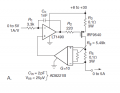
Can anyone simulate this in LTSpice, I tried multiple times but it doesn't work for me. I understand its working principle but I just cant get it to work.
Hi Eric, I am doing an internship and for now I have to implement a current source I managed to make this one and it works, problem is that I want to use an 160 miliohm resistor and I cannot do it practically with this one, so I'm trying to find different topologies.
But you can.
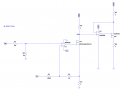
Below is the circuit with some superfluous resistors removed :
The first op amp (U1) generates a constant-current through R3 and R4 to translate the ground-referenced control signal (Vin) to a signal (Ref) referenced to the high-side (Vdd).
The negative-feedback connection of the second op amp (U2) causes the Ref voltage to appear across Rsense, generating the desired high-side current into the grounded load.
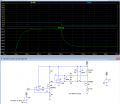
If you select the proper relative (ratio) values for R3 and R4 then you will get 4A of current (green trace) for a 4V input (blue trace) with a 160mΩ Rsense resistor (shown going from 4A initially to 1A @ 50ms).
(Since this is Homework, I leave the values for R3 and R4 as an exercise for you to calculate, which should be reasonably straight-forward based upon the above description of the circuit operation, requiring the solving of just three simple sequential, but non-simultaneous Ohm's law equations.
The absolute resistor values are arbitrary, only their ratio is critical, but their minimum value should be at least 1kΩ, not the 1Ω shown in your circuit.
Hint: R4 resistance is less than R3.)
The second op amp has to be an input/output rail-rail type.
The added resistors and capacitors are to eliminate the oscillations and startup high-current overshoot (≈20A) I observed in the simulation.

 Facebook
 Google
 GitHub
 Linkedin