Need help for Dynamic Braking Unit Design

Thread Starter

Mussawar

Joined Oct 17, 2011
158
Working on a Dynamic Braking unit design and have some questions in my mind.
Scenario: This DBU is intended to use with a 400V class VFD (75KW max) with 55KW induction motor installed on construction crane.
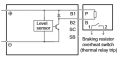
VFD will waste excess DC Bus energy to a 10Ω resistor. Braking range is between dc bus 650V (start) to 800V (peak). Here is a snapshot from a branded manual.
Untitled.png

Requesting some guidance to some points. Might be very basic but still need to clear my mind.
  • IGBT Selection: Since the maximum expected current is 80A, I'm selecting an IGBT with 1200V 100A. Is it enough?
  • PWM or PFM? which one is the best approach to drive braking chopper? A general search on Internet recommends PWM but I want opinion considering this specific scenario. What frequency is good to use?
  • Free Wheel Diode: Resistors used (as I observed) are sometimes wire wound spring type and some are just metal plates with cuts to lengthen them. Are they considered a nominal inductive load? Do I need to use a separate free wheel diode or the built-in body diode is enough to protect the chopper transistor?
  • Protection: In case of chopper transistor damage or short, what protection technique is recommended to save VFD? or to protect DBU from overloading? (sometime users attach resistors lower than recommended values i-e <10Ω). Is a fast blowing fuse with suitable voltage rating enough?

Thanks and best regards.
 
Last edited:

BobTPH

Joined Jun 5, 2013
11,487
No expert here, but it seems to me that changing the frequency will have non-linear effects and be harder to control.

Hope this gets a discussion going, consider it an intuition, not a knowledge based definitive answer.
 

Thread Starter

Mussawar

Joined Oct 17, 2011
158
No expert here, but it seems to me that changing the frequency will have non-linear effects and be harder to control.

Hope this gets a discussion going, consider it an intuition, not a knowledge based definitive answer.
So the very first vote goes to PWM. Little efforts sometime worth tons. What kind of effects come in your mind btw?
 

BobTPH

Joined Jun 5, 2013
11,487
So the very first vote goes to PWM. Little efforts sometime worth tons. What kind of effects come in your mind btw?
The impedance of the inductance changes with frequency, so the relationship between the PFM and power is complex. This is what I was thinking of. I.e, doubling the frequency of a fixed width pulse will not necessarily double the power. But then, with inductance, the same can be said of PWM and duty cycle. I would use simulation to explore the effects. It all depends on the details.

Hopefully, someone with more specific knowledge will weigh in.
 

Thread Starter

Mussawar

Joined Oct 17, 2011
158
The impedance of the inductance changes with frequency, so the relationship between the PFM and power is complex. This is what I was thinking of. I.e, doubling the frequency of a fixed width pulse will not necessarily double the power. But then, with inductance, the same can be said of PWM and duty cycle. I would use simulation to explore the effects. It all depends on the details.
At very low frequencies this will have very little effect. Am I right? Today I observed a practical working system. This observation was just hearing the "ticking/buzzing" sound coming from Resistance box when IGBT switch ON and OFF. I'm sure it was not more than 100Hz.
 

MisterBill2

Joined Jan 23, 2018
27,321
Other questions are HOW HARD do you need to stop? A HARD BRAKING STOP for a half horse 120 volt motor worked with 12 volts DC from a battery charger. And it rolled the motor across the floor the first try. (no load connected)
SO shorting the motor with PWM is a sensible choice. But experimenting will be needed. DC braking , start with a quite low DC voltage.
 

Thread Starter

Mussawar

Joined Oct 17, 2011
158
Other questions are HOW HARD do you need to stop? A HARD BRAKING STOP for a half horse 120 volt motor worked with 12 volts DC from a battery charger. And it rolled the motor across the floor the first try. (no load connected)
SO shorting the motor with PWM is a sensible choice. But experimenting will be needed. DC braking , start with a quite low DC voltage.
Ramping down to stop is decided by VFD deceleration parameter. Usually it is kept between 2.5~4.0 Seconds from 50Hz to zero. Primary goal is not stop the motor by braking but to keep dc bus voltage of VFD within safety limit (between 650V to 800V in this case) during deceleration. While decelerating, due to heavy load inertia, motor generates voltage back to dc bus causing the dc bus voltage rise up beyond the limit. This causes a VFD "Over Voltage" trip. Practical devices vary chopper switching time proportional to bus voltage rise. Let say (if PWM) start braking at 650V (dc bus) with 5% duty cycle and increase the duty cycle proportional to voltage up to 95% at 800V.
DC injection braking can't be used in this case because motor speed is always changing during work and motor can't be left free of VFD control. Imagine a construction crane the have 5 different speeds range from 10Hz to 50Hz (or may be 80Hz or more in some cases). Operator constantly keep changing speed while shifting materials up and down the building.
Keeping the above scenario in mind what PWM frequency should be enough to drive chopper transistor? I can't speculate the system behavior for very low (Hz) to very high (KHz) frequencies.
 

MisterBill2

Joined Jan 23, 2018
27,321
I have seen some drive systems with a LARGE braking load resistor to absorb and disperse the braking energy. Thatis because it is much more than can simply be fed back into the power mains.
Bob makes a very good case towards PWM since there is also the chance of hitting some resonance point when changing the frequency.
 

Thread Starter

Mussawar

Joined Oct 17, 2011
158
I have seen some drive systems with a LARGE braking load resistor to absorb and disperse the braking energy. Thatis because it is much more than can simply be fed back into the power mains.
Bob makes a very good case towards PWM since there is also the chance of hitting some resonance point when changing the frequency.
So PWM seems more suitable.
Next come free wheel diode. High power resistors are usually spring type or Nichrome wire wound. I don't have much knowledge about their inductive behavior. Large IGBTs usually comes with built-in reverse diode like IXYN100N120C3H1 with diode and IXYN100N120C3 without diode. Is it enough to save IGBT from back surge or a separate diode is mandatory?
 

MisterBill2

Joined Jan 23, 2018
27,321
I have seen what I assumed to be braking resistors, mounted above motor control cabinets, that appeared to be made of cast iron. They apparently were intended to handle alot of power.
 

MaxHeadRoom

Joined Jul 18, 2013
30,595
Most motor applications I have been involved in used the resistive (dynamic) braking method.
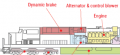
The largest was on Locomotives. the pic shows where the large braking resistors and cooling fans are located.
These are used to suppliment the wheel brakes for use in mountanous regions.

1774974130256.png
 

Thread Starter

Mussawar

Joined Oct 17, 2011
158
I have seen what I assumed to be braking resistors, mounted above motor control cabinets, that appeared to be made of cast iron. They apparently were intended to handle alot of power.
In my specific application, resistors come in to ready made boxes called the "Resistors Box" with different values and power. They can also be combined to obtain desired Wattage and resistance in a metal panel box with good ventilation.
 

MisterBill2

Joined Jan 23, 2018
27,321
So PWM seems more suitable.
Next come free wheel diode. High power resistors are usually spring type or Nichrome wire wound. I don't have much knowledge about their inductive behavior. Large IGBTs usually comes with built-in reverse diode like IXYN100N120C3H1 with diode and IXYN100N120C3 without diode. Is it enough to save IGBT from back surge or a separate diode is mandatory?
The coiled braking resistors have air cores, no iron cores, and so the inductance is much less. BUT possibly a resonance condition could happen if the wrong PWM frequency were used. THAT could get very confusing in a hurry. It might be a harmonic resonance, which certainly has happened in a few instances.
 
Top