Effect of source impedance on DC return path in instrumentation amplifier

Thread Starter

sreedev27

Joined Jan 16, 2026
36
I am trying to understand the DC return path in an instrumentation amplifier and its effect on the circuit. I would like to know how the behavior changes depending on the source impedance specifically, what happens when the source is high impedance versus when it is a 50Ω source?
 

LvW

Joined Jun 13, 2013
1,995
I am trying to understand the DC return path in an instrumentation amplifier and its effect on the circuit. I would like to know how the behavior changes depending on the source impedance specifically, what happens when the source is high impedance versus when it is a 50Ω source?
Why didn`t you show us the circuit? It is not easy to help you without a circuit diagram.
 

ronsimpson

Joined Oct 7, 2019
4,646
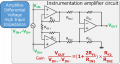
Probably the amplifier is something like this. The signal input is show going from Vin- to Vin+. The input has little to do with the ground. With in reason the inputs can be any voltage the inputs can handle. The amp responds to a difference in voltage of the two inputs.
It can be argued the signal loop is in on Vin+ and back on Vin-. (no ground connection) It can also be argued there is no current flow.
This type of amp has very high input impedance. (almost unmeasurable input current) It will not care if the source impedance is 50 ohms or 50k ohms.
1774541434012.png
 

MisterBill2

Joined Jan 23, 2018
27,170
AS the circuit in post#4 shows, an instrument amplifier is an narrangement of three op-amps. AND, the published specs always give the operational voltage ranges. WHATTHAT MEANS is that it is not so very simple to understand the current flow in an I.A. MOST of the input current flow is between the input terminals, BUT, in addition, part of that input current also flows thru the power supply connections of the two input opamps. You can see that by replacing the three devices with a published opa-amp circuit. At that point the analysis becomes both difficult and tedious.
 
Last edited:

Thread Starter

sreedev27

Joined Jan 16, 2026
36
1774586072409.png

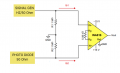
I am referring to the attached diagram as a reference for my question.
In this setup, I have added 1 MΩ resistors from both inputs of the instrumentation amplifier to ground. My intention is to understand the impact of these resistors with respect to the source impedance.
Specifically, since my sources (signal generator and photodiode path) have an impedance of around 50 Ω, I would like to know how the presence of these 1 MΩ resistors affects the input signal.
what would happen if the signal generator (or source) had a high output impedance instead? In that case, how would these 1 MΩ resistors influence the signal in terms of attenuation, loading, or measurement accuracy?

@mis45545 @ronsimpson @LvW @crutschow
 

MisterBill2

Joined Jan 23, 2018
27,170
What I see is NOT AN INPUT TO THEAMPLIFIER! I see two possibly "ground referenced" NOISE sources, each atached to one input of the I.A. with their signals being in series. Of course there is also a connection to ground inbetween the two sources. So this is not really a realistic application for an I.A.
The result is that the output of the IA (Vout) will be the sum of the difference between "Vb1 in and Vb2 in.
The circuit described in post#1, and shown in post #6, is totally different from what an instrument amplifier circuit scheme would ever be used for.
As for the two resistors from the inputs to the common ground, That is often done to center the input common mode voltage within the specified operating voltage range for the I.A. BUT most often the resistors would not be that high a value.
Regarding the effect on the measurement accuracy, the effect is the same as if the 1M resistors were shunted across each separate voltage source. Since both are stated to be 50 ohm source impedances, the effect will be very small.
So any error contribution will also be very small. Consider that for each input the effect is the one megohmresistor across a voltage in serieswiith 50 ohms
 
Last edited:

panic mode

Joined Oct 10, 2011
4,864
regardless of what the
I am trying to understand the DC return path in an instrumentation amplifier and its effect on the circuit. I would like to know how the behavior changes depending on the source impedance specifically, what happens when the source is high impedance versus <low>?
start by simplifying the problem. think in terms of equivalent circuit...
the simplest representation is case is where you have some source (voltage source - with internal resistance) and some load (internal resistance) an the two are connected directly to each other (parallel, wire length is irrelevant since assumed ideal case).

then you will see that two resistances form voltage divider - so voltage at load will be less than voltage of the signal source. low input impedance of an amp is attenuating signal.
to avoid that (to minimize the effect) you want source of signal to be low impedance (the smaller the better) which of course is hard to achieve. so goal is that input impedance of the "load" (your amplifier or whatever) is several times higher than source impedance.
 
Last edited:
Top