Facebook
 Google
 GitHub
 Linkedin
I'll start with a picture...
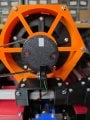
The two red circles are magnets embedded in a 3D printed pulley that I marked before printing to make sure I had the right side towards the sensor. The sensor itself is glued on the inside of the post with the wires coming out the back with roughly 3 mm between the sensor and the magnets as they pass by. Both magnets are triggering the sensor as expected and everything appears correct when turned by hand.
What is happening is as the pulley rotates at higher speeds the sensor does not seem to register the magnets correctly. I measured the pulley RPM with a separate tachometer and it showed around 3000 RPM, but the Hall sensor was only triggering around 110Hz which would equal out to around 55 RPM.
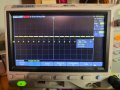
I watched the scope as long as I could handle the noise (it's a siren project) and as far as I could tell there was no erratic signalling, every edge looked nice and crisp, and no other oddities where seen. I tried some different triggering and timing to catch anything out of the ordinary saw nothing different. I tried everything again with a separate power supply and temporary circuit with only the sensor and pull up connected (what is actually in the above picture) and nothing changed.
I did buy the sensors off Amazon and they don't seem to have any manufacturer's logo on them at all so maybe it's just a matter of buying proper parts, but I wanted to see if anyone has any ideas as to what could be wrong. They are your typical transistor looking device https://www.amazon.com/dp/B0CHDSD62C?ref=ppx_yo2ov_dt_b_fed_asin_title&th=1. As far as I can tell from other datasheets they should be fast enough to register at 3000 RPM and even still good at the 5120 RPM I need to hit assuming they are to have similar specifications.
The two red circles are magnets embedded in a 3D printed pulley that I marked before printing to make sure I had the right side towards the sensor. The sensor itself is glued on the inside of the post with the wires coming out the back with roughly 3 mm between the sensor and the magnets as they pass by. Both magnets are triggering the sensor as expected and everything appears correct when turned by hand.
What is happening is as the pulley rotates at higher speeds the sensor does not seem to register the magnets correctly. I measured the pulley RPM with a separate tachometer and it showed around 3000 RPM, but the Hall sensor was only triggering around 110Hz which would equal out to around 55 RPM.
I watched the scope as long as I could handle the noise (it's a siren project) and as far as I could tell there was no erratic signalling, every edge looked nice and crisp, and no other oddities where seen. I tried some different triggering and timing to catch anything out of the ordinary saw nothing different. I tried everything again with a separate power supply and temporary circuit with only the sensor and pull up connected (what is actually in the above picture) and nothing changed.
I did buy the sensors off Amazon and they don't seem to have any manufacturer's logo on them at all so maybe it's just a matter of buying proper parts, but I wanted to see if anyone has any ideas as to what could be wrong. They are your typical transistor looking device https://www.amazon.com/dp/B0CHDSD62C?ref=ppx_yo2ov_dt_b_fed_asin_title&th=1. As far as I can tell from other datasheets they should be fast enough to register at 3000 RPM and even still good at the 5120 RPM I need to hit assuming they are to have similar specifications.