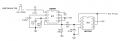
Hall effect sensor signal to VR convertor #2

Thread Starter

MikeBass

Joined Nov 8, 2025
3
Reading through this thread, I have a similar situation.

I'm adapting a Hall sensor output to be read by a VR sensor input. The Hall sensor outputs 1V (constant) and frequency varies 0-130Hz according to wheel speed. The VR sensor input is expecting 0-1V & 0-130Hz according to wheel speed. Obviously, the frequency is not the problem, but the voltage is.

Anyone have a way to make this work ?


Moderators note, this was moved from this thread:
https://forum.allaboutcircuits.com/threads/hall-effect-sensor-signal-to-vr-convertor.188642/
 
Last edited by a moderator:

Thread Starter

MikeBass

Joined Nov 8, 2025
3
Unfortunately not. Don't need any voltage boost. 1V is the max for this system.

The VR sensor varies the voltage from 0 to 1V according to wheel speed.
The Hall sensor registers 1V constant when any wheel movement is detected regardless of speed.

I'm looking to make the Hall sensor voltage output (constant @ 1V) appear to the VR sensor input as variable from 0-1V. The frequency for both sensors varies from 0-130Hz according to wheel speed, so perhaps the variability of the voltage from the Hall sensor could be based on the frequency ?

Additionally, the Hall sensor outputs a square wave, whereas, the VR sensor outputs a sine wave. Not sure what effect that has, but I'll mention that as well.

Ideas ? Off-the-shelf devices ? DIY circuit ?
 

geekoftheweek

Joined Oct 6, 2013
1,429
Typically the only thing a VR input looks for is when the signal either crosses zero and goes negative or crosses zero and goes positive. The actual voltage produced typically doesn't matter as long as it is not more than the input can handle. It may be possible to connect the hall output directly to one wire of the VR input and ground the other VR input and use it that way.

What are you using to measure voltages? A 1V hall signal doesn't sound normal and depending on the waveform your meter may not be measuring it correctly.
 

MisterBill2

Joined Jan 23, 2018
27,180
For a positive square wave signal to drive a zero crossing input you need a capacitor coupling to allow it to be zero centered,
But for that to be optimum you need to have an idea as tothe signal source impedance.

(GOODNIGHT FOLKS. Till tomorrow, later..)
 

MisterBill2

Joined Jan 23, 2018
27,180
Getting a voltage that increases according to frequency in a linear manner is often useful, BUT if the application is to feed an antilock brake controller that an AC waveform signal at 4 volts, zero center input there is not much benefit. THAT is the reason I suggested an amplifier with a capacitor RC filtered output in post #6. No, I did not draw a circuit. It will need to be a single supply op-amp with some offset arrangement because the output will be only positive. So capacitor coupled with a resistor to common.for the output.
 

geekoftheweek

Joined Oct 6, 2013
1,429
Tried to direct wire the Hall sensor output to the VR sensor input. Doesn't work.
I was hoping that would work like it does for HEI modules. Is the low part of the signal from the Hall sensor actually at 0V or a little above (like .5V or something)? If not at 0V a simple diode inline may do the trick. I know some sensors won't drop all the way to 0 as a form of error check. If the controller sees 0V in then it reads it as a fault.

At any rate the answer is probably going to be to create some form of zero crossing signal.
 

MisterBill2

Joined Jan 23, 2018
27,180
What will work depends quite a bit on exactly how the signal is registered. If it is looking for a zero crossing then yo need a zero crossing.
 
Top