I want a Demagnetize circuit

Thread Starter

q12x

Joined Sep 25, 2015
2,227
What happens if Im adding TOO MUCH coil? Lets say it will not overheat anymore from 240VAC from the amount of coil added. But what are the side effects of too much coil around this silicon core?
 

Thread Starter

q12x

Joined Sep 25, 2015
2,227
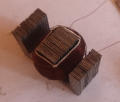
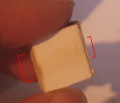
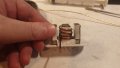
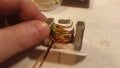
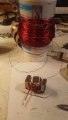
Tadaaa... I manage to make this:
20240618_114000.jpg
my finger there for scale.
I have no idea how many turns I put there. Lets say is 2000? But is a guess. As before, I winded like a neanderthal.
I finished that roll of coil, transferring all coil to this core here.
I tested at 24VAC from my variac. It passed like 15-20s until the coil started to warm up - not hot ! Which is good. It got hot at probably 30s or so.
-The good thing is that I tested some magnetized needles and it is demagnetizing them. I had to try a couple of times but is doing its job. The fact that is running warm and not hot is very important to make several tests for demagnetization.
It is a real handicap to NOT use it at 240VAC directly, without overheating it. But I kind of learned my lesson with this one. The lesson is "a ton of wire" !!! Aaaah...
Theoretically it is done now, is doing its demagnetization thing, and not overheating too quickly.
I will try to push it to 240Vac and also slow down the time its getting hot. These are the 2 remaining things left to do. If you ask me, its already VERY big ! It may look small in the picture but when Im holding in my hand, and winding unterminables wires over it ...it's ohohohoooa big ! Its my subjective impression now. Especially from where I started with that small coil in its center: 1718701054539.png
Hmmmmm.... interesting project nevertheless. Im happy its giving signs of working now.
 
Last edited:

Lightium

Joined Jun 6, 2012
320
I think you should know this formula for heating of a mass.

The mass being your wire, V*I*t*eff = c*m*dT

V=volts I=current t=time eff=efficiency
c=specific heat of the wire
m=mass in Kg
dT=temperature change in C
 
Last edited:

MrChips

Joined Oct 2, 2009
34,870
What you need now is a coil winder. Then you will be able to create tight compact coils very quickly. Add a revolution counter and you can wind an exact number of turns. You don't need the motorized version. One that is hand cranked gives you better control.

1718720094501.png
 

Thread Starter

q12x

Joined Sep 25, 2015
2,227
haha, you read my mind. Im actually dreaming on a coil winding for a looooooooooooooooooooong time. I never stopped to build one. Also its counter; Im very undecided if mechanical (VERY reliable) or electronic (im not that sure how reliable it is - to be mega sincere). Mechanical is costly to my forever empty unemployed pockets because I live in romanian capitalism that doesnt care if you die poor or die working like a slave,... or electronicaly I can make it in 1 or few days with the components I have.
You read very good that I made that coil by hand -very good eye. Also my hand joints are not that great after this exercise.
 
Last edited:

Thread Starter

q12x

Joined Sep 25, 2015
2,227
- Like I said, I have like 5 or 6 --different-- diameter wires inside this experimental coil. Some VERY thin and very scrapped and some thick enough like you see in the images I posted already, 0.6mm diam was the thickest, the rest are VERY thin.
- Today test was at 240VAC and I obtain a very strong Hum. But between the major windings I have some gaps and I actually seen a small spark through this gaps. Then a small smoke string exactly from that zone where I see the spark. This is because my very scrapped wires I used, I know. But Im also thinking is because the very small diameter wire perhaps.
- The test was like this: Switch ON, count 1-2, then switch OFF. I did this operation 5 times with some pause between them. The first was the spark, the second and the 3rd the smoke. The 4th and 5th was hot with strong tendency to get very hot if I wasn't careful + good specific hot smell indicative. Usually I test with my fingers and this time with my upper lip, being very sensitive to warm-hot surfaces, especially coming from interior of the winding. With everything unpowered.
- Im thinking.... to unwind everything back to 0, and rewind again, but only with this thick wire + another thick one in continuation. Avoiding those very thin wires I used so far. I bet they act like very fine fuses and they most probably get the hottest. I strongly think they are the weak links. Hmmmm....
- Never expect good results from the first try, and now I have a better idea of the size of this coil, how big it should be in the end.
 
Last edited:

Thread Starter

q12x

Joined Sep 25, 2015
2,227
I didnt test it at 240VAC ! It was smoking and sparking and I didnt wanted to risk it, putting my attention in other direction.
But it did it for 24VAC !
 

Thread Starter

q12x

Joined Sep 25, 2015
2,227
I already took out all the coils out now !
I will wind thicker wire for the core inside the E. And the exterior wire will be this red one + another hopefully same diameter. The idea is to add thicker in interior, close to the core and thinner as im expanding outside the core. Ideally the same thickens if I have the material. Will see. I already see the burned cardboard where the coil was sparking and yellowed from heat.
1718811653701.png
yellowed from heat:
1718811725360.png
 

Thread Starter

q12x

Joined Sep 25, 2015
2,227
Update on the progress.
I rewind the entire coil with the best (scrapped) coil I had. No more black (most probably scorched) wires.
But I get to an impasse. I dont have any more -scrapped- wire left. Good ones I mean.
The coil as it is right now is having very thick wire in the core center, and getting thinner as progressing outwards.
Now I have 5 types of coil but more resilient and more turns as before.
When I plug it in 240VAC, Switch ON, 1-2-3-4s and is getting hot, then Switch OFF.
It is still very hot ! And I dont have any more good wires to spare, only very risky ones. And is pretty big already.
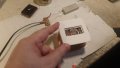
20240620_122140.jpg
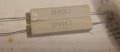
I put a variety of resistors in series with the coil. Small ones like 1R,10R are not getting hot, only the coil.
Bigger resistors are getting hot, like 100R-1K. Here I put 2x1k=500R in // and they still got very hot.
At 1k I cant hear the transformer humm. At 100R I can hear it good enough. At 500R barely I can hear it.
THat humm is an indicative how strong the field will be.
Im trying literally my best, to make it reliable, not overheat and safe. So far.... I failed.
20240620_122133.jpg
After power resistor failed experiment, I got an interesting IDEA !!!
If you remember, with the previous coil I could drive it safely at 24VAC from my variac. But it was still overheating after some time.
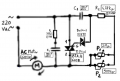
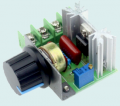
What if Im controlling the mains AC voltage and reduce it to about 25Vac, but using a triac-diac pair circuit ? Eh,eh ?
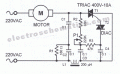
Like this one that I reverse engineer it long time ago and I also have components for it to build it myself:
1718876730388.png1718877045159.png
This cct is chopping the AC voltage exactly like a DC PWM. So its basically a PWM for AC.
The Motor in the circuit is basically a coil, and is exactly what I have on my table.
My idea is to tweak the circuit until the coil remains cold, and there is good amount of EMF (the humm) to do the job I need.
What you think of this idea? Cool, no?
Im also thinking ahead, to an automatic mechanism that when I press a button, it will lower down automatically the intensity of the EMF, simulating my hand movement in the demagnetizing process. I will have to think on that after I will resolve the overheating problem.
Hmmmm..... Why didnt I think of this earlier? before rewinding the 2nd bobin with such big amount of coil?
Anyway- tell me what you think. Or other interesting ideas.
Thank you.
--------
here is an alternative cct (from internet), to my reversed engineered one:
motor-speed-regulator-schematic.gifI trust my cct more, because I build it 3 times in my life and it worked. Im not sure about this alternative cct. Will see. Is good to have options.
 

sarahMCML

Joined May 11, 2019
699
Update on the progress.
I rewind the entire coil with the best (scrapped) coil I had. No more black (most probably scorched) wires.
But I get to an impasse. I dont have any more -scrapped- wire left. Good ones I mean.
The coil as it is right now is having very thick wire in the core center, and getting thinner as progressing outwards.
Now I have 5 types of coil but more resilient and more turns as before.
When I plug it in 240VAC, Switch ON, 1-2-3-4s and is getting hot, then Switch OFF.
It is still very hot ! And I dont have any more good wires to spare, only very risky ones. And is pretty big already.
View attachment 325010
I put a variety of resistors in series with the coil. Small ones like 1R,10R are not getting hot, only the coil.
Bigger resistors are getting hot, like 100R-1K. Here I put 2x1k=500R in // and they still got very hot.
At 1k I cant hear the transformer humm. At 100R I can hear it good enough. At 500R barely I can hear it.
THat humm is an indicative how strong the field will be.
Im trying literally my best, to make it reliable, not overheat and safe. So far.... I failed.
View attachment 325011
After power resistor failed experiment, I got an interesting IDEA !!!
If you remember, with the previous coil I could drive it safely at 24VAC from my variac. But it was still overheating after some time.
What if Im controlling the mains AC voltage and reduce it to about 25Vac, but using a triac-diac pair circuit ? Eh,eh ?
Like this one that I reverse engineer it long time ago and I also have components for it to build it myself:
View attachment 325012View attachment 325013
This cct is chopping the AC voltage exactly like a DC PWM. So its basically a PWM for AC.
The Motor in the circuit is basically a coil, and is exactly what I have on my table.
My idea is to tweak the circuit until the coil remains cold, and there is good amount of EMF (the humm) to do the job I need.
What you think of this idea? Cool, no?
Im also thinking ahead, to an automatic mechanism that when I press a button, it will lower down automatically the intensity of the EMF, simulating my hand movement in the demagnetizing process. I will have to think on that after I will resolve the overheating problem.
Hmmmm..... Why didnt I think of this earlier? before rewinding the 2nd bobin with such big amount of coil?
Anyway- tell me what you think. Or other interesting ideas.
Thank you.
--------
here is an alternative cct (from internet), to my reversed engineered one:
View attachment 325014I trust my cct more, because I build it 3 times in my life and it worked. Im not sure about this alternative cct. Will see. Is good to have options.
Just find a suitable voltage to run it at from your Variac, and then slowly turn it down to zero. Done!
 

Thread Starter

q12x

Joined Sep 25, 2015
2,227
Just find a suitable voltage to run it at from your Variac, and then slowly turn it down to zero. Done!
I did it already and it works - like I said, at 24VAC and I managed to demagnetize a few needles.
But I want to make it more permanent and more portable, this means to plug it at 240VAC.
 

Thread Starter

q12x

Joined Sep 25, 2015
2,227
- The second coil that has 5 diameters wires in it, I tested today at 24VAC and is demagnetizing ok, but the field is very weak. I test it for probably 1minute or so, with interruptions, and is getting -warm- very slowly, not as fast as with the other ones before it. So this is a tiny progress.
- And I was right ! The thinner the coil, the hotter and faster it gets. The middle of the coil, in the middle of the E core was cold, and the core itself made from steel, was also cold. Only the --exterior-- was warming up because is small diam wires, remember? I put very thick wire inside and thinner towards outside. This way I can monitor the situation. It was a good idea I had. And now I have the answer, and I was right.
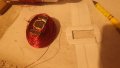
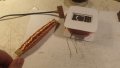
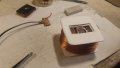
#1 coil(very thick):20240619_190725.jpg#2coil:20240619_192101.jpg#3coil(the red one)20240619_193342.jpg20240619_211531.jpg
#4coil is already added and #5coil is to be added from that stick20240620_105301.jpg
and here is with #5coil20240620_122126.jpg
- My conclusions: -Using a thicker wire reduces the resistance and heat generation ! The thinner the wire, the faster and hotter will get. So my earlier idea that the diameter of the wire doesnt matter was a bad guess. This experiment proves how reality is. This was (partially) my original question and I didnt 100% know this detail. Nobody did also it seems. So you, like me, have little experience with coils as well, right? I think its a very underestimated component in electronics, although it is used all the time in a large variety of boards all around us. But we never use them in our projects ! That's my point.
- The way I make the coil: neanderthal way ! No thinking, just winding mindlessly because the more winds you have, the better. Thats the only philosophy.
No matter the core diameter, size, area, height, shape. Just wind coil and thats it. Neanderthal way.
- To be truthful, Im not completely happy with this last coil. Because it is not stronger at 24VAC with more coils on it as I was expecting to be, from my earlier experiments. I slowed down the heating time, that is true and is very good, but inverse proportional, the strength diminished. Aaah.... And I have an idea why, is because a lot of wire is too much outside the core and not really affecting the EMF, but they are playing the role of a resistor only. The interior wire, close to the core, thats what is creating the EMF, how strong it gets from how many turns around in the very-very-very proximity of the core. Not too outside. Thats my theory and how I see it.
- I have no idea how to make this core have stronger EMF and not get too hot in the same time. What a project. But in some %, I did make it.
- I also realized that this demagnetizer is also an electromagnet in the same time. It serves 2 purposes. Nice, right?
 
Last edited:

Thread Starter

q12x

Joined Sep 25, 2015
2,227
Sohow long does it take to demagnetize something like a screwdriver?? Just a very few seconds, really.
yes, like 5 sec. But sometimes remains some islands of magnetization and you have to redo this process like 3-4-5 times until is really completely demagnetized. Also the tool you are testing with, gets magnetized so you have to demagnetize that as well, until nothing sticks.
 
Last edited:

Thread Starter

q12x

Joined Sep 25, 2015
2,227
These are interesting details for me to know, from your experience.
This is the first demagnetizer for me, in my entire life! I have no reference to compare with. Only movies from internet and web pages and forum discussions.
I start to realize that the thicker the wire, less resistance through the wire and less heat. I had a very good intuition to add thicker wire, I wasnt very sure, but now I start to be very sure, it is the answer. I also start to believe there is a sweet spot, like a perfect balance between heating up, good EMF, number of coils, AC voltage applied, current allowed, + some cooling I have no idea where to place it if its a slab of aluminium, and not using a fan. So... all of these, I have to balance them in such a way, to give me the best result I can get. Most certainly it will not be the most perfect or efficient result but it will be good enough to collect a good result from it. Thats how I feel it should be. This is the "old way" of electronics that I observed in my past encounters. This is done purely experimental and I have to proceed with patience and to listen to the smallest changes and hints. Its very difficult. I already started to give up on the project, in some percentage. We'll see if I will ever continue it, because doing it alone, is not easy nor fun.
 

MisterBill2

Joined Jan 23, 2018
27,652
These are interesting details for me to know, from your experience.
This is the first demagnetizer for me, in my entire life! I have no reference to compare with. Only movies from internet and web pages and forum discussions.
I start to realize that the thicker the wire, less resistance through the wire and less heat. I had a very good intuition to add thicker wire, I wasnt very sure, but now I start to be very sure, it is the answer. I also start to believe there is a sweet spot, like a perfect balance between heating up, good EMF, number of coils, AC voltage applied, current allowed, + some cooling I have no idea where to place it if its a slab of aluminium, and not using a fan. So... all of these, I have to balance them in such a way, to give me the best result I can get. Most certainly it will not be the most perfect or efficient result but it will be good enough to collect a good result from it. Thats how I feel it should be. This is the "old way" of electronics that I observed in my past encounters. This is done purely experimental and I have to proceed with patience and to listen to the smallest changes and hints. Its very difficult. I already started to give up on the project, in some percentage. We'll see if I will ever continue it, because doing it alone, is not easy nor fun.
With thicker wire certainly there is less resistance, and therefore more current, and so the amount of heat will be different. Keep in mind that power in watts equals voltage multiplied by current.
The reality is that power (in watts) is directly related to heat produced, and so there may, or not, be more heat. Of course, power in minus the work delivered, leaves the balance as heat. If the efficiency was 100% then there would not be any heat produced. But 100% efficiency is quite rare, and so moost processes produce some amount of heat.
 
Top