Facebook
 Google
 GitHub
 Linkedin

Hi, I'm building a Piezoelectric (PVDF) sensor based BCG measuring circuit that will be used to extract HRV and RR. It is supposed to lay underneath a mattress, and measure these using the recoil in our body due to heartbeat and also our breathing rate. The sensor I'm using is the SML-300. No exact datasheet to be found, the internal Capacitance is 2nF.
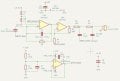
Ive attached the image of the circuit i made. Small difference, Im not using the VREF rail since i made that because the STM32 cant handle negative voltages but for now im using a Saleae logic analyzer to measure voltage change.
Pressing the fully insulated film (tape + silicone strip) → absolutely no change in the output. No spike, nothing.
The only time I get a response is touching the bare exposed electrode with a finger — and that's a clean 50 Hz waveform, i.e. mains coupling through my body into the high-Z node, not a mechanical signal.
So I have no evidence of any real mechanical piezo response — everything I've seen appears to be electrical mains pickup via bare contact. Ideally a press through the insulator should generate charge and show a spike, and it doesn't.
A second oddity I can't explain: increasing R4 (the gain stage's input-to-VREF resistor, 1k → 100k → 1M) makes the decay transient look more prominent (see the two attached traces). By the non-inverting gain formula (1 + R5/R4) increasing R4 should reduce gain toward unity, so I'd expect the signal to shrink, not grow. Not sure if I'm seeing a time-constant/settling effect rather than real gain, or something else. Image 2 is with R4 = 1K ohms and image 3 is with R4 = 1M ohm.
1. Why does increasing R4 (which should lower the gain) make the transient more visible, not less? Time constant / DC settling effect, or am I misreading the topology?
2. Bigger issue: why would a mechanical press through insulation produce zero output while only bare-contact 50 Hz shows up? Does this mean my sensor isn't mechanically coupling/working, or is gentle finger pressure just too weak/slow to generate detectable charge through a charge amp with a 0.17 Hz HPF?
3. For bare PVDF on a high-Z charge amp, is a grounded foil shield (insulated from electrodes) the standard fix for the 50 Hz pickup? Any grounding gotchas?
4. How do people bench-test PVDF mechanical response in a way that isn't contaminated by body-coupled mains? (Battery power, Faraday cage, mechanical tapper, signal injection?)
Any help is appreciated! Thanks!
Ive attached the image of the circuit i made. Small difference, Im not using the VREF rail since i made that because the STM32 cant handle negative voltages but for now im using a Saleae logic analyzer to measure voltage change.
Pressing the fully insulated film (tape + silicone strip) → absolutely no change in the output. No spike, nothing.
The only time I get a response is touching the bare exposed electrode with a finger — and that's a clean 50 Hz waveform, i.e. mains coupling through my body into the high-Z node, not a mechanical signal.
So I have no evidence of any real mechanical piezo response — everything I've seen appears to be electrical mains pickup via bare contact. Ideally a press through the insulator should generate charge and show a spike, and it doesn't.
A second oddity I can't explain: increasing R4 (the gain stage's input-to-VREF resistor, 1k → 100k → 1M) makes the decay transient look more prominent (see the two attached traces). By the non-inverting gain formula (1 + R5/R4) increasing R4 should reduce gain toward unity, so I'd expect the signal to shrink, not grow. Not sure if I'm seeing a time-constant/settling effect rather than real gain, or something else. Image 2 is with R4 = 1K ohms and image 3 is with R4 = 1M ohm.
1. Why does increasing R4 (which should lower the gain) make the transient more visible, not less? Time constant / DC settling effect, or am I misreading the topology?
2. Bigger issue: why would a mechanical press through insulation produce zero output while only bare-contact 50 Hz shows up? Does this mean my sensor isn't mechanically coupling/working, or is gentle finger pressure just too weak/slow to generate detectable charge through a charge amp with a 0.17 Hz HPF?
3. For bare PVDF on a high-Z charge amp, is a grounded foil shield (insulated from electrodes) the standard fix for the 50 Hz pickup? Any grounding gotchas?
4. How do people bench-test PVDF mechanical response in a way that isn't contaminated by body-coupled mains? (Battery power, Faraday cage, mechanical tapper, signal injection?)
Any help is appreciated! Thanks!
Attachments
-
 178.3 KB Views: 19
 -
 243.9 KB Views: 15
 -
 246.3 KB Views: 11