Facebook
 Google
 GitHub
 Linkedin
Hello,
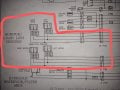
I am a farmer not an electrical engineer, but I have recently been trying to learn more about the electronics we use in farming. I have been trying to troubleshoot the grain loss system on our combine that hasn't worked in years. Keeping in mind that I am a farmer, as I understand it the sensors are just a piezo sensor glued to a piece of plastic over a piece of foam that isolates the sensor from the vibration of the machine (first picture). Any grain striking the plastic will send a signal to a monitor in the cab telling me that the machine is overloaded and dumping grain onto the ground with the chaff. There are four sensors on the machine @ $800 a piece. Could we fix these sensors for around ten bucks?
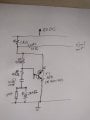
The resistors seem to have tested as good. The pair on the bottom left (second picture) @ 46k ohm, top center @ 22k ohm, and pair on bottom right @ 1k ohm.
The number on the transistor reads 2N 4401 422. I found a clip on YouTube on how to test small transistors using diode mode, and it showed a reading from base to emitter and from base to collector. I'm assuming it is good, but as I said, I am a farmer.
Now the problem, I could not get any reading from the piezo or capacitor. As I understand (again from YouTube), a good piezo should flash a voltage reading when tapped. I could not get any reading. And a good capacitor should build a charge (?) in diode mode or build resistance when ohmed. I could not get either reading. The number on the capacitor is 473K 100N.
Now my questions:
1) The piezo and capacitor are wired directly in series and both seem to be bad. Would one going bad cook the other? This sensor is original off a 1998 machine, so it is old.
2) The capacitor number is 473K 100N. I read that the top number on a small capacitor is usually the capacitance in Farad and the lower number is the maximum voltage it can handle. So what's with the N? Is it in Newtons? The closest I could find on Amazon is a 473K 250V metallized film capacitor; would that work? I forgot to mention that the power to the sensor is 8V.
3) Putting quality of manufacture aside, is a piezo a piezo a piezo? I couldn't find any product that suggested a difference in the voltage put off by a sensor when struck, but none look like the one I have on the sensor. Would any generic piezo do?
This machine is old and the components are getting harder to find. Many sensors are getting ridiculously expensive. Do you think this is possible to fix? Maybe I'll have to bite the bullet and drop the $3200? Thank you all in advance for your help and insight. Thank you. Thank you.


I am a farmer not an electrical engineer, but I have recently been trying to learn more about the electronics we use in farming. I have been trying to troubleshoot the grain loss system on our combine that hasn't worked in years. Keeping in mind that I am a farmer, as I understand it the sensors are just a piezo sensor glued to a piece of plastic over a piece of foam that isolates the sensor from the vibration of the machine (first picture). Any grain striking the plastic will send a signal to a monitor in the cab telling me that the machine is overloaded and dumping grain onto the ground with the chaff. There are four sensors on the machine @ $800 a piece. Could we fix these sensors for around ten bucks?
The resistors seem to have tested as good. The pair on the bottom left (second picture) @ 46k ohm, top center @ 22k ohm, and pair on bottom right @ 1k ohm.
The number on the transistor reads 2N 4401 422. I found a clip on YouTube on how to test small transistors using diode mode, and it showed a reading from base to emitter and from base to collector. I'm assuming it is good, but as I said, I am a farmer.
Now the problem, I could not get any reading from the piezo or capacitor. As I understand (again from YouTube), a good piezo should flash a voltage reading when tapped. I could not get any reading. And a good capacitor should build a charge (?) in diode mode or build resistance when ohmed. I could not get either reading. The number on the capacitor is 473K 100N.
Now my questions:
1) The piezo and capacitor are wired directly in series and both seem to be bad. Would one going bad cook the other? This sensor is original off a 1998 machine, so it is old.
2) The capacitor number is 473K 100N. I read that the top number on a small capacitor is usually the capacitance in Farad and the lower number is the maximum voltage it can handle. So what's with the N? Is it in Newtons? The closest I could find on Amazon is a 473K 250V metallized film capacitor; would that work? I forgot to mention that the power to the sensor is 8V.
3) Putting quality of manufacture aside, is a piezo a piezo a piezo? I couldn't find any product that suggested a difference in the voltage put off by a sensor when struck, but none look like the one I have on the sensor. Would any generic piezo do?
This machine is old and the components are getting harder to find. Many sensors are getting ridiculously expensive. Do you think this is possible to fix? Maybe I'll have to bite the bullet and drop the $3200? Thank you all in advance for your help and insight. Thank you. Thank you.