I trust my cct more, because I build it 3 times in my life and it worked. Im not sure about this alternative cct. Will see. Is good to have options.Just find a suitable voltage to run it at from your Variac, and then slowly turn it down to zero. Done!Update on the progress.
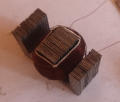
I rewind the entire coil with the best (scrapped) coil I had. No more black (most probably scorched) wires.
But I get to an impasse. I dont have any more -scrapped- wire left. Good ones I mean.
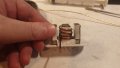
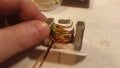
The coil as it is right now is having very thick wire in the core center, and getting thinner as progressing outwards.
Now I have 5 types of coil but more resilient and more turns as before.
When I plug it in 240VAC, Switch ON, 1-2-3-4s and is getting hot, then Switch OFF.
It is still very hot ! And I dont have any more good wires to spare, only very risky ones. And is pretty big already.
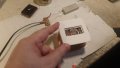
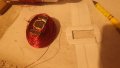
View attachment 325010
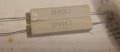
I put a variety of resistors in series with the coil. Small ones like 1R,10R are not getting hot, only the coil.
Bigger resistors are getting hot, like 100R-1K. Here I put 2x1k=500R in // and they still got very hot.
At 1k I cant hear the transformer humm. At 100R I can hear it good enough. At 500R barely I can hear it.
THat humm is an indicative how strong the field will be.
Im trying literally my best, to make it reliable, not overheat and safe. So far.... I failed.
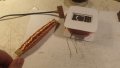
View attachment 325011
After power resistor failed experiment, I got an interesting IDEA !!!
If you remember, with the previous coil I could drive it safely at 24VAC from my variac. But it was still overheating after some time.
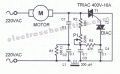
What if Im controlling the mains AC voltage and reduce it to about 25Vac, but using a triac-diac pair circuit ? Eh,eh ?
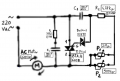
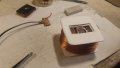
Like this one that I reverse engineer it long time ago and I also have components for it to build it myself:
View attachment 325012View attachment 325013
This cct is chopping the AC voltage exactly like a DC PWM. So its basically a PWM for AC.
The Motor in the circuit is basically a coil, and is exactly what I have on my table.
My idea is to tweak the circuit until the coil remains cold, and there is good amount of EMF (the humm) to do the job I need.
What you think of this idea? Cool, no?
Im also thinking ahead, to an automatic mechanism that when I press a button, it will lower down automatically the intensity of the EMF, simulating my hand movement in the demagnetizing process. I will have to think on that after I will resolve the overheating problem.
Hmmmm..... Why didnt I think of this earlier? before rewinding the 2nd bobin with such big amount of coil?
Anyway- tell me what you think. Or other interesting ideas.
Thank you.
--------
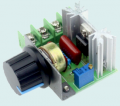
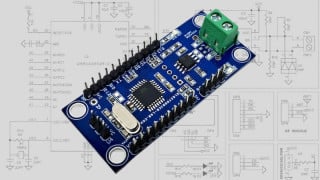
here is an alternative cct (from internet), to my reversed engineered one:
View attachment 325014I trust my cct more, because I build it 3 times in my life and it worked. Im not sure about this alternative cct. Will see. Is good to have options.
I did it already and it works - like I said, at 24VAC and I managed to demagnetize a few needles.Just find a suitable voltage to run it at from your Variac, and then slowly turn it down to zero. Done!
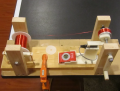
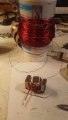
#2coil:
#3coil(the red one)


yes, like 5 sec. But sometimes remains some islands of magnetization and you have to redo this process like 3-4-5 times until is really completely demagnetized. Also the tool you are testing with, gets magnetized so you have to demagnetize that as well, until nothing sticks.Sohow long does it take to demagnetize something like a screwdriver?? Just a very few seconds, really.
With thicker wire certainly there is less resistance, and therefore more current, and so the amount of heat will be different. Keep in mind that power in watts equals voltage multiplied by current.These are interesting details for me to know, from your experience.
This is the first demagnetizer for me, in my entire life! I have no reference to compare with. Only movies from internet and web pages and forum discussions.
I start to realize that the thicker the wire, less resistance through the wire and less heat. I had a very good intuition to add thicker wire, I wasnt very sure, but now I start to be very sure, it is the answer. I also start to believe there is a sweet spot, like a perfect balance between heating up, good EMF, number of coils, AC voltage applied, current allowed, + some cooling I have no idea where to place it if its a slab of aluminium, and not using a fan. So... all of these, I have to balance them in such a way, to give me the best result I can get. Most certainly it will not be the most perfect or efficient result but it will be good enough to collect a good result from it. Thats how I feel it should be. This is the "old way" of electronics that I observed in my past encounters. This is done purely experimental and I have to proceed with patience and to listen to the smallest changes and hints. Its very difficult. I already started to give up on the project, in some percentage. We'll see if I will ever continue it, because doing it alone, is not easy nor fun.