How do you properly troubleshoot a simple circuit that isn’t working?

Thread Starter

BeablossomR_

Joined Jun 4, 2026
27
Hi everyone,

I’m still learning the basics of electronics and was wondering when a simple circuit (like an LED circuit) doesn’t work, what’s your usual step-by-step troubleshooting process?

Do you start with checking voltage, connections, or components first? I’d like to build a good habit early on instead of just guessing.

Appreciate any advice!
 

bertus

Joined Apr 5, 2008
22,949
Hello,


The series resistor for the led can be calculated as followed:
Rled = (Vsupply - Vled) / ledcurrent.
For example the Vsupply = 12 Volts.
Vled = 3 Volts. ( a blue led has a voltage drop of about 3 Volts, use the correct voltage given in the datasheet of the used led)
Ledcurrent = 20 mA =0.02 A.
Rled = ( 12 - 3 ) / 0.02 = 450 Ohms.
The closest higher value for the resistor will be 470 Ohms.

If the led will not light up, there can be several things wrong.
A led is a light emmitting diode, when connected the wrong way around, there will be no light.
There is a wrong (to high value) resistor or a bad connection.
You can measure the voltage accross the resistor and accross the led.
If you measure almost the battery voltage accross the led, the led is mounted the wrong way around or defective.

Bertus
 

WBahn

Joined Mar 31, 2012
32,953
A lot depends on the context. If I'm powering the circuit from a battery that I know is good (just used it for something else), I'm not going to check to see if it is still supplying the expected voltage. But if that part of the circuit is being supplied by some other part of the circuit, say a transistor switch, then the presence of the expected voltage is probably one of the first things I will verify.

In general, go for the low-hanging fruit first. Things that are quick and easy to check, in circuit, with a DMM are top contenders.
 

Thread Starter

BeablossomR_

Joined Jun 4, 2026
27
A lot depends on the context. If I'm powering the circuit from a battery that I know is good (just used it for something else), I'm not going to check to see if it is still supplying the expected voltage. But if that part of the circuit is being supplied by some other part of the circuit, say a transistor switch, then the presence of the expected voltage is probably one of the first things I will verify.

In general, go for the low-hanging fruit first. Things that are quick and easy to check, in circuit, with a DMM are top contenders.
That makes a lot of sense, especially starting with the easy checks first. I think I tend to overthink it sometimes instead of just verifying the basics.

Using a DMM for quick checks is something I’m trying to get more comfortable with too.

Appreciate the insight!
 

Thread Starter

BeablossomR_

Joined Jun 4, 2026
27
Hello,


The series resistor for the led can be calculated as followed:
Rled = (Vsupply - Vled) / ledcurrent.
For example the Vsupply = 12 Volts.
Vled = 3 Volts. ( a blue led has a voltage drop of about 3 Volts, use the correct voltage given in the datasheet of the used led)
Ledcurrent = 20 mA =0.02 A.
Rled = ( 12 - 3 ) / 0.02 = 450 Ohms.
The closest higher value for the resistor will be 470 Ohms.

If the led will not light up, there can be several things wrong.
A led is a light emmitting diode, when connected the wrong way around, there will be no light.
There is a wrong (to high value) resistor or a bad connection.
You can measure the voltage accross the resistor and accross the led.
If you measure almost the battery voltage accross the led, the led is mounted the wrong way around or defective.

Bertus
Thanks, that actually helps a lot. The example made it much clearer, especially how to calculate the resistor value.

I’ll double check the polarity and try measuring across the LED and resistor like you suggested. I didn’t realize that could point out if it’s connected the wrong way or faulty.

Appreciate the detailed explanation!
 

WBahn

Joined Mar 31, 2012
32,953
That makes a lot of sense, especially starting with the easy checks first. I think I tend to overthink it sometimes instead of just verifying the basics.

Using a DMM for quick checks is something I’m trying to get more comfortable with too.

Appreciate the insight!
Also, don't forget that the wires connecting things can be the problem, too, particularly on a solderless breadboard. So check the voltage at both pins of a connection. If you get different results, the connection between them is bad.
 

Thread Starter

BeablossomR_

Joined Jun 4, 2026
27
Also, don't forget that the wires connecting things can be the problem, too, particularly on a solderless breadboard. So check the voltage at both pins of a connection. If you get different results, the connection between them is bad.
That’s a good point I think I tend to overlook the wires sometimes, especially on a breadboard.

I’ll start checking both ends of the connection more carefully. Makes sense that a bad connection could throw everything off.

And yeah… I guess I’m still working my way into that third type of person
 

MrChips

Joined Oct 2, 2009
34,930
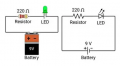
Here are two images.
The one on the left is a graphic of real components.
The one on the right (preferred) is the circuit schematics.


1781035093003.png

To trouble-shoot a set up such as this, connect the BLACK lead of the DMM to the negative side of the battery.
With the DMM set to measure up to 20 VDC, connect the RED lead to:

(1) the left leg of the resistor
(2) the right leg of the resistor

These two voltage readings will provide useful diagnostic information.
 

panic mode

Joined Oct 10, 2011
5,056
and what kind of wires? it is common to make short jumpers from solid wire. but if wire is enameled, that enamel will need to be removed so metal-on-metal contact is possible.
as for measuring things, what tools / instruments you have at your disposal?

measuring voltage is 99% of all measurements since simple, accurate and very low impact.. one can measure current of course but in most cases this is not very convenient since it would require interrupting circuit. then DMM would need to be reconfigured... and one would usually need to take burain of the of the selected range into account... all for just one measurement.
 

Thread Starter

BeablossomR_

Joined Jun 4, 2026
27
and what kind of wires? it is common to make short jumpers from solid wire. but if wire is enameled, that enamel will need to be removed so metal-on-metal contact is possible.
as for measuring things, what tools / instruments you have at your disposal?

measuring voltage is 99% of all measurements since simple, accurate and very low impact.. one can measure current of course but in most cases this is not very convenient since it would require interrupting circuit. then DMM would need to be reconfigured... and one would usually need to take burain of the of the selected range into account... all for just one measurement.
Good point about the wires, I’m just using basic jumper wires on a breadboard right now, so I’ll double check the connections and make sure everything is making proper contact.

For measuring, I’m using a basic DMM and mostly checking voltage so far. I haven’t really tried measuring current yet since it seems a bit more involved.

Appreciate the tips, that helps a lot.
 

dl324

Joined Mar 30, 2015
18,400
I’m still learning the basics of electronics and was wondering when a simple circuit (like an LED circuit) doesn’t work, what’s your usual step-by-step troubleshooting process?

Do you start with checking voltage, connections, or components first?
If the circuit was known to work, I'd measure the voltage across the LED. If it never worked, I'd check the wiring and the orientation of the diode.
I haven’t really tried measuring current yet since it seems a bit more involved.
I'm not a big fan of measuring current, particularly if there's a resistor in the circuit that you can measure the voltage drop across it.
 

WBahn

Joined Mar 31, 2012
32,953
Good point about the wires, I’m just using basic jumper wires on a breadboard right now, so I’ll double check the connections and make sure everything is making proper contact.

For measuring, I’m using a basic DMM and mostly checking voltage so far. I haven’t really tried measuring current yet since it seems a bit more involved.

Appreciate the tips, that helps a lot.
Measuring current is a bit more involved, but it's not that much more and it's a good skill to be comfortable with.

For beginners, measuring current directly with a DMM (or analog VOM) is pretty standard fair and completely reasonable. For most things you will be doing as a beginner, the results are perfectly useable. But you will discover that inserting an ammeter into a circuit can affect the circuit's behavior enough to cause problems in some circuits. The same is true when measuring voltage -- nearly any measurement you make will affect the circuit in some way -- but voltage measurements tend to be far less disturbing to the circuit than current measurements are.
 

Thread Starter

BeablossomR_

Joined Jun 4, 2026
27
Measuring current is a bit more involved, but it's not that much more and it's a good skill to be comfortable with.

For beginners, measuring current directly with a DMM (or analog VOM) is pretty standard fair and completely reasonable. For most things you will be doing as a beginner, the results are perfectly useable. But you will discover that inserting an ammeter into a circuit can affect the circuit's behavior enough to cause problems in some circuits. The same is true when measuring voltage -- nearly any measurement you make will affect the circuit in some way -- but voltage measurements tend to be far less disturbing to the circuit than current measurements are.
That’s really helpful, especially the part about the measurement affecting the circuit.

I’ve mostly been sticking to voltage measurements so far, but I’ll start trying current measurements on simpler setups first.

Out of curiosity, are there certain types of circuits where measuring current tends to cause more issues?
 

dl324

Joined Mar 30, 2015
18,400
Out of curiosity, are there certain types of circuits where measuring current tends to cause more issues?
It depends on the circuit and the meter. Meters insert a resistance in the circuit and measure the voltage drop across it. The magnitude of that resistance is what affects the circuit (and the reading).

With modern DVMs, the input resistance for voltage measurements is generally of a magnitude that the circuit isn't perturbed. Similarly, the burden voltage for current measurements is also low, but forgetting to change the measurement setting from current to voltage and trying to measure a voltage can damage the meter.
 

WBahn

Joined Mar 31, 2012
32,953
That’s really helpful, especially the part about the measurement affecting the circuit.

I’ve mostly been sticking to voltage measurements so far, but I’ll start trying current measurements on simpler setups first.

Out of curiosity, are there certain types of circuits where measuring current tends to cause more issues?
When you make a voltage measurement, you are putting the meter's input resistance in parallel with a part of the circuit. Since that resistance is typically about 10 MΩ with most modern meters (but 1 MΩ is far from uncommon and is pretty typical of most oscilloscope inputs). If you are measuring the voltage across a 1 MΩ resistor, then that 10 MΩ input resistance has a noticeable affect and will drop the voltage by about 10%. Whether or not that results in anything more than just an error in the reading (which can be accounted for), or actually causes a significant change in the behavior of the circuit depends entirely on the circuit and how it works.

The same is true when measuring currents. When you put an ammeter in series with a circuit, you are (generally) inserting a small resistance and measuring the resulting voltage drop across it. The size the resistance depends on the range you are using, with lower ranges having a higher resistance. On a 20 mA range, it might be 10 Ω, but on a 200 μA range it might be 1000 Ω. The way to view it is to consider what the impact is if you insert that resistance at that point in the circuit. If the effect is minimal, then it's a non-issue (and you can often correct your measurement for the effect), but if it would significantly change the behavior, then it is a real issue.
 

MrChips

Joined Oct 2, 2009
34,930
The simple way to measure current in a circuit is to measure the voltage across a known resistor and use Ohm's Law to calculate the current.

I = V / R

This avoids:

(1) having to change the DMM from measuring volts to measuring current,
(2) having to alter the circuit in order to insert the ammeter in series,
(3) blowing the fuse in the DMM when you forget to switch back to measuring voltage.
 

WBahn

Joined Mar 31, 2012
32,953
With modern DVMs, the input resistance for voltage measurements is generally of a magnitude that the circuit isn't perturbed. Similarly, the burden voltage for current measurements is also low, but forgetting to change the measurement setting from current to voltage and trying to measure a voltage can damage the meter.
As the vast majority of us have done at least once or twice.
 

ci139

Joined Jul 11, 2016
2,006
most devices work significantly better when the power plug is connected to mains ?
----↑!do NOT associate!↓----
with the led circuit it's often the LED that is blown
though if it's an smd one at diy circuit the proper polarity or voltage may've been "misguessed"
 

BobTPH

Joined Jun 5, 2013
11,567
Since you are new to this, and using a breadboard, do you know how the breadboard holes are connected together? It is possible that you are not making the connections you think you are.
 

Ya’akov

Joined Jan 27, 2019
10,262
Without more information knowing where to look for the problem is impossible, but, there are a few things you can do because they represent universal properties of practical circuits.

1. Check the power supply. If the supply is not supplying power the circuit will not operate. This extends to voltage and capacity (to provide current).

2. Check polarity. Any polarized circuit element (e.g. the power supply, diodes, polarized capacitors, &c) could be reversed. Check each one carefully.

3. Loose/disconnected or disconnected wires. For obvious reasons. When making a circuit, try to be consistent with color code, use the proper length (not too long) and route the wires neatly.

There are troubleshooting techniques that depend on more information but these three things above account of an unreasonable number of cases
 
Top