I want a Demagnetize circuit

Jon Chandler

Joined Jun 12, 2008
1,607
Also at 15 VAC, the Voltage indicator on my variac is lowering down to ~12V (from 15V), sign that is entering into current mode, exactly as my Var DC PSU, when Im exceeding the voltage limit is switching into current mode.
NO. A variac does not have a current-limiting mode. If the voltage drops, it's overloaded.
 

MisterBill2

Joined Jan 23, 2018
27,641
If you lay the screwdriver flat across the three legs and then draw it off in line with the three legs over the course of five seconds and keep moving it away then switch off before the coil gets hot that should work.
BUT my original suggestion was to use the original winding of the transformer, which probably had a lot more turns.. Why make things so much more complicated????
 

MrAl

Joined Jun 17, 2014
13,720
Disagree all you want. I explained what I have done in the past and it works well. That's proof enough for me.
Hello again,

The problem here is that the constructions are different even with a small difference in the way it is set up and used. You would be doing something other than what I would be doing. It's not that your version would not work, it's that when it comes to these designs there are different ways to do it and some ways are just better than others, and for various reasons, and the interpretation of what is better or not as good is often subject to what is available at the time and what exactly the objective is at the time. We'd have to discuss this in much more detail to bring out the differences. That is not to say that your version does not work for what you wanted it to work for and the way you used it. That means that I do not necessarily disagree with what you are doing. I am merely stating the best design practices for this kind of construction and that still does not mean that an inferior design will not work, it can still work and be effective. For example, if we used an air core coil 10 meters in diameter wound with #10 AWG wire with a billion turns, it may still work for this purpose even though it would involve a lot of material and a lot of space to put it, so in most cases we would not really want to do it that way. If we happened to already have such a coil already made from a previous project though, we may just want to use it because it's already there and available. It's not the best design idea, but we already had it so why not use it, and as long as it works, we can accomplish what we needed to accomplish.
I am sure there are other analogies.
 

Danko

Joined Nov 22, 2017
2,172
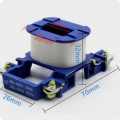
For demagnetization of tool tips I use contactor coil.
Tip smoothly inserts to coil during 2 seconds,
then also smoothly pulls out in next couple of seconds.
So coil becomes ON about 4-5 seconds.
After procedure temperature of coil is 40-45°C.
With mains voltage 220 V used coil with nominal voltage 380 V.
With 110-120 V mains nominal voltage of coil should be 220V.
1718284663149.png
https://aliexpress.ru/item/10050052...&traffic_source=recommendation&type_rcmd=core
 

Thread Starter

q12x

Joined Sep 25, 2015
2,227
I mean creating a new winding for the transformer. Of course that is assuming that it was not a burned out scrap transformer, and that it was actually some sort of power transformer with a mains rated primary.
I already mentioned in #3 that this was a transformer with the coils burned black and I only scrapped its silicon steel, a long time ago, when I was an adolescent. I have them sitting there for a very long time. So NO coil whatsoever on them. I thought this is the perfect project to use them into something practical. But making a coil, its a bit more complex than I imagined. Not simple. So keep in mind that I am trying all my best, not complicating anything. I know I am going on a hard road here but... I have you guys, on my right, so we must make something in the end. I believe in you.
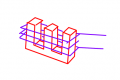
- I was thinking to add coils around the E core. Using the entire E core like I would use an I core.
This way I will not be restricted by the internal space inside the E core. Also I have a good bunch of -aluminium- wire scrapped from a CRT monitor, quite thick, laying around that I can use it in this scope. Hmmm? It will work?
Like this:
.1718285682338.png20240613_164130.jpg
 
Last edited:

MisterBill2

Joined Jan 23, 2018
27,641
About 25 years ago O had considered what it would take to provide enough of a short term magnetic fields to demagnetize magnetic memory at a distance, in a short time. The logistics challenge was the show stopper. It seems that there is no way to hide a ten megawatt generator system, or be subtle about connecting it to a suitable electromagnet able to erase magnetic memory at 100 feet.
 

Thread Starter

q12x

Joined Sep 25, 2015
2,227
q12x, I am just curious. What field strength are you aiming for in your device?
Im not into fields so I can not give you a specific answer. A general field, probably strong enough, with the purpose of demagnetizing a tweezer or a screwdriver. My goal is to make it very simple to use. But I start to give up on making windings myself because I always suck at them and Im trying this subject very rarely in my entire life. Pity it didnt work. I cant have it ALL, right?
 

Lightium

Joined Jun 6, 2012
320
It could be worse. You could be building something that measures the field from the tool and then drives enough current to demagnetize the tool?
 

Thread Starter

q12x

Joined Sep 25, 2015
2,227
It could be worse. You could be building something that measures the field from the tool and then drives enough current to demagnetize the tool?
well... if you have the cct, give it here to take a look over it. +explanations where it needs.
-Indifferent of how strong the field is, if I can not run it at 240Vac -heck, not even at 10Vac - then the field doesnt matter because I can not power the thing.
My biggest problem im facing right now is the coil to not overheat when is powered. Im missing something and I cant see what. One idea is that it needs 4000 turns instead of my 400 turns that is having right now.... its the only idea I can think of, that might be the solution for this overheating problem.
 
Last edited:

Thread Starter

q12x

Joined Sep 25, 2015
2,227
if it's over heating, your supplying too much current. No?
Theoretically yes. I used a formula and I find out it might need 4000 turns, instead of 400 that I practically put and tested with and everyone here were believing is good enough. Even at 10VAC it is getting extremely hot but not instantaneously as at 240VAC. A bit slower-delayed time, like 5seconds and then is too hot to touch. This means, even at 10VAC is too lower (AC) resistance (or reactance bcause its an inductor) which = too much current passing through the coil.
 

Thread Starter

q12x

Joined Sep 25, 2015
2,227
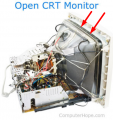
What you can't see in the img is that I put some very thin and very scrapped wires under this red wire. So practically, I have 5 or 6 very different diameter wires in this experimental coil element. Probably 150-200 turns of that very thin scrapped wire. on the exterior of the core. Every wire im adding, Im turning it in the same direction as the previeous winding. I know if you winding in oposite direction, the effect it suppose to happen, will cancel out. This red wire you see here is actually aluminium wire scrapped from a CRT coil that was around the viewing glass tube. From here:
1718608288959.png
So because its aluminium and not copper, it has little value for me and although it looks and feels brand new, I can use at discretion from it because I dont care. One problem is soldering, so Im using copper wire wound over the aluminium wire and soldering it in both ends. THis is how Im connecting this Alum wire. A bit of trouble but is ok.
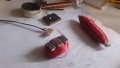
20240617_100427.jpg1718608103551.png
Now, in total I probably have something around 1000 turns. I didnt count anything anymore. So im guessing its 1000. Im just adding wire like a neanderthal.
I powered it (as you can see in the picture) to 10VAC from my variac,. For my surprise, nothing got hot, not warm in about 10sec of finger testing.
I immediately increase to 24VAC and after about 8-10seconds, the coil was starting to get extremely hot from interior towards exterior windings. It might be those very thin wires I put but im not 100% sure. One idea I have, for this particular project here, Im starting to believe, the diameter of the wire doesnt matter ! All that matters is the quantity, the length of the wire. Its thickness is irrelevant. So no matter if its thick or thin. In other words, I may use the same ammount of coil but at very thin diameter , 1000 turns , and have the exact same result as with all these different diameter wires I used already. So diameter of the wire, how thin it is, is helping only for the size of the coil, how FAT it gets. But electrically, is the same, whatever I use. THis is my personal theory.
All this experimentation here, is telling me that the more coil Im adding, it is ressisting better to the overheating and can support bigger voltages. My target is to reach 240VAC and to mantain the coil cold or warm, but not hot. From this perspective, I may have to use that entire red coil over this core !!! Its what I predict.
Another idea is to dissassemble everything, unwind all, and start winding only with this red coil. But this idea is for the event that the coil thickness does matter. So in the same time, Im afraid the overheating it may be from those very thin coil windings. Thats why I want to redo everything with only 1 diam coil.
Do tell me what you think. Any ideas are welcomed as long as they are serious and not jokes.
For some inexplicable reason, I find this coil thing very hard to make. It might seem easy in our heads but when you sit down and actually make it...oooh, its hell. Or is my inexperience talking, my first try. Actually I did try it a couple of times before in my life, but I always failed on making a relieable coil winding. I believe I stopped too soon, like I did already these days with this coil here. But back then, when I was young, I didnt had the variac and the experience I have now in general electronics. In one sense, I believe I can trust myself making it to the end and get a reliable result. Will see. Or I can give up at any momment, because its so damn easy to do it.
 
Last edited:

MrChips

Joined Oct 2, 2009
34,866
You are partially correct. The inductance is directly proportional to the number of turns and does not depend on the size of the wire. Fine gauge wire is used in order to have a smaller coil with more turns.

Your wire appears to be about 24-22AWG which is very large diameter for this application. I would expect that 40-36AWG would be used.

However, as the diameter of the wire gets smaller and the total length increases, the DC resistance also increases. Hence the total impedance also increases, i.e. the AC current will also decrease.
 

MisterBill2

Joined Jan 23, 2018
27,641
The heating of the wire is caused by current flow thru resistance: "P= I x I x R" , and I=V/R .
And for any value of current, the generated flux increases with the number of turns.
And the good news is that there is a huge amount of information available about electromagnets and how to achieve focused magnetic fields. And most of the accurate information is not on the cartoon channel in videos. It is better explained with equations including units, and descriptions than I can provide on this forum.
 

Thread Starter

q12x

Joined Sep 25, 2015
2,227
You are partially correct. The inductance is directly proportional to the number of turns and does not depend on the size of the wire. Fine gauge wire is used in order to have a smaller coil with more turns.
ok so I leave it as it is, with multiple size wires, and continue to add more to it. So I will not have to take out what it is already wind up and re-wind from scratch only with a single diam wire as I was thinking. Ok, good to know. I know some basics but...not dealing with them for years, and only hearing or reading them once in a lifetime, I kind of mistrust my accumulated information. Thats why I need you. Very simple. And thanks for the confirmation.
 
Top