Facebook
 Google
 GitHub
 Linkedin

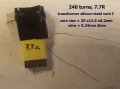
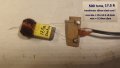
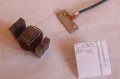
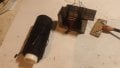
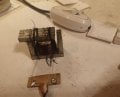
Not sure what you mean about the "E I" laminations. The "E" does not form a circular path with a narrow gap.Rather than destroy a good toroid core, why not just add pole pieces to a wound coil solenoid magnet?? Or even just bend a section of steel rod into a "U" shape?? Or wind a bunch of wire around an old "horseshoe" magnet that has lost it's magnetism. Or even pull the "I" section off of a transformer made wit"E-I" laminations??
As to the steel rod, it may work but steel that is not made for magnetically active magnetic circuits is inferior to steel made for that purpose. The permeability is far lower.
I suggested the "C" core because it consists of two "U" shapes already, so putting the two "U" shapes open faces together forms a circular magnetic path. One of the tips of one (or both) of the "U" sections could be ground or cut off probably with a hacksaw.
A similar case for the horseshoe magnet. The metal used for that would be for a different purpose than for a magnetic circuit like a transformer. That would mean high coercivity (wide BH curve) which may get in the way when we go to energize it.
Bear in mind that it may be possible that a rock from the garden might work too, I am just suggesting what are probably the best ways of doing it. There are other ways. Take a spool of wire and run a steel rod through the center, that may work. The object though is to get as strong a magnetic field as possible so as to exceed the magnetism of the target object, and by concentrating the field this is easier to achieve.
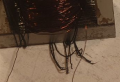
I've gotten toroid cores less than $1 USD. I've cracked several of them and glued them back together to measure the change in characteristics. You can get some with very high permeability and that means less current to operate.
I think maybe the hardest part of this project is not the core though, I think it is the electronics. The current has to be reversed many times as the level of the current is decreased. That's the only way to overcome the target metal's coercivity. A sine wave would normally be used but maybe a triangle current wave would work too as long as it reversed too. Lucky it does not have to be high frequency, even 50Hz would do it.
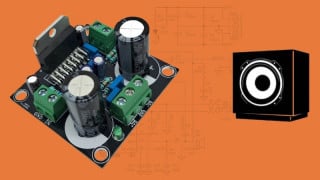
One quick solution might be to use an audio amplifier with enough output current. It can be driven with a frequency generator maybe a triangle wave. The output would be capacitively coupled to the winding on the core.
So although there may be other ways to do this, I think a circular path with as small a gap as needed would work the best, and that means require the least current flow to get it to actually work. And, because less current is required with high permeability, get the highest permeability you can find (magnetic material made for these purposes).
As an example, you can get magnetic cores with relative permeability like 3000 or even 5000, while a steel 10 penny nail may only exhibit 100. Maybe if we bent the nail around in a circle it might work better.
Note that 3000 compared to 100 means we need 30 times the level of current for the nail in order to get the same field strength as that of the 3000 magnetic core. The electrical analog is the 'resistance' (which is reluctance in magnetic terms) would be 30 times higher for the nail than for the 3000 core which it comes to conducting the 'current' (flux in magnetic terms). That's kind of a big difference.