Facebook
 Google
 GitHub
 Linkedin
I want a Demagnetize circuit
- Thread starter q12x
- Start date

Scroll to continue with content


Hi,I used black sowing string to tie in place those I core together and then the I core to the E core as well.
View attachment 324286
I left a small gap this time as you mentioned.
View attachment 324287
--------
But the entire coil got extremely hot in 1 second switch. Actually, very funny, a white dense smoke come out this time - hahaha. Originally I thought its the enamel on the copper wire. But I quickly realized it was the sawing string that smoked instantaneously from the intense heat of the coil. Here is the proof:
View attachment 324288
So.... this method didnt solved the over heating of the coil. Actually with this string method, I can check the temperature of the coil for very short time duration. If its getting in smoke, then the coil had reached that 100*C I estimate. If not getting in smoke, then project successful. Hmmmmmmm...
- how to make it not overheat? -My immediate thought is to add even MORE wire to the coil. Right?
I start to believe I will actually reach that 1000 turns you mentioned.
Yes, its a good solution but.... I want to plug it into 240VAC, like a normal transformer or (serious) electrical tool.
I will get a very strong EM field this way, so I'm counting on that. I'm not sure how strong it will be from the variac, with a lower AC voltage. I also want to find a solution to 240VAC to really calibrate it and make it work reliably.
This idea with the variac is plan B or if anything else fails.
First, that's not the way I indicated to do this. You left the gap in one arm of the E core, NOT in the center 'column'.
Look at the drawing carefully. The gap must be formed using just one arm of the E core and the center column. If you try to do it the way you have pictured, you effectively lower the magnetization of the part with the gap by a huge amount. The gap must involve just ONE outer leg of the E core, and the center column. Look at the drawing again, see how far offset the "I" part of the core is. It was slid much farther than in your drawing.
See attachment.
With the smaller gap the current would be less. That means less heating of the wire.
You do have to realize that these constructions are done with some design criteria that are used with transformers and the like. Another point is the maximum AC voltage which is governed by the inductance and culminates in a formula know as the transformer equation, however there is more than one. The one here is:
Bmax=E*10e8/(4.44*F*A*N)
where
E is the AC sinusoidal voltage in voltage AC,
F is the frequency in Hertz,
A is the cross sectional area in square centimeters,
N is the number of turns.
Bmax is the maximum flux for the core, which you can figure to be around 15kG for typical line voltage transformers.
What this means is you set Bmax to 15000, then set the other variables, then solve for N which is the number of turns. If you have less than that number of turns, then your current will be too high and things could heat up pretty quickly.
It would help a lot now if you would provide the cross sectional area of your core, or at least the side measurements in either inches or centimeters. To get the area you multiply one side by the other.
Normally this would be for the center leg, but because we only use half of the core here we have to know the cross-sectional area of one of the outer legs not the center column.
We also have to know the frequency.
We also have to know the applied AC voltage, but since you have a variac you must use that to start the voltage at some low level like 10 volts AC or something. You can gradually turn it up until it starts to feel warm, then makes sure it does not get too hot, then stop there.
If you find the magnetic strength is not enough, you will have to alter the core by making a smaller gap and then maybe remove some of the turns. Unfortunately, then another limitation sets in. The total current can not be too high. This brings in the wire diameter or the wire AWG gauge so we can calculate the maximum current for that wire.
If the wire is damaged you will have to fix that. If it's just the insulation maybe a little tape will help, but if the wire is badly kinked you have to solder it, then tape it.
Also, it is very bad to wind any wire on the bare metal core itself. The corners of the core will dig into the wire insulation and cause one or more shorts. You have to either use a bobbin for that core (leg) or use some good tape like mylar tape or some other higher temperature tape. If you were to use regular tape, it may melt and then short out anyway.
A substitute may be the tape plumbers use for raping pipe threads. It's Teflon. You need to wind tape around the core several times in order to build up a layer that will protect the wire from direct contact with the core metal.
Attachments
-
 98.8 KB Views: 3
Last edited:
Ver1 formula is my formula I had before and present it in #9 post. (now is modified and possibly more correct than it was before)a formula know as the transformer equation, however there is more than one. The one here is:
Bmax=E*10e8/(4.44*F*A*N)
where
E is the AC sinusoidal voltage in voltage AC,
F is the frequency in Hertz,
A is the cross sectional area in square centimeters,
N is the number of turns.
Bmax is the maximum flux for the core, which you can figure to be around 15kG for typical line voltage transformers.
What this means is you set Bmax to 15000, then set the other variables, then solve for N which is the number of turns. If you have less than that number of turns, then your current will be too high and things could heat up pretty quickly.
Ver2 formula is your formula and I think it works for Bmax 1.5 (not 15000 like you suggested). So now I have 4000! number of coils - ohohoa. I think this is more close to reality... perhaps.... Im still unsure. That 4000 N of coils represent the maximum saturation of the iron core. So until 4000 coils is good enough, meaning a lower strength of the EMF of the core. Which Im OK with. I dont need the max, but only not to heat up and Im confident the EMF will be strong enough at even 30%. Is my speculation.

Last edited:
Ver1 formula is my formula I had before and present it in #9 post. (now is modified and possibly more correct than it was before)
Ver2 formula is your formula and I think it works for Bmax 1.5 (not 15000 like you suggested). So now I have 4000! number of coils - ohohoa. I think this is more close to reality... perhaps.... Im still unsure. That 4000 N of coils represent the maximum saturation of the iron core. So until 4000 coils is good enough, meaning a lower strength of the EMF of the core. Which Im OK with. I dont need the max, but only not to heat up and Im confident the EMF will be strong enough at even 30%. Is my speculation.
View attachment 324338
Hello again,
You seem to be trying to work in Teslas while I was working in Gausses. I did, however, type the formula wrong.
I typed:
Bmax=E*10e8/(4.44*F*A*N)
when it should have been:
Bmax=E*10^8/(4.44*F*A*N)
or:
Bmax=E*1e8/(4.44*F*A*N)
so the "10e8" was a typo it should have been either 10^8 or 1e8.
Anyway, the units are:
B in Gausses,
E in volts RMS,
F in Hertz,
A in square centimeters,
N the number of turns.
For and example, if E=120vrms and F=60Hz and a core cross sectional area of 1 square inch, if N=349 turns then Bmax is about 20kG which is 20000 Gauss. That's 2 Teslas. 15000 Gauss is 1.5 Teslas, so you see it does not matter what magnetic units you want to work in just as long as you keep the relationship in mind and apply the appropriate factor. Working at 50Hz required 60/50 times as many turns, and working at twice the voltage (240vrms) requires 2 times as many turns as at 120vrms.
You also have to keep in mind that this construction will have a gap. Even though the gap will be small, this will require more turns than we calculate above. It could even be twice as many turns. This means it could be hard to get something to work where you can apply the full 240 volts rms (I guess you are using that voltage), you may have to use the variac to lower the voltage.
Did you mention yet what your cross sectional area is and what units you are using (inches cm, mm, etc.). I think you did, but it would be better if you posted the BUILD and the THICKNESS of the core "I" section (see attachment, and note that is using the old drawing not the new one, the new one has the correct placement of the "I" section).
I ask because as an example if I have a core with an "I" section with a 10mm THICKNESS with a 40mm BUILD I get about 1800 turns for a core with no gap.
Lastly, even if you have the right number of turns the wire diameter may be too small to handle the excitation current. We could estimate that perhaps. If the excitation current is too high the wire gets hot fast, but if you only intend to use it for a few seconds that may not matter.
These designs have to take in several factors to get right and use the least number of turns, so it's not just a matter of winding a bunch of turns on a core and hoping it will work out. Luck sometimes does help though

Small question, do you really have 240vrms or 230vrms?
Attachments
-
 104.8 KB Views: 2
Last edited:
You mean you can't afford to get it sent to the international space station for an experiment say in a year or two?Haha, I wish I had a vacuum pump. Im not THAT rich ! Interesting idea nevertheless.
Gee that's a shame
MisterBill2
- Joined Jan 23, 2018
- 28,344
So far every responder to my comment has got it WRONG!!!! The transformer I used was a low voltage output one, six volts at about 5 amps. I DID NOT REWIND A NEW COIL!!! I simply took off the frame that had held the "I" part in place. I used a 24 volt transformer to power the connections to what had been the 120 volt primary. I put the screwdriver flat across the top three legs of the "E" part and switched on the power, 24 volts across the original primary connection. I slid the screwdriver across the three legs and then kept moving it away another foot. That took about FIVE SECONDS.
Then I switched the power off.
That worked, but not completely.
So I connected my 120 volts directly to the 120 volt primary and tried it again, starting with the screwdriver across all three legs. I switched on the power and pulled the screwdriver across just like before, and then switched off the power. The coil was quite warm, actually sort of hot. The screwdriver had tended to stick by magnetic attraction, and it buzzed against the ends of the "E" legs as I slid it off. And it was demagnetized.
WHY rewind a new coil when there was already one made for the job????
AND since the field reverses 60 times every second, why move slowly??
Then I switched the power off.
That worked, but not completely.
So I connected my 120 volts directly to the 120 volt primary and tried it again, starting with the screwdriver across all three legs. I switched on the power and pulled the screwdriver across just like before, and then switched off the power. The coil was quite warm, actually sort of hot. The screwdriver had tended to stick by magnetic attraction, and it buzzed against the ends of the "E" legs as I slid it off. And it was demagnetized.
WHY rewind a new coil when there was already one made for the job????
AND since the field reverses 60 times every second, why move slowly??
Hi,So far every responder to my comment has got it WRONG!!!! The transformer I used was a low voltage output one, six volts at about 5 amps. I DID NOT REWIND A NEW COIL!!! I simply took off the frame that had held the "I" part in place. I used a 24 volt transformer to power the connections to what had been the 120 volt primary. I put the screwdriver flat across the top three legs of the "E" part and switched on the power, 24 volts across the original primary connection. I slid the screwdriver across the three legs and then kept moving it away another foot. That took about FIVE SECONDS.
Then I switched the power off.
That worked, but not completely.
So I connected my 120 volts directly to the 120 volt primary and tried it again, starting with the screwdriver across all three legs. I switched on the power and pulled the screwdriver across just like before, and then switched off the power. The coil was quite warm, actually sort of hot. The screwdriver had tended to stick by magnetic attraction, and it buzzed against the ends of the "E" legs as I slid it off. And it was demagnetized.
WHY rewind a new coil when there was already one made for the job????
AND since the field reverses 60 times every second, why move slowly??
That's very interesting and I am happy you got it to work. I see there are some things you still don't realize, or maybe you do, but it may not be that important since you got it to work and I happen to like that idea because it's simpler to construct.
The coil got hot because once you remove the "I" part, the inductance goes WAY down and thus the current goes WAY up. The current will be way above the original design value, and thus the wire gets hot. As mentioned before, if it's only on for a short time it may not matter. Would be interesting to see a current measurement though.
The reason for moving it slowly is because if it was quickly jerked away from the core, there is no telling where in the cycle the field was removed from the metal. If the field is still at a higher value, it will keep the metal magnetized. Moving it away slowly means the target metal is taken through it's BH curve with the encircled area constantly decreasing. Once the field has no more effect we have to hope the metal magnetization was lower than the coercive force value. If it was then it's demagnetized.
Moving it slowly helps to ensure this happens, but as you noticed 60Hz is quite fast relative to a humans arm movement so it probably does not have to be too slow, but a reasonably slow movement ensures we get the required result.
In the old days of CRT TV's they used to move the coil slowly but also move it around in a circle in order to be sure it affected the entire tube. Then came auto degaussing, which applied a decreasing field inside the TV itself. You could sometimes hear it buzz a little when the TV was turned on
MisterBill2
- Joined Jan 23, 2018
- 28,344
"SLOW" is relative here. in five seconds there are 300 polarity reversals in that electromagnetic field.Hi,
That's very interesting and I am happy you got it to work. I see there are some things you still don't realize, or maybe you do, but it may not be that important since you got it to work and I happen to like that idea because it's simpler to construct.
The coil got hot because once you remove the "I" part, the inductance goes WAY down and thus the current goes WAY up. The current will be way above the original design value, and thus the wire gets hot. As mentioned before, if it's only on for a short time it may not matter. Would be interesting to see a current measurement though.
The reason for moving it slowly is because if it was quickly jerked away from the core, there is no telling where in the cycle the field was removed from the metal. If the field is still at a higher value, it will keep the metal magnetized. Moving it away slowly means the target metal is taken through it's BH curve with the encircled area constantly decreasing. Once the field has no more effect we have to hope the metal magnetization was lower than the coercive force value. If it was then it's demagnetized.
Moving it slowly helps to ensure this happens, but as you noticed 60Hz is quite fast relative to a humans arm movement so it probably does not have to be too slow, but a reasonably slow movement ensures we get the required result.
In the old days of CRT TV's they used to move the coil slowly but also move it around in a circle in order to be sure it affected the entire tube. Then came auto degaussing, which applied a decreasing field inside the TV itself. You could sometimes hear it buzz a little when the TV was turned on
The reasons for moving the color TV degausing coil slowly were to assure covering the whole shadow mask, because rapid motions are more difficult for most folks to control. Also it reduced the probability of some klutz throwing the coil and causing problems.

"SLOW" should be about 0.5cm per second. The total number of reversals is not important.
The magnetic field diminishes very rapidly with distance, not 1/(r^2), but 1/(r^3) or even higher, depending on the geometry of the poles.
Think of it as going over the threshold as you go out the door. There is a critical point when the magnetic field falls off and you don't know exactly where that point lies. Hence you want to cross that threshold very slowly.
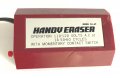
I have a couple of demagnetizers. This is the smaller of the two. Note that they both have momentary power push buttons so that power is applied only for short periods.
The magnetic field diminishes very rapidly with distance, not 1/(r^2), but 1/(r^3) or even higher, depending on the geometry of the poles.
Think of it as going over the threshold as you go out the door. There is a critical point when the magnetic field falls off and you don't know exactly where that point lies. Hence you want to cross that threshold very slowly.
I have a couple of demagnetizers. This is the smaller of the two. Note that they both have momentary power push buttons so that power is applied only for short periods.
I give up !
I've added as many turns as I could, with the wire I have. This second one is having a transparent isolator over it and is a bit more thicker than the other darker coil underneath.
I test it and is still getting very hot in ~1sec contact. I physically can not add more wire inside the core. A little bit I may squeeze but it will not make any difference. I didnt even count the turns anymore, but I guess Ive added another 200 probably.
Pitty it didnt work. At least I tried.
And with this, project finished.
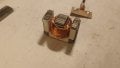
I've added as many turns as I could, with the wire I have. This second one is having a transparent isolator over it and is a bit more thicker than the other darker coil underneath.
I test it and is still getting very hot in ~1sec contact. I physically can not add more wire inside the core. A little bit I may squeeze but it will not make any difference. I didnt even count the turns anymore, but I guess Ive added another 200 probably.
Pitty it didnt work. At least I tried.
And with this, project finished.

Jon Chandler
- Joined Jun 12, 2008
- 1,647
Aren't y'all making this far more difficult than it need be?
About a thousand years ago, I accomplished this with a coil from a solenoid*. Connect the coil to AC to demagnetize, insert the screwdriver into the coil and slowly draw it out. To magnetize, connect the coil to DC and repeat the process.
*The coil was from an ancient office intercom system. The main unit, which would be at a secretary station, had what was essentially a solenoid for each line. When someone buzzed, the solenoid for that station would pop out to show which station had called, and remain out until it was pushed back in.
About a thousand years ago, I accomplished this with a coil from a solenoid*. Connect the coil to AC to demagnetize, insert the screwdriver into the coil and slowly draw it out. To magnetize, connect the coil to DC and repeat the process.
*The coil was from an ancient office intercom system. The main unit, which would be at a secretary station, had what was essentially a solenoid for each line. When someone buzzed, the solenoid for that station would pop out to show which station had called, and remain out until it was pushed back in.
MisterBill2
- Joined Jan 23, 2018
- 28,344
That is probably better than across the "E" ends. But the same principle. and creating a new winding is a whole lot of work I am sure. And I am still wondering about the logic of moving so very slowly. Probably because it provides a lot more time for heating to happen.Aren't y'all making this far more difficult than it need be?
About a thousand years ago, I accomplished this with a coil from a solenoid*. Connect the coil to AC to demagnetize, insert the screwdriver into the coil and slowly draw it out. To magnetize, connect the coil to DC and repeat the process.
*The coil was from an ancient office intercom system. The main unit, which would be at a secretary station, had what was essentially a solenoid for each line. When someone buzzed, the solenoid for that station would pop out to show which station had called, and remain out until it was pushed back in.
Jon Chandler
- Joined Jun 12, 2008
- 1,647
When I said slowly, I meant a second or two. That's about all my patience allowsAnd I am still wondering about the logic of moving so very slowly
Wrapping a coil around a plastic tube is probably easier than prying a transformer apart. But if you pry it apart, maybe ditching the laminations entirely would be a good solution if the coil will slide off.
How "slow" is slow?
What they really mean to say is, don't turn off the power while the item to be demagnetized is still in the magnetic field.
What you want to do is gradually reduce the magnetic field to zero. You can achieve this by moving the object slowly away from the magnetic field.
What they really mean to say is, don't turn off the power while the item to be demagnetized is still in the magnetic field.
What you want to do is gradually reduce the magnetic field to zero. You can achieve this by moving the object slowly away from the magnetic field.
You do not seem to be taking the advice from people here. You will not get anywhere like that because the dimensions and other things are very important with this kind of design.I give up !
I've added as many turns as I could, with the wire I have. This second one is having a transparent isolator over it and is a bit more thicker than the other darker coil underneath.
I test it and is still getting very hot in ~1sec contact. I physically can not add more wire inside the core. A little bit I may squeeze but it will not make any difference. I didnt even count the turns anymore, but I guess Ive added another 200 probably.
Pitty it didnt work. At least I tried.
And with this, project finished.
View attachment 324380
For one, I do not see the "I" section. You MUST include that section as the drawing had shown. It's a must.
You must also use the variac. The variac, if not anything else, will prevent the wire from overheating, at least until you can test it. The magnetization should be enough but there's still a chance it will still be too low, but at least the wire will not burn.
Step by step:
1. Add the I section so it just barely touches the center leg as the picture had shown. If you do not do this and you instead decide to lay the screwdriver across two of the leg flats, it may be too late if the wire burns up. The "I" section will allow higher magnetization while keeping the wire cooler for a given voltage, which ensures the strongest field. If you want to stick with no "I" section, then try laying the screwdriver across two of the flats before you turn on, then turn on, then turn right off. See if that works. Alternately turn on, then decrease the voltage with the variac.
2. Add the variac, it's a must.
3. I see the coil still on the center leg, which is not the correct way to do this, although you can still try it that way. That means the resistance will be higher, but if you can adjust the voltage it may not matter.
You absolutely have to follow these ideas or else you'll never get it to work unless you are very lucky or something
That will result in much less magnetic field strength, but if it's only on for a second it may be possible to apply a higher than usual current which might get it up high enough anyway. It's a sort of gamble.When I said slowly, I meant a second or two. That's about all my patience allows
Wrapping a coil around a plastic tube is probably easier than prying a transformer apart. But if you pry it apart, maybe ditching the laminations entirely would be a good solution if the coil will slide off.
As Mr Chips says, you want the field to decrease slowly so that you still have some field when it gets down to near the coercive force point and below. The loop gets smaller and smaller, and if you look at a diagram of the BH curve during this process it is clear that you want to go slowly."SLOW" is relative here. in five seconds there are 300 polarity reversals in that electromagnetic field.
The reasons for moving the color TV degausing coil slowly were to assure covering the whole shadow mask, because rapid motions are more difficult for most folks to control. Also it reduced the probability of some klutz throwing the coil and causing problems.
You can do this very abruptly too but I think it would take some careful measurements. You have to disconnect the power in such a way where you have the magnetization go to zero. If you were to disconnect at the wrong instant the target piece could still have some residual magnetism.
Yes slow is relative here, and in five seconds if the field reverses 300 times then the path around the BH curve went around 150 times. The question then is, is that enough, and when did the magnetization get low enough. If the excitation from the field had minimal effect at the 10th loop, would that be good enough. It's hard to predict exactly when the magnetization will go to zero. If near the 10th loop the excitation became too low near the peak of the higher magnitude of the field, that would probably leave it magnetized. We want the last loop to be very small.
Maybe 5 seconds is enough, but that is a lot slower than 1 second or 1ms or 1us, and that is what I was talking about.
Jon Chandler
- Joined Jun 12, 2008
- 1,647
Disagree all you want. I explained what I have done in the past and it works well. That's proof enough for me.That will result in much less magnetic field strength, but if it's only on for a second it may be possible to apply a higher than usual current which might get it up high enough anyway. It's a sort of gamble.
Connected by itself, with no I core, to my Variac, at 10 VAC !!!! the coil is slowly getting warm- then hot- then VERY hot !!!
I can keep my fingers on the coil and feel how 'fast' is warming up. In about 6-8 seconds is getting insupportable hot, that I can not keep my fingers on it.
WOW... I did not expect that. Especially at 10V (AC).
I made a test at 15 VAC and I could barely hear a hooom from it. I can not hear it at 10 VAC but I can feel the hooom in my fingers, extremely weak. I put my ear close to it and I can not hear it.
Also at 15 VAC, the Voltage indicator on my variac is lowering down to ~12V (from 15V), sign that is entering into current mode, exactly as my Var DC PSU, when Im exceeding the voltage limit is switching into current mode.
At this point and after observing these phenomenons, I conclude that this coil is seen as a dead short by the variac or my mains. Thats why the fuse blown up and thats why the coil is heating instantly to a crazy amount of >100*C.
Hmmmmmm ... Im out of ideas how to stabilize it at this point.
So this was PLAN B, with the variac. I was expecting to work with no heating, I was actually expecting to START to heat a little bit at around 100 VAC !!! But not hot at 10 VAC !!! Thats the surprise. HEH....
Connected by itself :
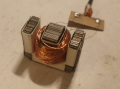
I can keep my fingers on the coil and feel how 'fast' is warming up. In about 6-8 seconds is getting insupportable hot, that I can not keep my fingers on it.
WOW... I did not expect that. Especially at 10V (AC).
I made a test at 15 VAC and I could barely hear a hooom from it. I can not hear it at 10 VAC but I can feel the hooom in my fingers, extremely weak. I put my ear close to it and I can not hear it.
Also at 15 VAC, the Voltage indicator on my variac is lowering down to ~12V (from 15V), sign that is entering into current mode, exactly as my Var DC PSU, when Im exceeding the voltage limit is switching into current mode.
At this point and after observing these phenomenons, I conclude that this coil is seen as a dead short by the variac or my mains. Thats why the fuse blown up and thats why the coil is heating instantly to a crazy amount of >100*C.
Hmmmmmm ... Im out of ideas how to stabilize it at this point.
So this was PLAN B, with the variac. I was expecting to work with no heating, I was actually expecting to START to heat a little bit at around 100 VAC !!! But not hot at 10 VAC !!! Thats the surprise. HEH....
Connected by itself :
| Thread starter | Similar threads | Forum | Replies | Date |
|---|---|---|---|---|
| L | Bi-directional current limiting circuit? | Power Electronics | 51 | |
| C | Schmitt trigger debounce circuit problem(s) | Digital Design | 15 | |
| F | Basic Amp Circuit Question | Homework Help | 7 | |

|
Capacitor discharge circuit in modern multimeter | General Electronics Chat | 31 | |
| P | Demagnetize a television picture tube? | Homework Help | 9 |