I want a Demagnetize circuit

Thread Starter

q12x

Joined Sep 25, 2015
2,227
I want to make a demagnetize circuit for my never ending magnetized screwdrivers and tweezers.
I didn't searched on the net for a cct yet, I want your versions first. But I will. It will exceptionally if you actually build one and share your cct + beauty picture of the device + impressions of its working in time. If Im lucky, of course. If not, we will make a bright new one right here.
The catch is to make it with what I have (scrapped), and I have a good bunch I can choose from.
 

Thread Starter

q12x

Joined Sep 25, 2015
2,227
interesting !
I actually have E+I laminations (only) put aside from VERY long time ago, from a burned and scrapped very small transformer. I do not have the primary coil from it, like I said, have only the laminations. I will have to make a new primary coil for it and I dont know how many turns and what copper wire diameter to use. Im terrible with transformers, I know some basics but nothing else after that.
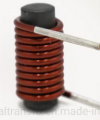
- Another question is if I can use ferrite core?!? Because I have a LOT of them scrapped. Donut O and stick | ferrite shape.
Like these: 1717189430661.png 1717189371502.png
 

Thread Starter

q12x

Joined Sep 25, 2015
2,227
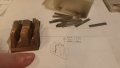
I only have these (scrapped and VERY old) laminations.
I do not have any coil from it anymore.
In the picture you can see E and I lamination sheets.
Im showing my finger for scale to see its quite a small traf.
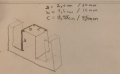
I only measured the middle column of the E.
And for my imperial friends, I had to convert here at my PC those mm into inch:
a = 0.78 inch
b = 0.55 inch
c = 0.37 inch
20240601_003030.jpg1717191269766.png
Im showing this because I have it already and I know these laminators or "tole" (in my language) are made from a special steel, specific for transformers. Not mild steel. It is called silicon steel or transformer steel. Special !
Wrap a few hundred turns of fine gauge magnet wire (28-34AWG) on a big fat iron bolt.
I already have some silicone steel I want to use. But your input was very good because it hint me I can actually use a I core with some wire around it. I was thinking on using the I silicone steel core. It should be way better than a iron I core. So I dont necessarily need to use that E core, correct? Thats very interesting to know ! hmmm.
 

Thread Starter

q12x

Joined Sep 25, 2015
2,227
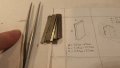
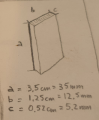
Ok, Now I measured the I laminators.
And for my imperial friends, I had to convert here at my PC those mm into inch:
a = 1.37 inch
b = 0.49 inch
c = 0.20 inch
20240601_005513.jpg 1717192724551.png
- And here is where I black out.
- How many turns and how thick wire to use for a 240VAC mains power source ?
(thats my daily tweezers and lately is insupportable magnetic)
 

Thread Starter

q12x

Joined Sep 25, 2015
2,227
Wrap a few hundred turns of fine gauge magnet wire (28-34AWG)
The copper wire diameter I have in stock:
0.12 mm =27AWG
0.17 mm =25AWG
0.25 mm =24AWG
0.32 mm =22.3AWG

I believe your 28-34 is even finer diameter than what I have here.
My 0.12 mm=27AWG is the closest to your 28AWG.
Next, how many turns more specifically?
How many hundreds?
And not to burn it and to use it at my 240VAC and with the laminator I core with its dimentions specified !
 

Thread Starter

q12x

Joined Sep 25, 2015
2,227
I found a formula !
If Bmax=1.5 I get Nmin 173
If Bmax=1.0 I get Nmin 260
What I dont understand from this formula is the thickness of the wire.
I imagine, for those 260 turns to fit in a small space like the E core (if I will use it) I will need very thin wire. I believe the thickness of the wire doesnt matter. What matters is to avoid core saturation when the energizing voltage is applied. The thickness of the wire is important only for the entire coil to fit into a specific limited space. This is my interpretation. Correct me if Im wrong.
1717197876968.png
 
Last edited:

Thread Starter

q12x

Joined Sep 25, 2015
2,227
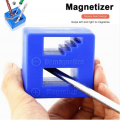
Oooh no.... I already have this piece of garbage :
In the picture is showing how to magnetize, to demagnetize you use the stairs Hole and rub inside it.
1717200168277.png
I tried it in all positions, all speeds, all angles and nothing works !
It is doing something but not completely, like 50% of the job. Sometimes, but very rarely, I get my tool demagnetized like 80% but is very random and very rare and I have no idea how to do it again. Its a garbage.
This is the reason I want to build one actually, because of this garbage.
 

Thread Starter

q12x

Joined Sep 25, 2015
2,227
So my formula and my interpretation is OK?
I assume if no one is saying anything, that is ok and I should proceed in building it.
The formula result fits with #4 very crude description and actually is good enough for me, in a sense.
 

MrChips

Joined Oct 2, 2009
34,824
Use the “I” core from the transformer and the 27 AWG enamelled copper wire. Put as many turns as you can get, 200-500 turns.
Try with a 25-40W incandescent light bulb in series to reduce the current.

The correct technique for demagnetizing tools is to bring the tool up to the coil and slowly remove the tool from the coil while the power is still on. It should take 3-5 seconds as you remove the tool. Don’t switch off the power while you withdraw the tool.
 

Thread Starter

q12x

Joined Sep 25, 2015
2,227
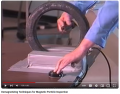
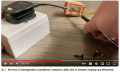
Yes, I watched a couple of youtube videos and they show this method how to handle the tool when demagnetizing.
I found 3 demagnetizing ways so far, including the one from #2 here in this thread.
I was wondering if its not possible to make a coil and run it with an alternative square wave current at 5V ! I have relays that are working at this voltage, I think is possible. I think it will be too much pain to make such a cct when cheaper versions exist. Hmm... but is an idea.
 

MisterBill2

Joined Jan 23, 2018
27,563
Certainly it is possible to make a coil and drive it with a 5 volt square wave. But it is not likely to be useful.Demagnetizing involves applying a fairly strong AC magnetic field and then reducing the field, usually by moving the tool away at some medium speed. But to start the field must be stronger than what the item already is magnetized.
 

SamR

Joined Mar 19, 2019
5,491
Oooh no.... I already have this piece of garbage :
I do also. Which is why I took a flyer on the Klein pricey one based on the Klein reputation. It works far better than others I've tried did. Not perfect but then not much in this world is... It has a "key" ring to attach to an electrician's tool belt but I simply stick it onto the drawer in one of my toolboxes. I do wonder how one of the old handheld reel to reel tape deck head Degaussers might work or one of the degaussing rings from an old CRT? I like to keep my screwdrivers magnetized but hate when my parts tweezers become magnetized which is what I mostly use it on. Of course, the real solution is to use austenitic stainless steel tweezers or I do have some ceramic tipped ones. Unfortunately, stainless steel tools rarely advertise which grade of stainless steel they are made from so it's usually Hobsen's choice.
 
Last edited:

Thread Starter

q12x

Joined Sep 25, 2015
2,227
Certainly it is possible to make a coil and drive it with a 5 volt square wave. But it is not likely to be useful.Demagnetizing involves applying a fairly strong AC magnetic field and then reducing the field, usually by moving the tool away at some medium speed. But to start the field must be stronger than what the item already is magnetized.
You might be right at 5V to get a very weak magnetic field. Hmmm.....
The "reducing the field, usually by moving the tool away at some medium speed" can be done from electronics, while the tool is stationary in a marked area+ an indicator led telling when the process started and when it finished, ready for the tool to pick up.
You are right, we need a strong field.....hmmmm.
Thats why is good to talk with people first. Heh.
 

MrAl

Joined Jun 17, 2014
13,708
I want to make a demagnetize circuit for my never ending magnetized screwdrivers and tweezers.
I didn't searched on the net for a cct yet, I want your versions first. But I will. It will exceptionally if you actually build one and share your cct + beauty picture of the device + impressions of its working in time. If Im lucky, of course. If not, we will make a bright new one right here.
The catch is to make it with what I have (scrapped), and I have a good bunch I can choose from.
Hello there,

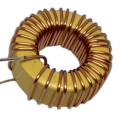
I see some readers said that toroid cores (donuts) do not work for this purpose, but they can be made to work better than a straight core like a core in the shape of a rod. This is because with a donut shape you can concentrate the magnetic field better than with a rod shape.

With a rod shape, the magnetic path is very long from one end to the other.
With a donut, the magnetic path is circular, so it's like a rod with both ends doing the work.
Don't think you can put the end of the screwdriver though the donut hole though, that's what does not work. That's because the magnetic field is very concentrated within the core material and so the external metal will see very little field strength.

The idea is to form a gap in the toroid, or get a toroid with a gap already in it. I would think the gap would have to be at least 1/8 of an inch (about 3mm) or so in order to have room to put the screwdriver end in between the two core sections. The gap does not have to be as perfect as when gapping for something like a power converter, it just has to be wide enough. This gives us a lot of leeway as to form the gap.

The first way would be to grind the gap yourself with maybe a Dremel tool and diamond disk. You have to be careful though because there will be dust so you have to wear a mask, and clean up the mess after. You also have to keep the core cool or else the temperature gradient as the core is being ground could cause the core to crack. The best way is to do the grinding under water, but you would really have to use a battery operated Dremel for that not a corded tool. I if you do have to use a corded tool, then only apply a little water or have someone do that for you as you grind, but of course being careful with the water and the drill. Distilled water might be best. If it does crack however, you can glue the cracked pieces back together with super glue like a 3d puzzle. The pieces will fit together very snug so it will still act almost as a single core again. In the mean time, you can grind two of the faces to form the gap. The gap does not have to be perfectly flat either, it can be like a diagonal through the core.

The second way is to crack a core in a vise by placing it in a rag and slowly applying pressure across the diameter. The core cracks somewhat neatly. You can then choose which faces you want to grind, then glue all the pieces back together again. There are usually four pieces when you do that, with possibly some smaller fragments. It's not hard to glue back together though, and you will get reasonable results.

The reason this works better is because the magnetic field is more concentrated between the gap as both ends of the core contribute to the magnetic field.

Now as to the electronics, the idea is to energize the core and then gradually decrease the current. You can do that manually if you have a means to do that with a power supply. In many degaussers they use an AC current though and gradually decrease that current. It should work with a DC current but you may have to reverse the field in addition to decreasing the current. That's to get the metal down through zero A/m in order to overcome the coercivity, and with a unipolar DC current I don't think you can do that because there will be no way to reduce the A/m to near zero. That's unless the metal already has a very low coercivity.

BTW, there are also metal "C" cores which would be much easier to gap on one side because they come in two parts already. They would also have a circular magnetic path.

Let us know what happens :)
 

MisterBill2

Joined Jan 23, 2018
27,563
Rather than destroy a good toroid core, why not just add pole pieces to a wound coil solenoid magnet?? Or even just bend a section of steel rod into a "U" shape?? Or wind a bunch of wire around an old "horseshoe" magnet that has lost it's magnetism. Or even pull the "I" section off of a transformer made wit"E-I" laminations??
 
Top