Electromagnetic brake

MisterBill2

Joined Jan 23, 2018
27,524
Normal electric motors do not operate in a constant power mode. So if the voltage is reduced the current will drop. And so will the torque and the speed.
For a great deal more capability you can have the gearbox turn a lead-screw. That will give a lot more force, do a linear move, and avoid any creeping while sawing.
AND, now I see it is a lumber mill, and not a metal working milling machine. I was a bit confused.
 

Thread Starter

rgsawmill

Joined Apr 13, 2025
103
Normal electric motors do not operate in a constant power mode. So if the voltage is reduced the current will drop. And so will the torque and the speed.
For a great deal more capability you can have the gearbox turn a lead-screw. That will give a lot more force, do a linear move, and avoid any creeping while sawing.
AND, now I see it is a lumber mill, and not a metal working milling machine. I was a bit confused.
As am I from time to time. Thank you for the information and response.
 

Irving

Joined Jan 30, 2016
5,123
for a unit supplied with the full 24volts.
Yes, typical run current in wheelchair use will be 10-15A running in a straight line on aw flat tarmac surface (motors are typically 250 - 400W) rising to 90 - 120A (controller limited) when initiating a standing turn on a soft surface (grass, gravel).

To throw a fly in the ointment, I am hoping to supply 12 volts to the 24volt motor. What will that do to the torque ? Also I'm thinking that the amperage will increase.
Hmmm, yes it will reduce torque. Speed => volts, torque => current, power in = volts x current, power out = speed x torque (W = rpm/10 x Nm, approx).

That motor you have would appear to be a 2-pole motor (how many brushes does it have, 2 or 4?) - you might get 10Nm torque out of it at 24v but 12v will be limiting. A 4-pole will have much better torque characteristics and double the starting torque for the same power input.

And also I'm assuming the wheelchair controller has something to do with the delay in the brake application for safety reasons.
Yes, it won't release the brake until the motor has started drawing enough current to hold still on a slope.
 

Thread Starter

rgsawmill

Joined Apr 13, 2025
103
Yes, typical run current in wheelchair use will be 10-15A running in a straight line on aw flat tarmac surface (motors are typically 250 - 400W) rising to 90 - 120A (controller limited) when initiating a standing turn on a soft surface (grass, gravel).


Hmmm, yes it will reduce torque. Speed => volts, torque => current, power in = volts x current, power out = speed x torque (W = rpm/10 x Nm, approx).

That motor you have would appear to be a 2-pole motor (how many brushes does it have, 2 or 4?) - you might get 10Nm torque out of it at 24v but 12v will be limiting. A 4-pole will have much better torque characteristics and double the starting torque for the same power input.


Yes, it won't release the brake until the motor has started drawing enough current to hold still on a slope.
Yes sir, it is a 2 pole motor. I will figure out what the torque requirement is to lift the load. Measuring the actual output torque of the gear motor will be more interesting because I do not feel like trying to manually stall the motor with a torque wrench. I don't want a chipped tooth . Thank you for your insight.
 

MisterBill2

Joined Jan 23, 2018
27,524
Yes sir, it is a 2 pole motor. I will figure out what the torque requirement is to lift the load. Measuring the actual output torque of the gear motor will be more interesting because I do not feel like trying to manually stall the motor with a torque wrench. I don't want a chipped tooth . Thank you for your insight.
Use a drum and line arrangement to lift a weight. Increase the weight until the motor draws rated current Torque=weight x drum radius. No tooth hazard.
 

Thread Starter

rgsawmill

Joined Apr 13, 2025
103
Good afternoon.
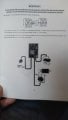
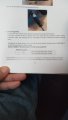
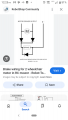
So why does my brake not set? I have a PWM driving my motor. I have it wired like this. The PWM has 12 volts on both motor legs when at rest . That is supplying 12v to keep the brake released. If I power it directly from the battery (no PWM) in the down direction the driven weight drags the motor and produces power by itself to keep the brake released. As you can see I'm no electrician. How do I fix this issue with the PWM in place.Screenshot_20250411-122535.png
 

Irving

Joined Jan 30, 2016
5,123
Good afternoon.
So why does my brake not set? I have a PWM driving my motor. I have it wired like this. The PWM has 12 volts on both motor legs when at rest . That is supplying 12v to keep the brake released. If I power it directly from the battery (no PWM) in the down direction the driven weight drags the motor and produces power by itself to keep the brake released. As you can see I'm no electrician. How do I fix this issue with the PWM in place.
I'm confused, so let's be clear: By 'set' you mean brake ON (ie not powered). when brake is powered it is OFF. So you want it OFF when motor is powered (ie only when active PWM is applied) and ON at all other times including when motor is back driven by load.

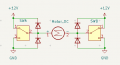
As you have seen you cannot achieve this directly by connecting brake to motor; it needs a little bit of 'intelligence'. This diagram shows a simplified version of the PWM controller at idle:

1745599698882.png

When PWM is applied one of the switches is connected to ground on & off quickly, which switch determines the direction, and how fast/long it's connected sets the motor speed. Incidentally, if both are connected to ground, that's actually braking the motor, but not all PWM controllers can do that. So with no PWM active, both sides of the motor have +12v applied, which of course will keep the brake OFF if it is returned to battery - (GND). When the motor is back driven, one side will become + and the other - and current will flow from the + side, through the switch into the battery, and back round to the -side of the motor via one of the bottom diodes, so effectively producing the same result. This probably isn't very good for the controller either.

To resolve this you need something to detect when either side of the motor is PWM'd to GND, but is not continuously there (as it would be when back driven), and that cannot easily be done with the brake on its own.

What controller are you using?
 

Thread Starter

rgsawmill

Joined Apr 13, 2025
103
I'm confused, so let's be clear: By 'set' you mean brake ON (ie not powered). when brake is powered it is OFF. So you want it OFF when motor is powered (ie only when active PWM is applied) and ON at all other times including when motor is back driven by load.

As you have seen you cannot achieve this directly by connecting brake to motor; it needs a little bit of 'intelligence'. This diagram shows a simplified version of the PWM controller at idle:

View attachment 347854

When PWM is applied one of the switches is connected to ground on & off quickly, which switch determines the direction, and how fast/long it's connected sets the motor speed. Incidentally, if both are connected to ground, that's actually braking the motor, but not all PWM controllers can do that. So with no PWM active, both sides of the motor have +12v applied, which of course will keep the brake OFF if it is returned to battery - (GND). When the motor is back driven, one side will become + and the other - and current will flow from the + side, through the switch into the battery, and back round to the -side of the motor via one of the bottom diodes, so effectively producing the same result. This probably isn't very good for the controller either.

To resolve this you need something to detect when either side of the motor is PWM'd to GND, but is not continuously there (as it would be when back driven), and that cannot easily be done with the brake on its own.

What controller are you using?
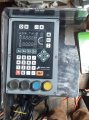
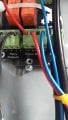
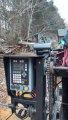
I haven't even gotten to tie it into the setworks controller yet. I think that will control the motor fine , it's the brake that is a problem. I will send you some pics of the controller and PWM.KIMG9937~2.JPG
 

Thread Starter

rgsawmill

Joined Apr 13, 2025
103
I realize, if I spend more money and buy an other gear motor with more gear reduction and inherent braking it would solve my problem of dealing with an electromagnetic brake. I was hoping you guys would say " just put this thing here " and the problem would be solved. You know, money dosn't grow on trees around me.
Tks Bob G.
 

Thread Starter

rgsawmill

Joined Apr 13, 2025
103
I realize, if I spend more money and buy an other gear motor with more gear reduction and inherent braking it would solve my problem of dealing with an electromagnetic brake. I was hoping you guys would say " just put this thing here " and the problem would be solved. You know, money dosn't grow on trees around me.
Tks Bob G.
At one point when testing directly to the battery without the PWM in the equation I was able to stop the downward travel and set the brake by removing the B+ and B- and shorting the two (I think). Leading me to think I was close. Then finding that the PWM was supplying 12v on both motor lugs at rest along with the motor producing power relay got me stumped.
So then I was trying to to figure out how to control a relay to either take away power or ground to the brake from signals at the PWM. At the same time I looked at the controller and found (I think) everything is controlled by grounding ckts. I don't want to destroy the controller or the PWM so I decided to ask more questions.
 

Attachments

Thread Starter

rgsawmill

Joined Apr 13, 2025
103
At one point when testing directly to the battery without the PWM in the equation I was able to stop the downward travel and set the brake by removing the B+ and B- and shorting the two (I think). Leading me to think I was close. Then finding that the PWM was supplying 12v on both motor lugs at rest along with the motor producing power relay got me stumped.
So then I was trying to to figure out how to control a relay to either take away power or ground to the brake from signals at the PWM. At the same time I looked at the controller and found (I think) everything is controlled by grounding ckts. I don't want to destroy the controller or the PWM so I decided to ask more questions.
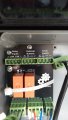
This is it if your not sick of me yet.
 

Attachments

Thread Starter

rgsawmill

Joined Apr 13, 2025
103
I haven't even gotten to tie it into the setworks controller yet. I think that will control the motor fine , it's the brake that is a problem. I will send you some pics of the controller and PWM.View attachment 347861
Yes sir. When operating the motor either up or down the brake needs to be energized which in turn releases the brake. When not commanding the motor to move the power needs to be taken away from the brake quickly to (set ) make the brake come on and hold the location.
More importantly to hold the load after raising the load. The controller can be programmed(or is programed) to drop below the target location and then come up to the target to allow any backlash (play) in the mechanics to be taken up for accuracy.
 

Irving

Joined Jan 30, 2016
5,123
You know, money dosn't grow on trees around me.
Understood. I'm sure there will be a cost-effective solution...

set the brake by removing the B+ and B- and shorting the two (I think)
Removing the power would set the brake Shorting the coil would have no effect...

The controller can be programmed(or is programed) to drop below the target location and then come up to the target to allow any backlash (play) in the mechanics to be taken up for accuracy.
I think we were at cross-purposes before. Now I understand the confusion between 'mill controller' and 'PWM controller'.

RE 'mill controller': OK, that's pretty good. Will it control the lifting motor speed as well as its direction? How does the mill controller connect to the PWM controller? I think the solution will be in that area...

[edit] just seen your photo of the connections... I'll go read the manual... [edit] or I would if it was online...

This is it if your not sick of me yet.
Nah, we love the challenge of solving problems (mostly) here on AAC!
 
Last edited:

Thread Starter

rgsawmill

Joined Apr 13, 2025
103
Understood. I'm sure there will be a cost-effective solution...


Removing the power would set the brake Shorting the coil would have no effect...


I think we were at cross-purposes before. Now I understand the confusion between 'mill controller' and 'PWM controller'.

RE 'mill controller': OK, that's pretty good. Will it control the lifting motor speed as well as its direction? How does the mill controller connect to the PWM controller? I think the solution will be in that area...


Nah, we love the challenge of solving problems (mostly) here on AAC!
Thank you for responding.
The sawmill setworks controller dose not control the setworks motor speed. There is actually a 1"-1.5" a second maximum allowable movement for the controller to react. (I assume)
The mill controller has a relay board with two relays. The relay out wires (1,2,3,4) go to the motor control relay or PWM. They are only the contact portions of the relays. #1-#2 are normally open on one relay. #3-#4 are normally open on the other relay.

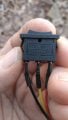
So on the PWM I would remove the three wire , three position switch and wire in #2+#3 from mill controller To the center wire of the switch (A).
#1 from mill controller. Will be connected to (A1)
#4 from mill controller will be connected to (A2)
Swap A1 and A2 id motor direction is wrong.
So on the PWM . The center wire on the switch has continuity to the ground post.
The (A1) + ( A2) has 12 volts when PWM is on.
Actuate the switch and voltage is lost in the related ckt. So I am assuming the switch supplies the ground for the winding side of the relay allowing motor rotation in one direction.
So, the relays in the mill controller are just replacing the switch. Hopefully I explained it well enough.
 

Thread Starter

rgsawmill

Joined Apr 13, 2025
103
Thank you for responding.
The sawmill setworks controller dose not control the setworks motor speed. There is actually a 1"-1.5" a second maximum allowable movement for the controller to react. (I assume)
The mill controller has a relay board with two relays. The relay out wires (1,2,3,4) go to the motor control relay or PWM. They are only the contact portions of the relays. #1-#2 are normally open on one relay. #3-#4 are normally open on the other relay.

So on the PWM I would remove the three wire , three position switch and wire in #2+#3 from mill controller To the center wire of the switch (A).
#1 from mill controller. Will be connected to (A1)
#4 from mill controller will be connected to (A2)
Swap A1 and A2 id motor direction is wrong.
So on the PWM . The center wire on the switch has continuity to the ground post.
The (A1) + ( A2) has 12 volts when PWM is on.
Actuate the switch and voltage is lost in the related ckt. So I am assuming the switch supplies the ground for the winding side of the relay allowing motor rotation in one direction.
So, the relays in the mill controller are just replacing the switch. Hopefully I explained it well enough.
Sorry correction: A1 and A2 at the PWM switch has 10 volts not 12.
 

Thread Starter

rgsawmill

Joined Apr 13, 2025
103
Sorry correction: A1 and A2 at the PWM switch has 10 volts not 12.
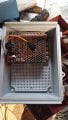
To further complicate things.(It's scary being in my head isn't it) I was thinking I could devote a relay next to the PWM that would be devoted to the brake by supplying 12v on the contact side to the brake.
On the winding side supply 12 volts. On the ground side of the relay winding wire in two blocking diods and connecting them to A1 and A2.
Now for the problem in my head.
The winding side of the brake relay will be 12 volts and that power will feed into A1 and A2 that is 10 volts. The power has no where to go until the mill controller closes the relay contacts sending it to ground.
Is that 10 volts at the PWM regulated for some reason and will feeding 12 volts harm what ever in the PWM is supplying that ?
I did not try supplying the PWM with 24 volts to see if that increases the voltage on A1+A2. The PWM is capable of being powered with different voltages .
I warned you that it would be scary looking into my head.
Sorry for all the posts. Just trying to let you know what I am thinking.
Tks Bob G.
 

Irving

Joined Jan 30, 2016
5,123
Hi Bob, your thinking is fine, and not scary at all. You've answered a few other questions I was about to ask.

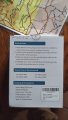
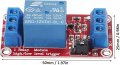
Now, while it would probably work to connect a relay to A1 & A2 via a couple of steering diodes, I'd probably not recommend doing it that way. Instead I'd get one of these, to give an extra layer of isolation :

1745622472641.jpeg

https://www.amazon.com/hrsyyl-Channel-Optocoupler-Isolation-Support/dp/B0D3FHB2CD/

Make sure you get the 12v version.

Select jumper for Low activation. On the input side, onnect the module DC + & - to the PWM controller + & - DC input, and your two steering diodes to IN and their other ends to A1 and A2, so that the diodes are pointing to A1 and A2.

On the output side, connect COM to DC+ & NO to one side of the brake coil. Connect the other side of the brake coil to DC-.

Now, if wired correctly, when the mill controller grounds either A1 or A2 the module will activate, powering the brake coil and releasing the brake.

That should do it.
 

Thread Starter

rgsawmill

Joined Apr 13, 2025
103
Hi Bob, your thinking is fine, and not scary at all. You've answered a few other questions I was about to ask.

Now, while it would probably work to connect a relay to A1 & A2 via a couple of steering diodes, I'd probably not recommend doing it that way. Instead I'd get one of these, to give an extra layer of isolation :

View attachment 347893

https://www.amazon.com/hrsyyl-Channel-Optocoupler-Isolation-Support/dp/B0D3FHB2CD/

Make sure you get the 12v version.

Select jumper for Low activation. On the input side, onnect the module DC + & - to the PWM controller + & - DC input, and your two steering diodes to IN and their other ends to A1 and A2, so that the diodes are pointing to A1 and A2.

On the output side, connect COM to DC+ & NO to one side of the brake coil. Connect the other side of the brake coil to DC-.

Now, if wired correctly, when the mill controller grounds either A1 or A2 the module will activate, powering the brake coil and releasing the brake.

That should do it.
Thank you. Are you concerned with introducing 12 volts from this unit into A1+A2 that has 10 volts ?
 

Thread Starter

rgsawmill

Joined Apr 13, 2025
103
Thank
Thank you. Are you concerned with introducing 12 volts from this unit into A1+A2 that has 10 volts ?
You very much for sticking with me on this project. Your patience and knowledge are greatly appreciated.
Thanks again. I'll keep you up to speed when I get the parts and assemble the electrical cabinet. I will of course bench test before hooking it to the mill controller.
Bob G.
 
Top