Facebook
 Google
 GitHub
 Linkedin

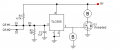
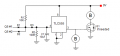
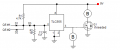
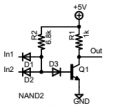
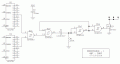
First pass at a schematic as described in #18.
R1-C1 are the monostable timing components. Their values are approximate because the input transition voltage levels in the 4093 are not tightly controlled in fabrication.
When both Y5 output are high (even for a few nanoseconds), U1A goes low and triggers the monostable. While it is timing, feedback from pin 10 to pin 11 prevents extra input activity from re-triggering the timer. The output is inverted in U1B to get the correct logic polarity for Q1.
A potential problem is that the 4017 outputs sometimes have very short glitches caused by the way the outputs are decoded from a shift register. To prevent these from creating false triggers, add a small R-C filter at U1A pins 1 and 2. 0.1 uF and 1.0 K should work.
ak
R1-C1 are the monostable timing components. Their values are approximate because the input transition voltage levels in the 4093 are not tightly controlled in fabrication.
When both Y5 output are high (even for a few nanoseconds), U1A goes low and triggers the monostable. While it is timing, feedback from pin 10 to pin 11 prevents extra input activity from re-triggering the timer. The output is inverted in U1B to get the correct logic polarity for Q1.
A potential problem is that the 4017 outputs sometimes have very short glitches caused by the way the outputs are decoded from a shift register. To prevent these from creating false triggers, add a small R-C filter at U1A pins 1 and 2. 0.1 uF and 1.0 K should work.
ak
Last edited: