DC Analysis Of This Circuit

MrAl

Joined Jun 17, 2014
13,724
Thanks Mr Al
Hello again,

You're welcome, and I see you are still working on this so I will add a little more to post #32.

From that approach we have a way to calculate the Beta given that the output would be biased as well as possible in the usual case.
Going from there, we want to use what we know about the circuit around Q1 and the precalculated voltages and collector current to do the calculation.
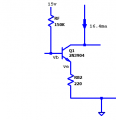
(See diagram)
In the diagram you can see from post #32 we ended the analysis with the circuit with Q1, and that part is shown there. We then concentrate on that section.

We know the input current is the current through RF:
iRF=(15-vb)/150000;
and the current through the emitter resistor is:
iRB2=iRF+0.0164;
thus the emitter voltage is:
ve=iRB2*220;
and it is also related to vb because of the diode drop:
ve=vb-0.7;
equating these last two we get:
iRB2*220=vb-0.7;
solving for vb we get:
vb=32475/7511
Back to the first equation:
iRF=(15-vb)/150000
replacing vb with the numerical value we get:
iRF=2673/37555000
and since this is the base current iB and we know iC=16.4ma=164/10000 we can calculate the Beta by dividing iC/iB:
Beta=(164/10000)/(2673/37555000)
and this gives us:
Beta=615902/2673
which with six digits is approximately equal to:
Beta=230.416

You should go over this and make sure everything is right.
Once we have this we can go on to look at some variations in both the Beta and small currents into the bases of the two driver transistor pairs and whatever else we'd like to know about. One thing we will find for example is that the circuit could really use the symmetrical output resistors usually found on these amplifiers as that helps to set the quiescent currents from those two driver pairs. There are other things to look at too through, such as the mismatch between the total voltage of the three diodes in series and the sum of the three base emitter voltages of the driver transistor pairs, which is what the symmetrical output resistors help to cure. The problem is if there is a difference in voltages the quiescent current in the drive transistors can end up going very high without these important resistors, especially when we are depending on diode voltage drops to match transistor base-emitter diode drops, which is not actually possible over all temperature values, and probably not even at room temperature.
The general idea here now is to go over the design using the calculations and see what would make the circuit more practical.
 

Attachments

Thread Starter

RRRRSSSS

Joined Jun 16, 2023
128
Hello again,

You're welcome, and I see you are still working on this so I will add a little more to post #32.

From that approach we have a way to calculate the Beta given that the output would be biased as well as possible in the usual case.
Going from there, we want to use what we know about the circuit around Q1 and the precalculated voltages and collector current to do the calculation.
(See diagram)
In the diagram you can see from post #32 we ended the analysis with the circuit with Q1, and that part is shown there. We then concentrate on that section.

We know the input current is the current through RF:
iRF=(15-vb)/150000;
and the current through the emitter resistor is:
iRB2=iRF+0.0164;
thus the emitter voltage is:
ve=iRB2*220;
and it is also related to vb because of the diode drop:
ve=vb-0.7;
equating these last two we get:
iRB2*220=vb-0.7;
solving for vb we get:
vb=32475/7511
Back to the first equation:
iRF=(15-vb)/150000
replacing vb with the numerical value we get:
iRF=2673/37555000
and since this is the base current iB and we know iC=16.4ma=164/10000 we can calculate the Beta by dividing iC/iB:
Beta=(164/10000)/(2673/37555000)
and this gives us:
Beta=615902/2673
which with six digits is approximately equal to:
Beta=230.416

You should go over this and make sure everything is right.
Once we have this we can go on to look at some variations in both the Beta and small currents into the bases of the two driver transistor pairs and whatever else we'd like to know about. One thing we will find for example is that the circuit could really use the symmetrical output resistors usually found on these amplifiers as that helps to set the quiescent currents from those two driver pairs. There are other things to look at too through, such as the mismatch between the total voltage of the three diodes in series and the sum of the three base emitter voltages of the driver transistor pairs, which is what the symmetrical output resistors help to cure. The problem is if there is a difference in voltages the quiescent current in the drive transistors can end up going very high without these important resistors, especially when we are depending on diode voltage drops to match transistor base-emitter diode drops, which is not actually possible over all temperature values, and probably not even at room temperature.
The general idea here now is to go over the design using the calculations and see what would make the circuit more practical.
Hi Mr Al:

Thanks, that was a lot of work. I worked through your numbers and I understand your process. One thing, the
VCC/2 = 15 volts. The sim shows 12.25 volts. If I plug the 12.25 into the math, it gives a wonky number.
Should the circuit be tweeked to get the 12.25 volts to be 15 volts? The weird thing is that using 15 volts results
in vb = 4.33 volts as does the sim.

RS
 
Last edited:

MrAl

Joined Jun 17, 2014
13,724
Hi Mr Al:

Thanks, that was a lot of work. I worked through your numbers and I understand your process. One thing, the
VCC/2 = 15 volts. The sim shows 12.25 volts. If I plug the 12.25 into the math, it gives a wonky number.
Should the circuit be tweeked to get the 12.25 volts to be 15 volts? The weird thing is that using 15 volts results
in vb = 4.33 volts as does the sim.

RS
Hello again,

Ha ha, yes, the analysis starts with the assumption that the output is at 15 volts and if you arbitrarily try to change that then you need to go through the whole process again with this new assumption. You can certainly try that if you like.

The reason for the difference could be caused by several things.
The first is all the diode voltage drops, including the base emitter diode drops for the upper and lower driver transistor pairs. These may all be different than the assumption of 0.7v for all.
Another is the Beta of Q1. The simulator Beta will be whatever it is for that model of that transistor, which may or may not correlate to real life either, and almost certainly will not because there is always a spread with real transistors especially over temperature. Remember we solved for the Beta given a certain output voltage while the simulator solved for the output voltage given a certain Beta. The Beta for the transistor is somewhat arbitrary while our assumption of output voltage is also somewhat arbitrary, although both are reasonable.
Another is the assumption of zero current into each of the driver transistor pairs, which would result in zero cross output transistor current. That's not usually the case, but that assumption was because it is impossible to set the quiescent cross current without those symmetrical output resistors (usually two low value resistors) or using a more sophisticated transistor model (rem we are using the CCCS model, which is a very simplified, linear model). That's because the three diode voltage drops will not match the three-transistor base-emitter voltage drops. If you would like to see the effect of some base current for the two driver sections, you can simply subtract something like 100ua or something from the 16.4ma assumed collector current of Q1. It may be more or less than 100ua though so be aware of that, and it could also be different for the upper section and the lower section.

What you could do check all the diode voltage drops including the base-emitter diode drops. It must be that the lower driver section is turning on SLIGHTLY more than the upper section, and keep in mind this is almost like trying to balance a 50 pound weight on the head of a pin without those symmetrical resistors, so it's easy to see an imbalance that results in an output offset. The simulators will be using the nonlinear models which although are usually considered to be better, may not be exact either in all circuit types. This means that what we look for is not an exact number, but some ideas about how the circuit operates and produces what it produces in real life, and what the possible problems may be when we decide to go to a real life circuit. With some design experience we can usually come up with a modification that helps make the circuit more practical. The important thing though is that you went through the analysis given the reasonable assumptions and come out of it with some understanding about how the circuit works in general. Once you have that understanding, you can always go back and ask questions about what happens when you change this or that, and investigate more deeply into what makes the output what it is.

Note we have not yet looked into the gain setting yet either. That would be part of the analysis with a real amplifier. It may or may not be that important to you just yet though so that can wait of course.
 

LvW

Joined Jun 13, 2013
2,031
Hi Mr Al:

Thanks, that was a lot of work. I worked through your numbers and I understand your process. One thing, the
VCC/2 = 15 volts. The sim shows 12.25 volts.
As mentioned in my post#34 I also have simulated the circuit (using the SPICE models for the transistors as given in your first post) - my result was: DC V_out=14.94 volts.
Which transistors did you use for your simulation ?
 

MrAl

Joined Jun 17, 2014
13,724
As mentioned in my post#34 I also have simulated the circuit (using the SPICE models for the transistors as given in your first post) - my result was: DC V_out=14.94 volts.
Which transistors did you use for your simulation ?
Hi there,

Oh that's an interesting and important fact. I guess your components were more like what we would think they should be.
I did not use a simulator (yet) I just did the math.
Since yours came out so close to 15v then I would think there is some variation in the models in the different simulators.

Sorry I missed your post somehow thanks for mentioning this again.
 

LvW

Joined Jun 13, 2013
2,031
Hi there,

Oh that's an interesting and important fact. I guess your components were more like what we would think they should be.
I did not use a simulator (yet) I just did the math.
Since yours came out so close to 15v then I would think there is some variation in the models in the different simulators.

Sorry I missed your post somehow thanks for mentioning this again.
Yes - I have used PSpice using advanced models for the corresponding transistor types.

As mentioned in post#34, my "handmade" calculations - starting with an estimated value B=200 for Q1 and 0.7 volts for all pn junctions - resulted in
Ic1=14mA and V_out(DC)=14.28 volts .
 

Bordodynov

Joined May 20, 2015
3,428
I take the opposite approach.
When I first started studying electronics, I calculated a simple common emitter amplifier. This was a long time ago, when I was in my first year of university. My approach is that I immediately set the voltage and current mode I want. I measured the gain of the transistor beforehand. It was a germanium transistor. Having the voltages on the base and collector resistors and using Ohm's law I calculated the value of these resistors. After that I soldered the circuit and connected the power supply. I measured the voltages and got the desired values. And no iterations were required.
Later I calculated hundreds of circuits using the method of setting the desired modes in more complex (multistage circuits) and always got what I wanted. Node voltages were obtained with an accuracy of 50 mV.
 

Thread Starter

RRRRSSSS

Joined Jun 16, 2023
128
Hi there,

Oh that's an interesting and important fact. I guess your components were more like what we would think they should be.
I did not use a simulator (yet) I just did the math.
Since yours came out so close to 15v then I would think there is some variation in the models in the different simulators.

Sorry I missed your post somehow thanks for mentioning this again.
Hi:

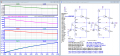
Here is my sim file. I meant to post it earlier but I guess I forgot to.
 

Attachments

MrAl

Joined Jun 17, 2014
13,724
Yes - I have used PSpice using advanced models for the corresponding transistor types.

As mentioned in post#34, my "handmade" calculations - starting with an estimated value B=200 for Q1 and 0.7 volts for all pn junctions - resulted in
Ic1=14mA and V_out(DC)=14.28 volts .
Thanks for the additional info.
I'll check out the simulation next since the .asc files has been posted now.
 

MrAl

Joined Jun 17, 2014
13,724
Hi:

Here is my sim file. I meant to post it earlier but I guess I forgot to.
Hi,

Thanks for posting the .asc file.

I had to change the two output transistors to the 2N3055 type because i did not have the model for the TIP31A.

I took a quick look and saw that the quiescent current in the two output transistors CE was way too high, over 2 amps. That means that the three diode voltage drops do not match with all the emitter-base voltage drops well enough, and that the three diode voltage drops are too much higher than the three base-emitter voltage drops, when measured independently. With that, I placed a 10 Ohm resistor in parallel with D1 to lower the total voltage across the three diode set, just for a quick adjustment. That lowered that voltage and thus the quiescent current of those two output transistor fell to just about 25ma each.
Now that 10 Ohm resistor may or may not be a valid fix, but it does show the importance of getting the three diode voltage drop nearly equal to the three base-emitter diode drops in order to keep the quiescent current low, although it should not be zero either.
There are better schemes for this part of the bias circuit, but this circuit is just for study I would say not for actual use. When we investigate it we find things like this, like the balance between the three diode voltage drops and the three transistor base-emitter voltage drops.
 

MrAl

Joined Jun 17, 2014
13,724
Hi:

Here is my sim file. I meant to post it earlier but I guess I forgot to.
Hello again,

Here is a formula for calculating the Beta of Q1 knowing the other things like the voltage at the top of RF which is the DC output (v4 here):
Beta=((Vcc-2*vd-v4)*(RF+RB2))/(-Vcc*RB2+2*vd*RB2+v4*RB2-vd*RB1+v4*RB1)
And, vd is the diode drop and it is assumed that all the diode voltage drops are the same. In the practical circuit it looks like the base-emitter diode voltage drops are less than 0.7 volts for the upper set and maybe higher for the lower set.
 

Thread Starter

RRRRSSSS

Joined Jun 16, 2023
128
Hi,

Thanks for posting the .asc file.

I had to change the two output transistors to the 2N3055 type because i did not have the model for the TIP31A.

I took a quick look and saw that the quiescent current in the two output transistors CE was way too high, over 2 amps. That means that the three diode voltage drops do not match with all the emitter-base voltage drops well enough, and that the three diode voltage drops are too much higher than the three base-emitter voltage drops, when measured independently. With that, I placed a 10 Ohm resistor in parallel with D1 to lower the total voltage across the three diode set, just for a quick adjustment. That lowered that voltage and thus the quiescent current of those two output transistor fell to just about 25ma each.
Now that 10 Ohm resistor may or may not be a valid fix, but it does show the importance of getting the three diode voltage drop nearly equal to the three base-emitter diode drops in order to keep the quiescent current low, although it should not be zero either.
There are better schemes for this part of the bias circuit, but this circuit is just for study I would say not for actual use. When we investigate it we find things like this, like the balance between the three diode voltage drops and the three transistor base-emitter voltage drops.
Isn't the quiescent current in the two output transistors approx. 240mA ?

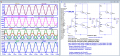
I have added a pair of 0.33Ω emitter resistors on the output transistors to prevent thermal runaway.
 

Attachments

Last edited:

Bordodynov

Joined May 20, 2015
3,428
Isn't the quiescent current in the two output transistors approx. 240mA ?

I have added a pair of 0.33Ω emitter resistors on the output transistors to prevent thermal runaway.
I would recommend reducing the current of the first transistor to reduce "thermal" distortion as I did for the second version of the circuit. See #53.
 

MrAl

Joined Jun 17, 2014
13,724
Isn't the quiescent current in the two output transistors approx. 240mA ?

I have added a pair of 0.33Ω emitter resistors on the output transistors to prevent thermal runaway.
Hi again,

That's a very good start assuming you are trying to improve the circuit, which I guess you have moved on to do now.

Those resistors are part of what sets the theoretical quiescent DC output current like in the emitter of that upper output transistor. The difference in voltage between the three diodes and the three transistor emitter-base junctions divided by that resistance will be the DC quiescent DC output current.
In other words, and remember this is pure theory:
Idc=(3*vd-3*vbe)/(2*Re)
assuming all the vd's and vbe's and Re's are the same value, and if not then:
Idc=(3*vd-vbe1-vbe2-vbe3)/(2*Re)
but I think you get the idea now.

Without those Re resistors, we have the difference in voltages divided by the very small transistor internal resistances, which is hard to nail down and can vary more widely than when we have those Re resistors.
Those Re resistors are sized according to output power and the expected maximum difference between the three different diode drops as outlined above.

With your new circuit, which is better, i still see over 400ma quiescent DC output current (in each Re). To get that lower, just for a quick example, i placed a 10 Ohm resistor in parallel to D1, and that reduces the voltage across the three diode series circuit. That resistor effectively shorts out D1 meaning now the voltage across those three are dependent on the current though them and it's really more like just two diodes in series now.
Note this may not be a practical solution, but just to illustrate how the 3 voltages differences and the Re's work to set the DC, no signal output current. The current that appears in the DC operating point analysis is around 21ma, much better. Shorting out D1 is not going to be the best solution though for a practical circuit, there are several different methods for that which sometimes require diodes, sometimes a transistor and resistors, etc. You can ask people here about that too.

I haven't actually built one of these circuits in years now, many years, and so i am tempted to build one. Not just to see the differences between the real, the simulated, and the simplified theoretical circuits, but to use as a pre-amp for headphones. I purchased a pre-amp but it's not quite enough because my tablet computer I use lowers the volume all by itself claiming that if the volume is too high it can hurt your ears. That's modern over assumptive technology for ya.

I'll include the Re resistors in the Beta formula so we can see how they play out overall, but the above two formulas should help with that already.

BTW, I may have made a mistake when I think I said or implied that the collector current of Q1 would be around 16.4ma. I got that from the base voltage of Q2 but we really have to subtract that base voltage from Vcc and then divide by the resistor value:
iC=(30-16.4)/1000
which of course comes out to 13.6ma. So it's a bit lower than 16ma.

Just to note, I am still seeing the output DC voltage to be around 12.4 volts in the simulation. That means that, in theory as we follow the procedure I gave, the Beta of Q1 would be higher than if the output DC was actually 15 volts.

Also, you can easily measure the quiescent current in the Re resistors by doing a DC operating point simulation rather than a transient analysis simulation. The voltages and currents are shown in a Windows message box.

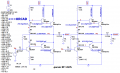
The results shown in the attachment are with the 10 Ohm resistor in parallel with D1, which can probably be changed to a short.
 

Attachments

Last edited:
Top