RC circuit with DC source: Kirchhoff’s law, voltage directions, and current flow convention

Thread Starter

Varsovia02

Joined Sep 25, 2025
2
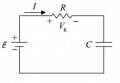
I am creating a video in Manim about basic electrical circuits. The circuit under consideration is an ideal RC circuit with a DC voltage source, no energy losses.

My reasoning is as follows:
  1. When the current leaves the DC source and flows through the circuit, the capacitor starts charging. At some point, the capacitor voltage becomes equal to the source voltage.
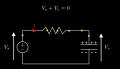
  2. According to Kirchhoff’s Voltage Law, this means that the sum of the two voltages is zero:
V_s + V_c=0
  1. From Ohm’s law, this implies that the current I in the circuit becomes zero, so the current eventually stops flowing.

My questions are:
1. Is this reasoning correct, or am I making a conceptual mistake in the way I apply Kirchhoff’s and Ohm’s laws?
2. Regarding the diagram: what is the correct direction of the voltage drop arrows across the resistor and capacitor? Are the directions shown in my image correct, or should they be drawn differently?

I would really appreciate clarification and references, since I want to avoid presenting misconceptions in the video.
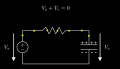
RC_Circuit02.png
 

MrChips

Joined Oct 2, 2009
34,627
What you are describing is called the steady-state condition when there are no changes in current and voltage.

Vs = Vc
I = 0

I would remove the arrows on the voltages. This is confusing.

By convention, an arrow is drawn on or beside the connecting wire from the Vs + terminal towards the resistor. Put a label I above this arrow.

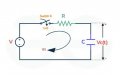
Put labels R and C beside the resistor and capacitor respectively, something like this.

1758788746970.jpeg

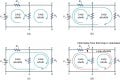
When describing Kirchhoff’s Laws, it is helpful to draw a looping arrow in a clock-wise direction flowing around the loop. This gives a consistent reference direction for voltages and currents around the loop.
IMG_2301.jpeg
For your information, the steady-state condition is uninteresting. The transient situation is very educational and requires calculus in order to solve.
 

Thread Starter

Varsovia02

Joined Sep 25, 2025
2
Yes, you are right that the arrows on the voltage should be deleted, therefore I will remove them of my video.
The labels R and C appear later on the video, so there is no problem with that, but I'm not sure if drawing a looping arrow is necessary. On the video, you will watch electric charges moving from the source to the capacitor, that is why I think it is not necessary

Thanks for the response
 

MrAl

Joined Jun 17, 2014
13,667
I am creating a video in Manim about basic electrical circuits. The circuit under consideration is an ideal RC circuit with a DC voltage source, no energy losses.

My reasoning is as follows:
  1. When the current leaves the DC source and flows through the circuit, the capacitor starts charging. At some point, the capacitor voltage becomes equal to the source voltage.
  2. According to Kirchhoff’s Voltage Law, this means that the sum of the two voltages is zero:
V_s + V_c=0
  1. From Ohm’s law, this implies that the current I in the circuit becomes zero, so the current eventually stops flowing.

My questions are:
1. Is this reasoning correct, or am I making a conceptual mistake in the way I apply Kirchhoff’s and Ohm’s laws?
2. Regarding the diagram: what is the correct direction of the voltage drop arrows across the resistor and capacitor? Are the directions shown in my image correct, or should they be drawn differently?

I would really appreciate clarification and references, since I want to avoid presenting misconceptions in the video.
View attachment 356380
Hi,

Arrows like that are good for indicating voltage polarity, but are usually drawn as shown in the attachment.
The current arrow is also shown, draw right in the wire with just an arrowhead.

BTW, Vs=Vc after time 't' approaches infinity. It gets so very close though after only 20 time constants 20*Tc where Tc=R*C.
 

Attachments

BobTPH

Joined Jun 5, 2013
11,463
Voltages are normally labelled with + and - as in @MrAl’s example.

Please try to understand this, as it is very important: It does not matter if you label a voltage (or a current) wrong. After you solve the equations, the voltage labelled wrong will simply come out negative.
 
Top